


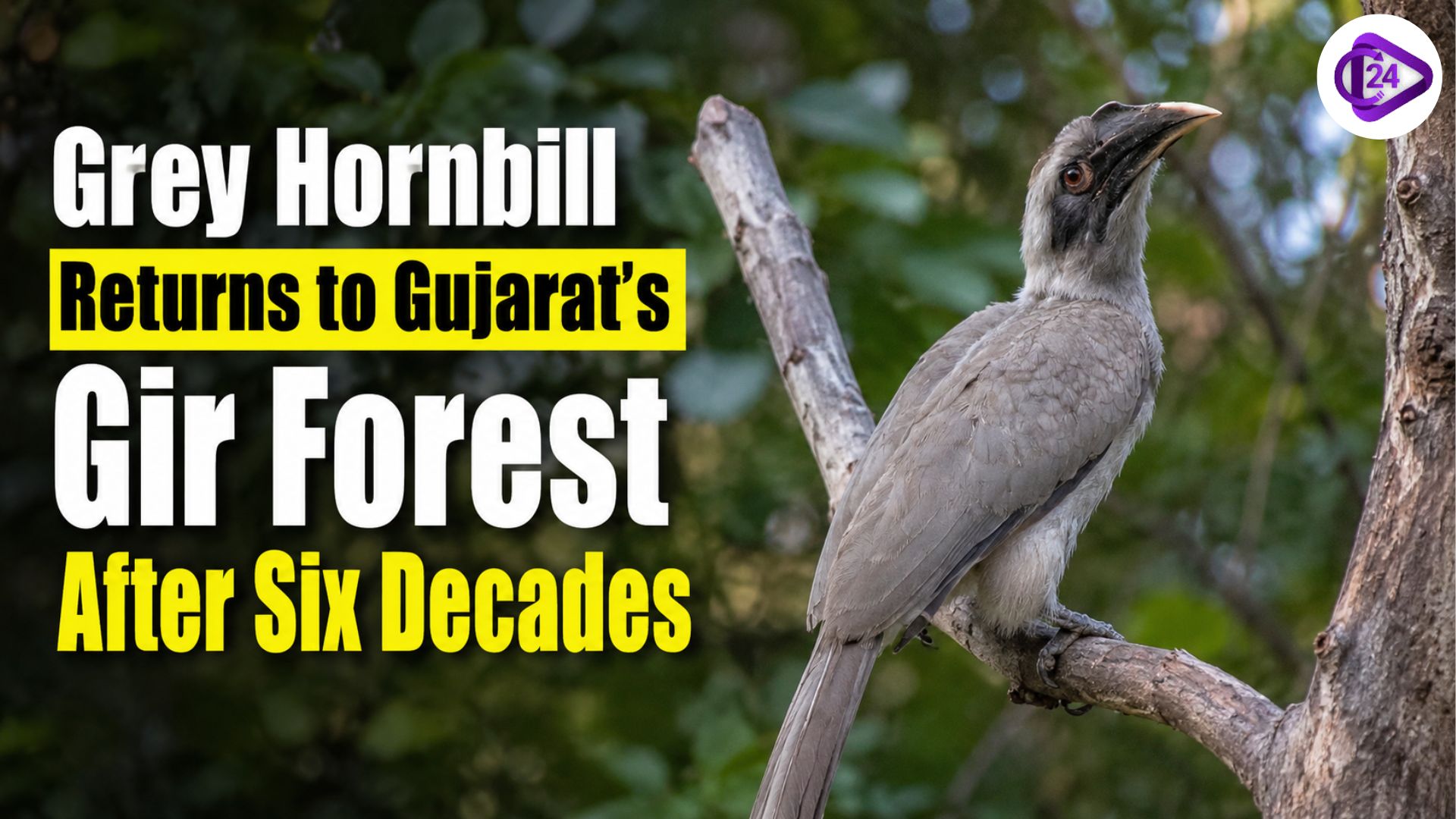
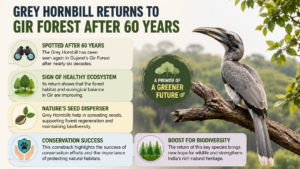
The resurgence of the Grey Hornbill in the Gir Forest, Gujarat, after almost 6 decades is a major achievement in Wildlife Conservation and Biodiversity restoration work. The presence of this significant forest bird suggests that the habitat condition and balance are improving in the Gir landscape. The Grey Hornbill is well known to play a role as a seed disperser, adding to forest regeneration and a healthy ecosystem. The reintroduction has made conservation efforts in Gujarat successful and has brought attention to the significance of conserving natural habitats to preserve the diversity of flora and fauna that India has to offer.
Why in News?
The Grey Hornbill has been spotted in Gujarat’s Gir Forest for the first time in almost 60 years. The reappearance of this bird species is seen as good news by wildlife experts, indicating better forest ecology and habitat conservation in the Gir region.
What is the Grey Hornbill?
Also called the Indian Grey Hornbill–Ocyceros birostrum is a medium-sized frugivorous bird of the Indian Subcontinent region. It is a member of the Hornbill family Bucerotidae and can be easily identified by its long, curved bill, grey colour, and loud calls. It is a common species in forests, woodlands, agricultural land and urban green spaces throughout India.
The Grey Hornbill is a significant seed disperser and, through this, acts as an asset to forest biodiversity by assisting in the regeneration of native tree species.
Key Highlights of Grey Hornbill
- After almost 6 decades, the Grey Hornbill has been seen making a return to Gir Forest.
- The sighting is indicative of better habitat quality and conservation efforts.
- The bird plays an important role in seed dispersal and in forest regeneration.
- Gir Forest is increasingly becoming the habitat of not only the Asiatic Lion but also an entire range of species.
- The figure of return means that wildlife and habitat protection is a successful undertaking in the state of Gujarat.
About Gir Forest
- Located in Gujarat.
- The only natural habitat of the Asiatic Lion (Panthera leo persica).
- This was declared as a Wildlife Sanctuary in 1965.
- Includes Gir National Park and its adjacent protected forests.
- Lush and fertile, with dry deciduous forests, grasslands, rivers and a wide variety of animals.
- Under the management of the Gujarat Forest Department.
- Essential biological value of Grey Hornbill
- Efficient seed disperser which supports forest regeneration.
- Ensures ecological equilibrium – promotes a variety of plant species.
- Promotes rehabilitation of degraded forests.
- Provides a measure of healthy forest habitats.
- Contributes to longterm biodiversity conservation.
Significance of the Return
The presence of the Grey Hornbill at Gir Forest is said to be a good conservation biology sign. It highlights the benefits of habitat restoration, better forestry practices and protection of wildlife occurring throughout the region. The presence of the species may enhance ecosystem resilience by facilitating the natural regeneration of native vegetation. It also underscores Gir’s emerging status as a rich biodiversity hotspot, in addition to hosting the renowned Asiatic lions.
Previous Year Questions (PYQs)
| Exam | Year | Question | Answer |
| UPSC Prelims | 2016 | In which of the following regions of India are you most likely to come across the Great Indian Hornbill in its natural habitat?
A. Sand deserts of northwest India B. Higher Himalayas of Jammu & Kashmir C. Salt marshes of western Gujarat D. Western Ghats |
D. Western Ghats |
| UPSC Prelims | 2017 | Recently, there was a proposal to translocate some of the lions from their natural habitat in Gujarat to which one of the following sites?
A. Corbett National Park B. Kuno Palpur Wildlife Sanctuary C. Mudumalai Wildlife Sanctuary D. Sariska National Park |
B. Kuno Palpur Wildlife Sanctuary |
| UPSC Prelims | 2019 | Consider the following statements:
1. Asiatic Lion is naturally found in India only. 2. Double-humped camel is naturally found in India only. 3. One-horned rhinoceros is naturally found in India only. Which of the statements given above is/are correct? A. 1 only B. 2 only C. 1 and 3 only D. 1, 2 and 3 |
A. 1 only |
Conclusion on Grey Hornbill Sighted Again in Gir Forest
Grey Hornbill’s return to Gir Forest after 60 years is a positive achievement of the conservation and management efforts undertaken in Gujarat for its survival. The species is an important seed disperser, especially for forests, and as such plays a significant role in forest regeneration and stability. The return of the big cat supports not just the conservation efforts of the Asiatic Lion, but also the importance of protecting the geographic range of this animal, as well as the need to continue with conservation measures and scientific monitoring and community involvement in protecting India’s diverse wildlife heritage.