

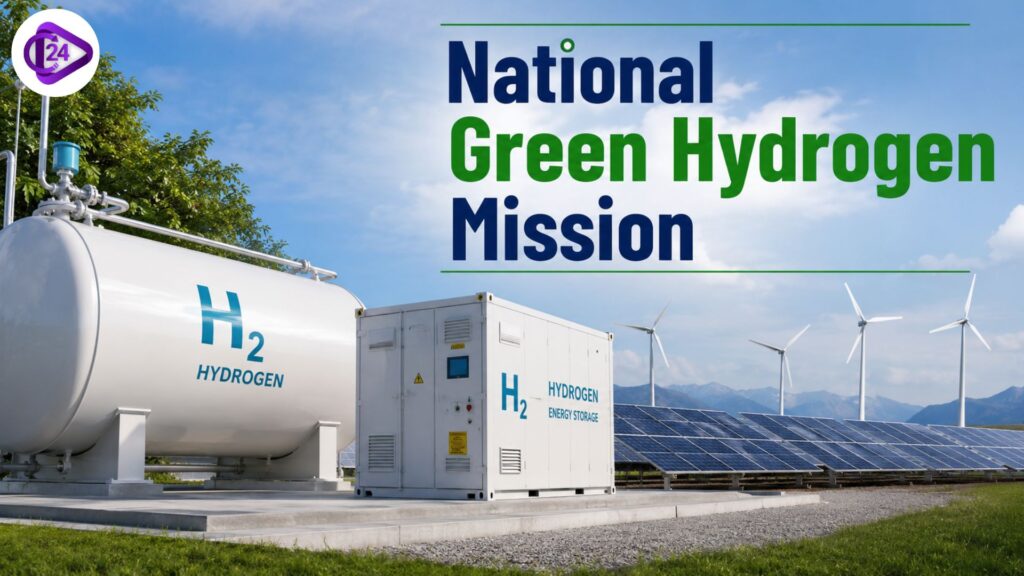
Hydrogen Mission: National Green Hydrogen Mission (NGHM) is a Government of India flagship programme launched on 4 January 2023 to help make India a global hub for green hydrogen production, utilisation and export. It features a vision of reducing dependence on imported floating fuels, with related benefits and commitments like net-zero carbon emissions by 2070 for India. Green hydrogen is generated via the electrolysis of water using renewable energy, which leads to zero emissions during production. The Mission aims to enhance energy security, promote domestic manufacturing, decarbonise industries and create green jobs, all while accelerating India’s shift towards a sustainable low-carbon economy by facilitating innovation and enhancing investment opportunities.
What is the National Green Hydrogen Mission?
- The National Green Hydrogen Mission (NGHM) is a flagship mission of the Government of India approved by the Union Cabinet on 4 January 2023 to make India a global hub for production, usage and exports of Green Hydrogen.
- The mission has a financial outgo of ₹19,744 crore at the outset to promote research and development (R&D), infrastructure creation, manufacturing, pilot projects and incentives for the generation of green hydrogen.
- Green hydrogen converts renewable electricity (for example, from solar and wind) into hydrogen and oxygen by means of water splitting so that during production it is a zero-carbon fuel.
- The mission is to touch hard-to-carbonise sectors (e.g. refineries, fertilisers, steel, shipping, heavy transport, chemicals) and there direct electrification has been very limited.
- Also seeks to cut India’s dependence on imported fossil fuels, enhance energy security and boost clean & green industrial growth.
- The mission backs the establishment of a production facility for electrolysers, plants that generate green hydrogen, and storage systems, along with transport infrastructure and export opportunities.
- It fosters research and development (R&D), pilot projects, and skill development for a strong green hydrogen ecosystem.
- This mission is in sync with India’s obligations under the Panchamrit goals it announced at COP 26, along with its commitment vis-à-vis the Paris Agreement and the 2070 target of Net Zero emissions.
National Green Hydrogen Mission Implementation
The National Green Hydrogen Mission will be executed in two phases for driving the gradual development of India’s green hydrogen ecosystem.
Phase I (2022–23 to 2025–26): Foundations Phase – National Green
- One of the main mandates is to build a strong policy and regulatory framework.
- Implemented the SIGHT (Strategic Interventions for Green Hydrogen Transition) programme
- Green Hydrogen production and electrolyser manufacturing: Financial incentives
- Building Green Hydrogen Hubs in the appropriate locations.
- Finally, several pilot projects were staged in industries such as steel, delivery, maritime and rescheduling energy.
- Third is the establishment of testing facilities, certification mechanisms, and safety standards.
- Encouragement of research & development (R&D), innovation and skill development.
- Setting up infrastructure for the integration of renewable energy such as hydrogen storage, transportation, and distribution.
Phase II (2026–27 to 2029–30): Scale-up Phase – National Green
- Green Hydrogen large-scale commercial production and adoption.
- Domestic electrolyser production capacity expansion
- There is also new hydrogen transmission, storage, export terminal and port infrastructure.
- Greater deployment of Green Hydrogen in refineries, fertilisers, steel, shipping, aviation and other hard-to-abate sectors.
- Export of Green Hydrogen to make India a global supplier.
- Mobilising private investments and international cooperation.
- Ramping up continuous efforts both in policymaking and technology upgrades to meet 2030 targets as envisaged in the mission.
National Green Hydrogen Mission: Objectives
- Global Hub for Green Hydrogen: Establish India as the top global producer, consumer and exporter of Green Hydrogen and its derivatives, driving India’s share in the global clean energy market.
- Large-Scale Green Hydrogen Production: Develop capability to produce a minimum of 5 Million Metric Tonnes (MMT) of Green Hydrogen per year by 2030 to meet domestic demand and export requirements.
- Double Down on Renewable Energy Capacity: Around 125 GW of renewable power generation, wind & solar combined, capacity will be required to coordinate the supply of energy with Green Hydrogen production.
- Declare a war on import of fossil fuels: Eliminate dependence on imported crude oil, LNG and natural gas thereby creating energy independence for India and freeing the balance sheet from the strain that comes with ever-increasing import bills.
- Indigenous Manufacturing: Advancing native manufacturing of electrolysers, gasoline cells, hydrogen storage programs and different tools under Atmanirbhar Bharat.
- Build Green Hydrogen Infrastructure: Develop Green Hydrogen Hubs, storage pipelines, transportation and refuelling stations and export terminals throughout the country.
- Encourage innovation, research, development and demonstration projects & the commercialisation through academia, startups and industries around advanced Green Hydrogen technologies.
- Employment and Investments: Create 6 lakh plus jobs and potential investments of more than ₹8 lakh crore in the hydrogen value chain.
- Fulfil Climate commitments: Play a role in India achieving its Net Zero by 2070, Panchamrit goals and commitment under the Paris Agreement.
National Green Hydrogen Mission: Benefits
- Enhances Energy Security: Biomass-based power generation reduces the dependence on imported fossil fuels, making India’s energy supply more secure and resilient.
- Well-to-Wheel GHG Emission Reduction: Provides a direct replacement for fossil fuels due to the unique property of hydrogen, as several industrial and transport sectors need to significantly decarbonise.
- Drives Adoption of Clean Energy: Introduces renewable energy targets that drive rapid growth in demand for solar and wind power, leading to faster development of renewable energy infrastructure.
- Greening Industrial Processes: Increasing the share of low-carbon production for steel, fertilisers, refineries, chemicals and other energy-intensive industries.
- Encourages Domestic manufacturing: The Centre lays out the framework for large-scale domestic manufacturing of electrolysers, fuel cells, storage tanks and hydrogen equipment as part of Make in India.
- Provides Employment: Supports millions of direct and indirect jobs across manufacturing, construction, logistics, research, operations & maintenance.
- Large-scale Investments: Attracts public and private investments to renewable energy, hydrogen production, infrastructure and technology development.
- Greater Export Potential: Places India as a key exporter of Green Hydrogen, Green Ammonia and hydrogen fuelling products across the globe.
- Support Quality of Innovation & Technology Development: Next to general support, the allocation also encourages indigenous R&D, participation of start-ups and promotion/ development of technology (production as well as storage, transportation and end-use fuel cells).
- Promotes Sustainability: Fosters cleaner energy use, protects nature and promotes inclusive growth, all while helping meet multiple Sustainable Development Goals (SDGs).
Important Links
National Green Hydrogen Mission: Challenges
- Cost competitiveness: The most challenging aspect is developing Green Hydrogen to outperform fossil fuel-based hydrogen. You also need massive reductions in renewable power costs and in the efficiency of electrolysers
- Make Electrolyser Manufacturing at Scale in Domestic Space: To reduce import dependency, strengthen supply chains and meet production targets in the near future, India needs to expedite scaling indigenous electrolyser manufacturing capacity.
- If you want to produce Green Hydrogen, it requires a continuous supply of renewable electricity. The second challenge is to ensure solar-wind power reliability, affordability and grid integration.
- Hydrogen Infrastructure Construction: Building hydrogen storage, pipelines and transportation systems, refuelling stations and export terminals entails considerable time, capital and technology.
- Management of water resources: Electrolysis needs very good, clean quality of water. Sustainability also involves discovering new sources for water, reusing wastewater and making less use of freshwater, especially in regional areas that already are using too much.
- Technology Maturity: Some Green Hydrogen technologies, such as next-generation electrolysers, hydrogen storage systems, fuel cells and hydrogen-powered transportation, are still maturing and need ongoing innovation and commercialisation of a robust supply chain.
- Strengthening Domestic Demand: Industrial applications are vital for large-scale adoption & agriculture, steel, fertilisers, refineries, shipping, heavy mobility and power generation have a key role in providing stable demand. Gradual Transition to Green Hydrogen from Conventional Fuels In Industries
- Large-scale finance: Setting up renewable energy plants, hydrogen production units, storage systems and logistics infrastructures also requires large chunks of long-term financing access at an affordable price.
- Safety Standards and Regulations: Hydrogen is extremely flammable, so safety codes, handling practices, and certification procedures have been developed for production, storage, transport, and end-use applications.
- Developing a Skilled Workforce: The Green Hydrogen industry needs skilled engineers, technicians, researchers, etc. and safety professionals. Sustainable growth calls for scaling up skill development and specialised training initiatives.
- International competition: Several countries are investing massively in green hydrogen production and exports. It will need to focus on efficiency, cut costs and develop competitive export capabilities to be a global hub.
- Inter-Ministerial Coordination: The success of these policies hinges on cooperation at various levels involving Ministries like Renewable Energy, Power, Petroleum, Steel, Fertilisers, Shipping and Heavy Industries, as well as state governments for effective implementation.