








Indus Valley Civilisation: Map, Script, Seals, Features & Important Sites

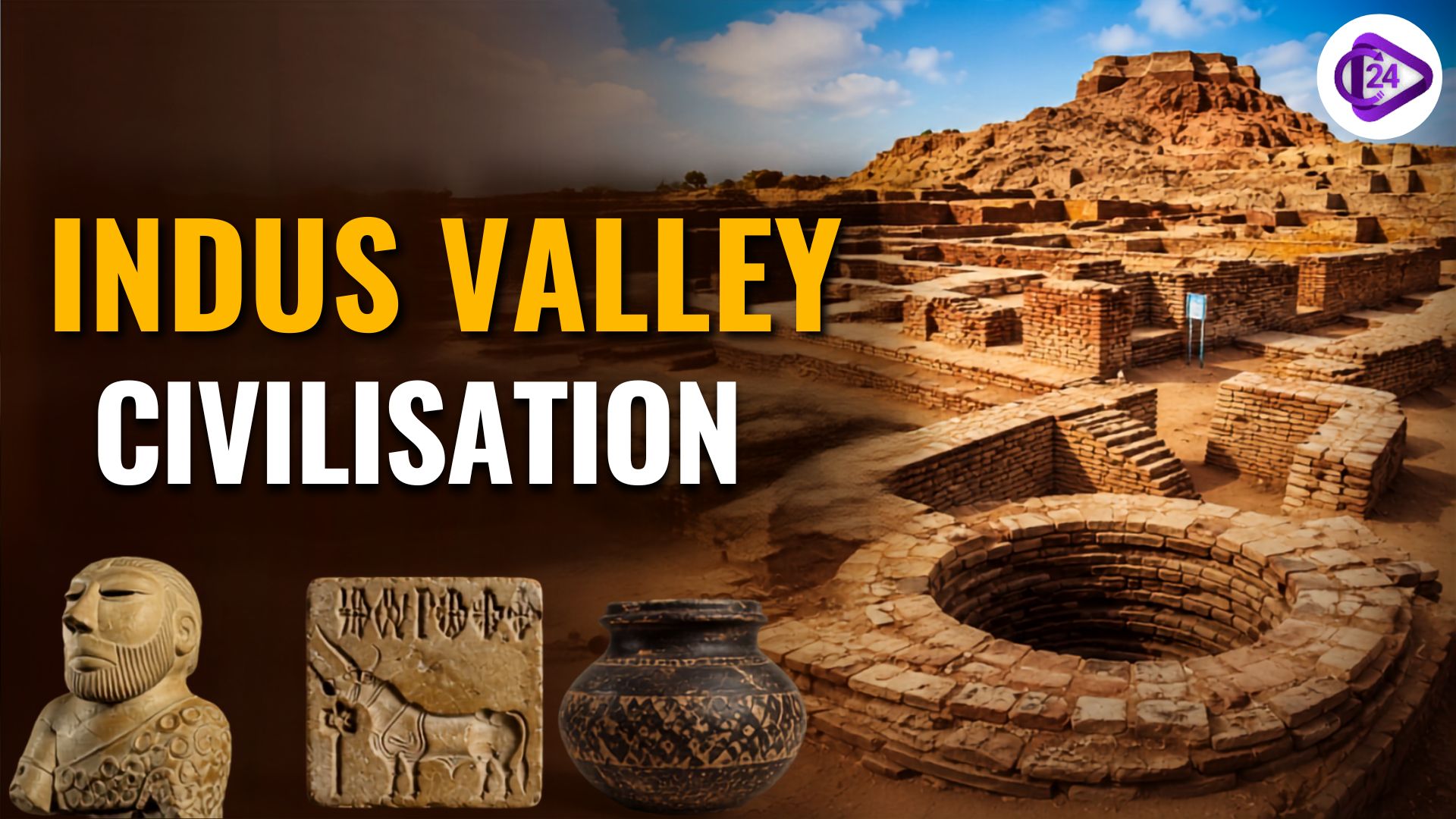
Indus Valley Civilisation: The Indus Valley Civilisation (IVC) or Harappan Civilisation was a Bronze Age civilisation primarily present in the northwestern part of the Indian subcontinent and one of three early cradles of civilisations, which was contemporaneous with Ancient Egypt, Mesoamerica and Ancient China. It was marked by site layouts,...

Indus Valley Civilisation: Map, Script, Seals, Features & Important Sites
Indus Valley

Indus Valley Civilisation: The Indus Valley Civilisation (IVC) or Harappan Civilisation was a Bronze Age civilisation primarily present in the northwestern part of the Indian subcontinent and one of three early cradles of civilisations, which was contemporaneous with Ancient Egypt, Mesoamerica and Ancient China. It was marked by site layouts, sewerage systems, standardised weights and measures, craftsmanship and long-distance trade networks (Archaeological Survey of India, ASI. The most important ones are Harappa, Mohenjo-daro, Dholavira, Rakhigarhi, Kalibangan and Lothal. Spanning a wide geographical area along the northwestern region of modern-day India and Pakistan, this majestic civilisation is renowned for its urban planning, architecture, agriculture, metallurgy, as well as complex socio-economic organisation that forms an integral part of India’s ancient cultural foundation.

How Was the Indus Valley Civilisation Discovered?

  • The Indus Valley Civilisation (IVC), or Harappan Civilisation, a Bronze Age urban culture in the Indian subcontinent which existed around 2600–1900 BCE
  • It evolved from pre-Harappan communities which were already engaged in agriculture and animal domestication, pottery-making, and permanent habitation.
  • The civilisation spanned the northern and western regions of South Asia, extending from the northeastern part of today’s Afghanistan to Pakistan’s Punjab province and most of the Indian state of Haryana up to its southern edge in such river basins as Ghaggar-Hakra (as supported by archaeology), Sutlej, and Sarasvati.
  • It extended around 1.5 million sq kilometres which covered the area of modern-day India, Pakistan and some parts of Afghanistan; thus becoming one of the largest early civilisations as well.
  • There was fertile, alluvial soil, perennial rivers, and an environment suitable for agricultural trade as well as for the planned settlement of large urban centres.

Discovery of the Indus Valley Civilisation

  • While the historical significance of those ruins went unrecognised, interest grew in what remained of the civilisation during the nineteenth century.
  • In 1826, the explorer Charles Masson described the mound at Harappa as the site of a once-fortified village.
  • It is not too surprising, considering that workers unearthing the site during the construction of a new railway line between Lahore–Multan in 1856 had removed thousands of baked bricks for use as railway ballast – hints at this archaeological potential surrounding Harappa.
  • Alexander Cunningham, as the first Director-General of the Archaeological Survey of India (ASI), visited it in 1872–73 and gave one of the earliest reports on its seals and antiquities.
  • The first systematic excavations were conducted at Harappa in 1921 by Daya Ram Sahni, and at Mohenjo-daro in 1922 by Rakhal Das Banerji.
  • The discovery of the Indus Valley Civilisation, one of the earliest planned urban civilisations in the world, was officially announced by Sir John Marshall, then Director-General of ASI, in 1924.
  • Further excavations in the decades that followed at sites like Dholavira, Lothal, Kalibangan, Rakhigarhi, Banawali and many other places revealed just how large and sophisticated this urban civilisation really was, about its geography and architectural infrastructure as well as trade routes set up by it towards distant lands and brilliant craftsmanship as evidenced by artefacts recovered from these archaeological digs.

Indus Valley Civilisation: Map and Major Archaeological Sites

The Indus Valley Civilisation spread over India, Pakistan and parts of Afghanistan, an area around 1.5 million sq. km. Harappa, Mohenjo-daro, Dholavira, Lothal, Kalibangan, Rakhigarhi, Banawali and Surkotada are some of its key archaeological sites. These places demonstrate evidence of high-level urbanism, drainage systems, trade networks and highly skilled craftsmanship.

Major Archaeological Sites of Indus Valley Civilisation

Archaeological Site Present Location Key Features / Significance
Harappa Punjab, Pakistan First excavated Harappan site; granary, cemetery (R-37), fortified citadel, seals, and standardized weights.
Mohenjo-daro Sindh, Pakistan Great Bath, Great Granary, Assembly Hall, advanced drainage system, and the famous bronze Dancing Girl sculpture.
Dholavira Kutch, Gujarat UNESCO World Heritage Site; unique water conservation system, reservoirs, stadium, and large Harappan signboard.
Lothal Ahmedabad district, Gujarat Famous for the world’s earliest known dockyard, bead-making industry, warehouse, and maritime trade.
Kalibangan Hanumangarh, Rajasthan Evidence of ploughed agricultural fields, fire altars, and both Pre-Harappan and Mature Harappan settlements.
Rakhigarhi Hisar, Haryana Largest Harappan site in India; evidence of planned urban settlement, drainage system, and human burials.
Banawali Fatehabad, Haryana Fortified town with radial street layout; yielded terracotta artefacts, seals, and agricultural evidence.
Surkotada Kutch, Gujarat Fortified settlement; known for horse bones, suggesting possible domesticated horses during the Harappan period.
Chanhudaro Sindh, Pakistan Major industrial centre; renowned for bead-making, shell working, and craft production; lacked a citadel.
Ropar (Rupnagar) Punjab, India Northernmost Harappan settlement in India; evidence of continuous cultural succession from the Harappan to later periods.
Alamgirpur Meerut, Uttar Pradesh Easternmost Harappan site; known for pottery, mud-brick structures, and textile-related remains.
Kot Diji Sindh, Pakistan Important Pre-Harappan site showing the transition to the Mature Harappan phase; fortified settlement.

Chronology of the Indus Valley Civilisation

Phase Time Period (Approx.) Key Characteristics Major Sites
Early Harappan (Pre-Urban Phase) c. 3300–2600 BCE Emergence of permanent settlements, agriculture, pottery, mud-brick houses, craft production, and regional trade. Kot Diji, Amri, Kalibangan (Early Phase), Banawali
Mature Harappan (Urban Phase) c. 2600–1900 BCE Peak of the civilisation with well-planned cities, grid-pattern streets, drainage systems, standardised weights and measures, seals, script, metallurgy, and long-distance trade. Harappa, Mohenjo-daro, Dholavira, Lothal, Rakhigarhi, Kalibangan
Late Harappan (Post-Urban Phase) c. 1900–1300 BCE Gradual decline of urban centres, reduced long-distance trade, disappearance of standardised script and seals, ruralisation, and regional cultural variations. Cemetery H (Harappa), Rangpur, Rojdi, Daimabad, Jhukar

Also Read

Revolt of 1857, Complete Histor Lodhi Dynasty (1451–1526)
Sayyid Dynasty (1414–1451) Tughlaq Dynasty (1320–1414 AD
Khilji Dynasty (1290-1320 AD Mamluk Dynasty (1206 – 1290 AD
Mesolithic Age in India Palaeolithic Age

Key Features of the Indus Valley Civilisation

Indus Valley Civilisation was characterised by: well-planned cities, grid-pattern streets, advanced drainage systems, uniformity in weights and measures, undeciphered script used for writing or keeping records, high levels of craftsmanship, widespread trade, extensive networks, bronze metallurgy, agricultural surplus, social stratification and urban administration. One of the world’s oldest and best-organised urban civilisations; its impressive town planning & water management show.

Social Hierarchy and Organisation – Indus Valley Civilisation

  • The society was well-organised, containing signs of planned cities, urban administration and civic management.
  • Archaeological remains did not produce any evidence for kings, nor a centralised monarchy.
  • The mix of merchants, artisans, farmers, traders, labourers and possibly craftsmen is an indication of occupational specialisation.
  • An evident craft economy is exhibited by work produced by specialist craftsmen producing beads, pottery, seals, jewellery, metal tools and textiles.
  • Provision for uniform town planning and standard weights and measures indicates an efficient administrative system.
  • Structures like the Great Bath and granaries suggest that much community action was aimed at the public good.
  • Differing sizes of houses suggest some social stratification, although wealth extremes are lacking.
  • It is thought that women played an important role in society, due to the many terracotta female figurines (often interpreted as for fertility)
  • Urban centres most certainly existed alongside long-distance trade networks that connected them to more remote regions and people engaged in commerce.
  • It seems that the civilisation rather prioritised urban planning for the collective, economic partnership, and social stability over building monumental instances of royal power.

Town Planning in the Indus Valley Civilisation

  • One of the major features of the Indus Valley Civilisation is its extremely advanced and organised city planning.
  • The streets were in a grid, forming rectangular-shaped city blocks.
  • Settlements were typically split into two parts—an area on an elevation known as the Citadel, which was generally reserved for administration and public buildings, and a Lower Town where most of the general population lived.
  • Brick houses were built to a standard by baking bricks.
  • There are covered street drains that lead to houses with a remarkable level of sanitation in between.
  • There was large-scale, efficient water management, as almost every house had private bathrooms, wells, and soak pits.
  • Public buildings, which included granaries and assembly halls as well as the ubiquitous Great Bath of Mohenjo-daro, graced major cities.
  • Standardisation of weights and measures or the dimensions of brick points to centralised planning and uniformity in construction.
  • Advanced water conservation systems, especially at Dholavira, indicate the civilisation’s sophistication in urban engineering and resource management.

Religion and Art of the Indus Valley Civilisation

  • Limited archaeological evidence such as seals, terracotta figurines and ritual structures provides insights into the religious beliefs of the Indus Valley Civilisation.
  • Several terracotta female effigies indicate the Mother Goddess veneration, representing fertility and prosperity.
  • The Pashupati Seal is commonly cited as showing a horned man seated in a yogic pose, perhaps the earliest representation of something similar to lord Shiva, although this interpretation is not without controversy.
  • Bulls, unicorns, elephants, rhinoceroses, tigers, and other animals are often seen on seals acts as a mark for religious value.
  • The fire altars found at Kalibangan and Lothal imply the existence of ritual worship and ceremonial pursuits.
  • Mohenjo-daro’s iconic Great Bath: A 4,500-year-old man-made structure believed to have been used for ritual purification and religious ceremonies
  • Specialisation of Harappa: Artisans specialised in bead-making, pottery, metallurgy (metal work), shell crafts and ivory carving, as well as jewellery.
  • This includes stone and bronze sculptures, displaying great artistic talents in pieces like the renowned “Dancing Girl” and “Priest-King”.
  • They used thousands of steatite seals, sometimes carved with animal designs and undeciphered Harappan writing, to record trade, identify ownership between traders (ensure their goods were not lost in transit), and make markers linked with religion.
  • The Harappans were adept in many artistic elements such as maintaining balance between aesthetic richness, technical skills and symbolic expression, as evidenced by the artworks comprising a rich cultural heritage.

Reasons for the Decline of the Harappan Civilisation – Indus Valley

  • Climate Change: Long-term climate changes and more arid conditions diminished agricultural yields and disrupted human settlements.
  • Rivers Changed: The progressive drying up or diversion of rivers, especially the Ghaggar-Hakra system, impacted irrigation and farming.
  • Deterioration of Trade: The relations with Mesopotamia and other regions that were mutually beneficial started to decline, impacting the economy of Harappan Civilisation.
  • Recurrent Floods: The archaeological evidence from places like Mohenjo-daro suggests frequent inundation that ruined urban centres.
  • Geological disturbances sometimes changed the course of rivers and dried up the springs needed to support settlements.
  • Resource Depletion: The Level of urban life may have diminished because of the excessive utilisation of natural resources such as forests and fertile land.
  • Late Harappan Phase: This is when we saw the slow ruralisation as people emptied out of the big cities into smaller, more low-key villages.
  • There is no definitive proof of any Aryan invasion. Modern archaeological evidence fails to verify this earlier hypothesis of an Aryan invasion that brought about the collapse of the civilisation.
  • Environmental, Economic, and Social Factors: Many historians and archaeologists think that the collapse was a result of environmental, economic, and social changes rather than one event.
  • Instead of vanishing without a trace, much like an instant collapse from the Catastrophe Theory, it transformed into regional cultures with many traditions being continued by successive societies.

FAQs on the Indus Valley Civilisation

The Indus Valley Civilisation (IVC), also known as the Harappan Civilisation, was one of the world's earliest urban civilisations that flourished between c. 2600 BCE and 1900 BCE in the northwestern Indian subcontinent.
MANAS, India’s AI-Powered Digital Shield Against Drug Abuse
India, Malaysia, and Singapore Unveil I-2SEA Submarine Cable System
Vikram-1, India’s First Privately Developed Orbital-Class Rocket
Govt Sends Notice to WhatsApp Over Username Feature
Birth and Death Registrations Nearly Match Official Estimates in 2024
BJP Two-Thirds Majority, Seat Numbers and Constitutional Significance

Start Learning Today with Class24

Class24 Mobile Application

Class24 also has a mobile application so that it becomes easily accessible and convenient. This can be downloaded on an Android device. Users have appreciated this app and the content provided as 4.1 out of 5 is its rating in the App Store. People loved it because Class24 is giving content which is extremely rich in every sense. The app comprises a wide variety of features for smooth learning:

  • User-Friendly Interface: The app is categorized into various sections so that students can navigate and access various resources with ease.
  • Offline Access: The study materials can be downloaded and the student can access them even when not connected to the internet.
  • Inbuilt eBook Reader: There is a lightning-fast reader for eBooks within the app, so reading is seamless.
  • Progress Tracking: The app tracks student’s progress in preparation and keeps them organized and focused.

Courses and Subjects Offered

The total syllabus will be covered, and there are in-depth practice materials so as to give deep preparation in the courses designed to each one of them. All the subjects come under the aegis of courses offered by Class24 to meet different needs of various aspirants such as:

Preparation Tips for All Exams

Preparation tips for all exams mentioned below:

  • Previous Year Papers: Try to attempt at least 5-10 years of question papers to know the pattern of questions, how much difficulty one would face while answering, and how many frequently asked topics were in the examination.
  • Take Mock Tests: Attempt Mock Tests regularly in order to time and accuracy. You may analyze the performance and make an improvement for weak areas.
  • Focus on Time Management: Solve questions in the given time to make a habit of having speed and efficiency. Allocate time sensibly between Paper 1 and Paper 2, while appearing in the examination.
  • Current Affairs: For Current Affairs and TET exams, be updated about current affairs, teaching aptitude, and general awareness.
  • Regular Revision: Spend your daily and weekly time for revisions to not forget concepts and formulas. Use flashcards or do self-summary notes for quick revisions.
  • Understand the Exam Pattern and Syllabus: Understand the pattern of your exam paper and syllabus very well. Both Current Affairs and CSIR NET examinations are two-tier ones and involve both Paper 1, which consists of general aptitude and Paper 2 that involves specific aptitude subjects.
  • Make a Study Plan: Divide the preparation time into three phases of concept building, revision, and mock tests. Allocate more time to weaker areas while maintaining equilibrium with stronger sections.
  • Online Coaching or Study Groups: Enroll in online coaching programs like Class24 to get proper guidance and a structured approach to the study. Study groups will be useful to discuss doubts and share resources.
  • Stay Consistent and Motivated: Maintain a steady study schedule. Stay motivated by making small achievable goals.
  • Use Quality Study Materials: Suggested study material refers to a textbook, a set of previously published question papers, and web sources such as Class24.

Conclusion

Class24 is a one stop solution for aspirants preparing for Current Affairs, CSIR NET, SET, UP PGT English, UP TGT PGT, UPHESC Assistant Professor, TET, IGNOU B.Ed and other competitive exams. There are structured courses, live classes, mock tests along with the guidance of experts to assist candidates in achieving success in their respective fields.

Get success in your hand. Start study anytime anywhere.

The journey becomes simple and enjoyable when you start taking interest in it. And through our app “Class24”, we will be your trusted partners in developing that interest.

Daily Quizzes
Mock Tests
Ongoing

No ongoing tests right now.