
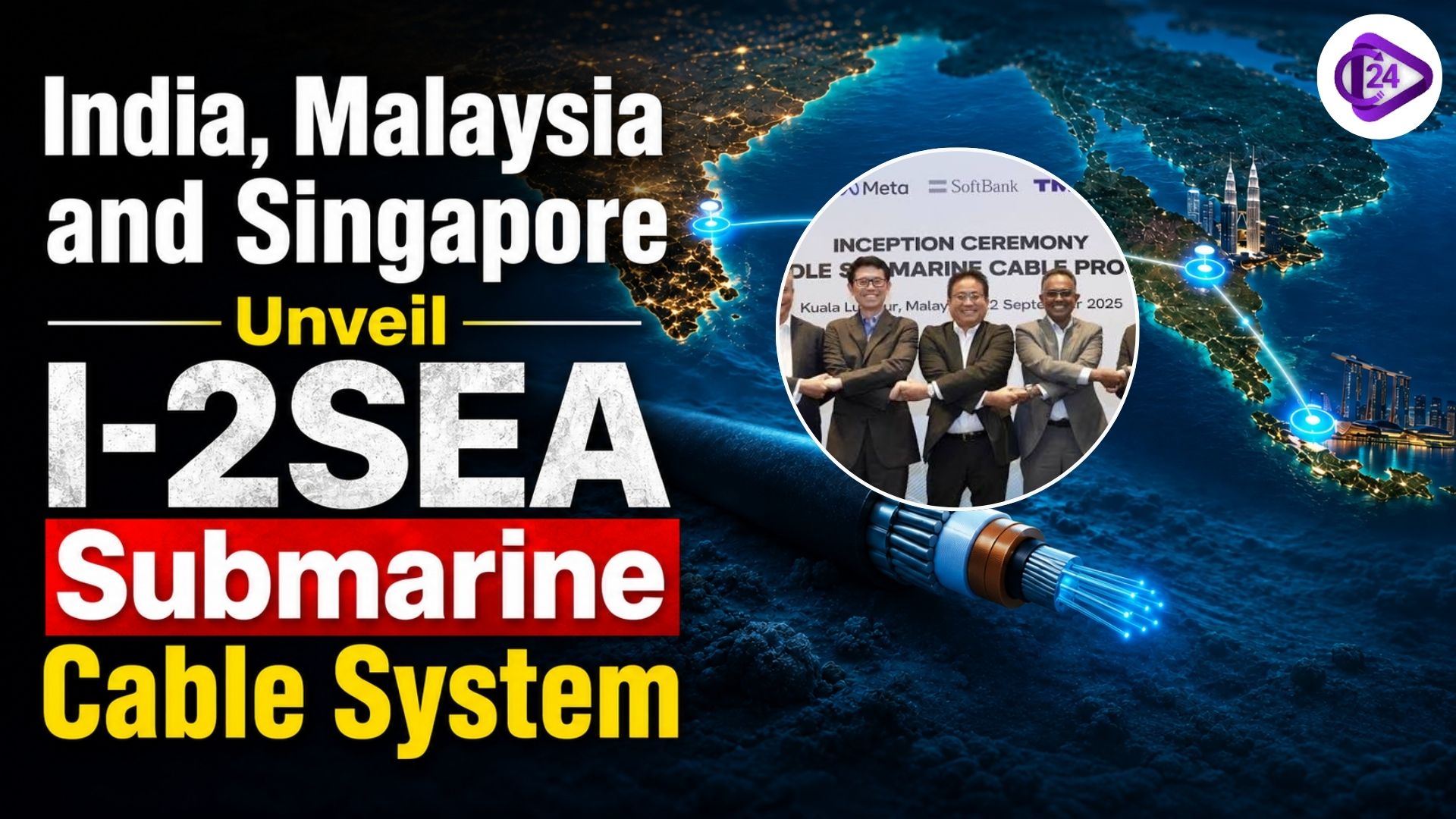
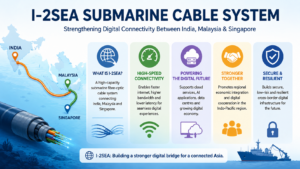
Submarine Cable System: The I-2SEA Submarine Cable System is a new initiative by the Indian and Malaysian governments, along with companies from Singapore, to enhance digital connectivity in Asia. India-International Submarine Cable Express Across the East (I-2SEA) is a high-capacity submarine cable programme that’s meant to boost internet speed and enhance data transmission and supply resilient digital infrastructure between the three countries. Additionally, the project helps India to achieve the government’s vision of becoming a global digital hub and secures and establishes low-risk cross-border connectivity. The I-2SEA Submarine Cable System is anticipated to contribute significantly to regional economic integration as the demand for cloud computing services, AI services and digital services keeps increasing.
Overview: I-2SEA Submarine Cable System
| Feature | Details |
| Project Name | India-International Submarine Cable Express Across the East (I-2SEA) |
| Type | Submarine Fibre-Optic Cable System |
| Countries Connected | India, Malaysia, Singapore |
| Medium | Undersea Optical Fibre Cable |
| Primary Purpose | High-speed international data connectivity |
| Key Benefits | Faster internet, higher bandwidth, lower latency |
| Supports | Cloud Services, AI, Data Centres, Digital Trade |
| Strategic Region | Indo-Pacific |
| Importance | Strengthens regional digital infrastructure |
What is I-2SEA Submarine Cable System (SCC)?
The programme of India, Malaysia and Singapore unveils the I-2SEA Submarine Cable System, which is set to create a new international fibre-optic cable network between the three nations. The system is capable of transporting huge amounts of data on the web, over optical fibres on the seabed.
There are several advantages of submarine fibre-optic communications over satellite communications, including much greater bandwidth, lower latency and higher reliability. Therefore, they have emerged as the backbone of the world’s Internet connectivity, carrying over 95% of global Internet traffic.
Objectives of the I-2SEA Submarine Cable System
The main goals are to:
- Enhance the digital linkage between Indian and Southeast Asian countries.
- Enliven World Wide Web bandwidth.
- To support the rapidly growing digital economy.
- Improve the cybersecurity and network resilience of regions.
- Support speedy cloud and AI services.
- Enhance trade in the digital arena.
- Facilitate investments in information technology infrastructure.
- Improve capacity in communications.
Previous Year Questions (PYQs)
| Year | Exam | Question | Options | Answer |
| 2024 | SSC CGL | Which medium carries most of the world’s international internet traffic? | (a) Communication Satellites (b) Microwave Towers (c) Submarine Fibre-Optic Cables (d) Radio Waves | (c) Submarine Fibre-Optic Cables |
| 2023 | UPSC Prelims | India Stack is primarily associated with: | (a) Renewable Energy (b) Digital Public Infrastructure (c) Space Technology (d) Defence Manufacturing | (b) Digital Public Infrastructure |
| 2022 | SSC CHSL | Optical fibre communication works on the principle of: | (a) Reflection of Sound (b) Total Internal Reflection (c) Refraction (d) Diffraction | (b) Total Internal Reflection |
| 2022 | CDS | Which of the following provides the highest bandwidth for data transmission? | (a) Twisted Pair Cable (b) Coaxial Cable (c) Optical Fibre Cable (d) Copper Wire | (c) Optical Fibre Cable |
| 2021 | AFCAT | Which communication medium offers the lowest latency for international internet connectivity? | (a) Satellite Communication (b) Optical Fibre Cable (c) Radio Transmission (d) Microwave Communication | (b) Optical Fibre Cable |
| 2021 | SSC CGL | The main advantage of optical fibre communication is: | (a) High bandwidth and low signal loss (b) Low installation cost only (c) Requires no repeaters (d) Uses electrical signals | (a) High bandwidth and low signal loss |
| 2020 | UPSC Prelims | Which technology forms the backbone of modern high-speed internet communication? | (a) Optical Fibre Network (b) Copper Cable (c) Satellite Television (d) Radio Broadcasting | (a) Optical Fibre Network |
| 2019 | SSC CGL | Which phenomenon is used in optical fibre communication? | (a) Diffraction (b) Total Internal Reflection (c) Dispersion (d) Polarisation | (b) Total Internal Reflection |
| 2018 | RRB NTPC | Fibre-optic cables transmit information in the form of: | (a) Electrical Pulses (b) Light Pulses (c) Sound Waves (d) Magnetic Signals | (b) Light Pulses |
| 2017 | SSC CHSL | Which communication system is considered the fastest for high-speed internet? | (a) Copper Cable (b) Optical Fibre (c) Coaxial Cable (d) Radio Link | (b) Optical Fibre |
Birth and Death Registrations Nearly Match Official Estimates in 2024
India, Malaysia, Singapore Unveil I-2SEA Cable: Conclusion
The latest I-2SEA Submarine Cable System announcement by India, Malaysia and Singapore marks the continued significance of secure high-power digital infrastructure in the current digitally connected world. The project will also enhance regional cooperation, optimise internet bandwidth and lower latency, thereby boosting digital transformation in South and Southeast Asian countries. Moreover, it reflects India’s vision to become a digital hub in the world and upholds economic growth, innovation, and technological cooperation in the Indo-Pacific region.