
It’s now a significant technology and digital governance dilemma in India that the Government sent a notice to WhatsApp for its Username feature. The Central Government has reportedly raised questions with WhatsApp on its plan to roll out username-based messaging, citing privacy, traceability, cyber-security and compliance with India’s digital laws. The development underscores the government’s heightened attention on fostering technological advances while ensuring national security and user protection. This piece of information provides a background on the reasons behind the proposed feature by the Govt Sends Notice to WhatsApp, the legal framework, concerns raised, and the implications of this feature for users and digital governance.
What is the Username Feature on WhatsApp?
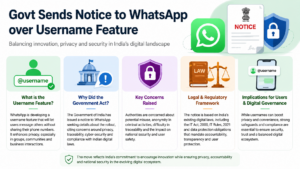
The proposed feature is called the Username Feature for WhatsApp, a new username for users to connect with instead of their cell phone number in a manner that prioritises user privacy. Users can select an identifier that they want others to recognise them by and send them messages, just like on other apps such as Telegram and Signal. However, even the phone number will be needed for account sign-up and verification. The idea behind the feature is to improve user privacy, minimising the need to subscribe to unnecessary exposure of personal contact information, particularly in group chats, business situations and communities that are public. It is in development and will not be made available to everyone.
Benefits of WhatsApp Username Feature
- Supports users’ privacy in less revealing connections, where they don’t need to expose their mobile numbers to the public.
- Limits exposure of personal information, particularly in group chats and community interactions.
- Facilitates safer communication by giving individual users more control over who can discover and contact them.
- Enhances business communications, allowing businesses to share usernames rather than personal/official phone numbers.
- Eases discovery of the account with helpful, easy-to-remember and shareable names.
- Enables existing privacy settings, such as controls for profile picture, last seen, and online status.
- Aids in minimising unwanted contacts with unknown individuals who get phone numbers.
- Extends end-to-end protection for both personal data and communications: safeguards messages, calls, photos, voice, and video sharing regardless of whether they’re sent in the app or via the browser.
PYQs on WhatsApp, Cyber Security & Data Protection
| Exam | Year | Question | Options | Correct Answer |
| UPSC CSE (Prelims) | 2023 | Which of the following best describes end-to-end encryption used by messaging platforms? | (A) Messages are stored permanently on government servers (B) Only the sender and intended recipient can read the messages (C) Anyone with internet access can view the messages (D) Messages are automatically shared with telecom operators | (B) Only the sender and intended recipient can read the messages |
| SSC CGL | 2023 | The Digital Personal Data Protection Act, 2023 primarily aims to: | (A) Regulate cryptocurrency (B) Protect personal digital data and regulate its processing (C) Conduct Population Census (D) Regulate telecom tariffs | (B) Protect personal digital data and regulate its processing |
| SSC CHSL | 2022 | Which Ministry administers the Information Technology Act, 2000? | (A) Ministry of Electronics and Information Technology (MeitY) (B) Ministry of Home Affairs (C) Ministry of Communications (D) Ministry of Law and Justice | (A) Ministry of Electronics and Information Technology (MeitY) |
| RRB NTPC | 2021 | WhatsApp primarily uses which security technology to protect users’ personal messages? | (A) Firewall Protection (B) End-to-End Encryption (C) Blockchain Encryption (D) Cloud Encryption | (B) End-to-End Encryption |
| RRB Group D | 2022 | The CERT-In functions under which Ministry? | (A) Ministry of Home Affairs (B) Ministry of Electronics and Information Technology (MeitY) (C) Ministry of Defence (D) Ministry of Communications | (B) Ministry of Electronics and Information Technology (MeitY) |
| SSC MTS | 2023 | What is the main objective of a username-based messaging feature? | (A) Increase internet speed (B) Allow communication without publicly sharing a phone number (C) Replace SIM cards (D) Disable encryption | (B) Allow communication without publicly sharing a phone number |
| CDS (GK) | 2021 | Which law provides the primary legal framework for cyber offences and electronic governance in India? | (A) Indian Penal Code, 1860 (B) Information Technology Act, 2000 (C) Consumer Protection Act, 2019 (D) Official Secrets Act, 1923 | (B) Information Technology Act, 2000 |
| State PCS | 2024 | Which organization serves as India’s national nodal agency for responding to cybersecurity incidents? | (A) NITI Aayog (B) CERT-In (C) UIDAI (D) National Informatics Centre | (B) CERT-In |
| UPSC CSE (Prelims) | 2021 | Which of the following is the primary purpose of the Information Technology Act, 2000? | (A) Regulate banking operations (B) Provide legal recognition to electronic records and address cyber offences (C) Conduct elections (D) Govern telecom spectrum allocation | (B) Provide legal recognition to electronic records and address cyber offences |
| RRB JE | 2022 | Which feature of WhatsApp ensures that only the sender and intended recipient can access the content of messages? | (A) Two-Factor Authentication (B) End-to-End Encryption (C) Cloud Backup (D) Username Verification | (B) End-to-End Encryption |
Jamir Nazir Wins 2026 Commonwealth
Conclusion on WhatsApp Username Feature Draws Government Notice
The relationship between digital innovation and regulatory oversight is evolving in India, as The Govt Sends Notice to WhatsApp over the username feature. This feature might enhance the usage of mobile numbers from trust issues; however, it would make a huge impact on security, traceability and compliance with Indian laws. Implementation of the same, bringing everything in one place, will balance the ease for users and legal and security reasons, which is a good advancement for India bucket.