


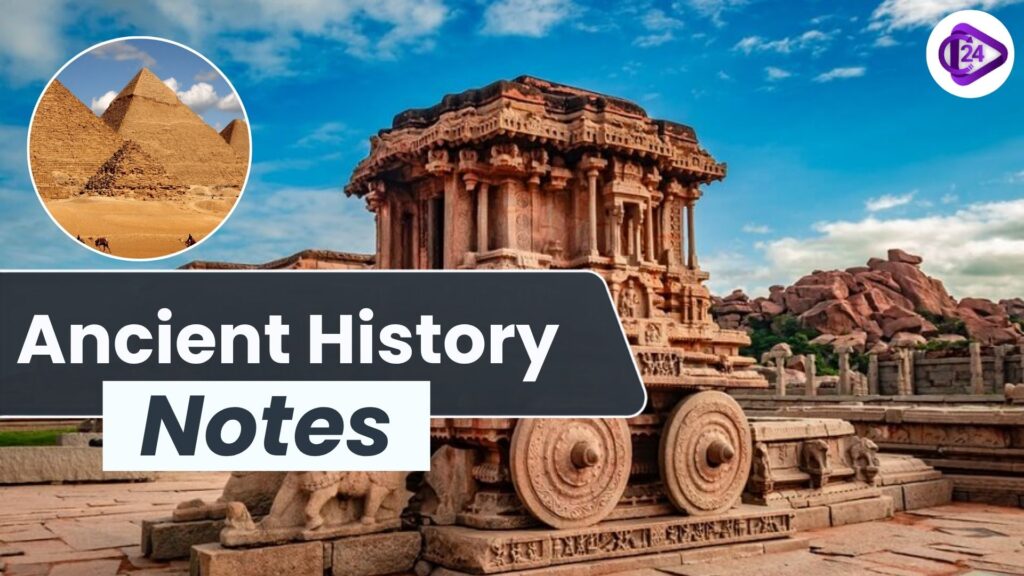
Ancient History is considered to be a significant subject for other competitive examinations like RAS and SSC, State PSCs, CDS(Civil Services), CAPF (Central Armed Police Forces) and other government exams. Indus Valley Civilisation, Vedic Age, Mahajanapadas, Mauryan Empire, Gupta Empire, Buddhism and Jainism, Sangam Age. Important Dynasties: Questions are asked about these topics very frequently. These Ancient History Notes 2026 PDF are prepared in an easy-to-understand, topic-wise pattern to ensure that aspirants can quickly grasp their concepts and revise well. These notes are a comprehensive resource containing key facts, timelines, maps and PYQs that will help you revise better and ace your exams.
Ancient History Notes
Ancient History Notes will help the aspirants in preparing for UPSC, RAS, SSC, Railway (RRB NTPC, Group D, ALP), State PSC, CDS, CAPF, NDA, CTET and other competitive examinations. The notes encompass the entire Ancient History syllabus —the Stone Age, Indus Valley Civilisation, Vedic Age, Mahajanapadas, Buddhism and Jainism, Mauryan Empire, Gupta Empire along with Sangam Age and ancient dynasties. Available in a topic-wise, concise and exam-oriented format, these notes have all important facts, timelines, maps, PYQs and quick revision pointers. These are perfect for establishing sound concepts and quick revision, which helps a lot in acing the History portion of general studies (GS) papers, and it will help you Score Better.
Ancient Indian Prehistory: Culture, Tools and Important Sites Ancient History
| Prehistoric Period | Approximate Time | Major Culture | Main Tools | Important Sites |
| Palaeolithic Age (Old Stone Age) | c. 2.6 million BCE – 10,000 BCE | Hunter-Gatherer | Hand axes, cleavers, choppers, scrapers | Bhimbetka (Madhya Pradesh), Hunsgi (Karnataka), Belan Valley (Uttar Pradesh), Attirampakkam (Tamil Nadu), Didwana (Rajasthan) |
| Mesolithic Age (Middle Stone Age) | c. 10,000 BCE – 6,000 BCE | Transitional Hunter-Gatherer | Microliths, blades, bone tools, arrowheads | Bagor (Rajasthan), Langhnaj (Gujarat), Adamgarh (Madhya Pradesh), Bhimbetka (Madhya Pradesh), Sarai Nahar Rai (Uttar Pradesh) |
| Neolithic Age (New Stone Age) | c. 7,000 BCE – 2,000 BCE | Early Farming Communities | Polished stone axes, sickles, celts, grinding stones | Mehrgarh (Pakistan), Burzahom (Jammu & Kashmir), Chirand (Bihar), Daojali Hading (Assam), Hallur (Karnataka) |
| Chalcolithic Age (Copper-Stone Age) | c. 3,000 BCE – 700 BCE | Copper-Stone Culture | Copper tools, stone tools, pottery | Ahar (Rajasthan), Kayatha (Madhya Pradesh), Inamgaon (Maharashtra), Navdatoli (Madhya Pradesh), Jorwe (Maharashtra) |
Indus Valley Civilisation: Ancient History, Features, Sites and Culture
| Feature | Details |
| Civilization Period | c. 3300 BCE – 1300 BCE (Mature Phase: 2600 BCE – 1900 BCE) |
| Discovery | 1921 at Harappa by Daya Ram Sahni |
| Major Excavators | John Marshall, Rakhal Das Banerji, Mortimer Wheeler |
| Geographical Extent | Spread across present-day India, Pakistan, and Afghanistan |
| Major Cities | Harappa, Mohenjo-daro, Dholavira, Lothal, Kalibangan, Rakhigarhi, Banawali, Chanhudaro |
| Town Planning | Grid pattern, well-planned streets, drainage system, citadel and lower town |
| Economy | Agriculture, trade, animal husbandry, handicrafts, bead-making |
| Agriculture | Wheat, barley, peas, sesame, cotton, dates |
| Trade | Internal trade and overseas trade with Mesopotamia, Oman, and Bahrain |
| Script | Undeciphered Indus Script |
| Religion | Mother Goddess, Pashupati Seal, sacred animals, tree worship |
| Art & Craft | Bronze Dancing Girl, Bearded Priest, seals, pottery, terracotta figurines |
| Metals Used | Copper, bronze, gold, silver (Iron was unknown) |
| Important Structures | Great Bath, Granary, Dockyard, Assembly Hall, Water Reservoir |
| Decline | Climate change, river shifts, floods, ecological changes (multiple theories) |
Important Ancient History Indus Valley Sites
| Site | Present Location | Importance |
| Harappa | Punjab, Pakistan | First discovered site; granary |
| Mohenjo-daro | Sindh, Pakistan | Great Bath, Great Granary, Bronze Dancing Girl |
| Dholavira | Gujarat | Water conservation system, stadium, signboard |
| Lothal | Gujarat | Dockyard, bead factory, trade centre |
| Kalibangan | Rajasthan | Fire altars, ploughed field |
| Rakhigarhi | Haryana | Largest Harappan site in India |
| Banawali | Haryana | Fortified town, barley cultivation |
| Chanhudaro | Sindh, Pakistan | Bead-making centre; no citadel |
| Surkotada | Gujarat | Evidence of horse bones |
| Ropar | Punjab, India | Harappan settlement on the Sutlej River |
Vedic Period: Early and Later Vedic Age, Society, Economy and Religion
| Feature | Early Vedic Age (c. 1500–1000 BCE) | Later Vedic Age (c. 1000–600 BCE) |
| Region | Punjab and Sapta Sindhu (Land of Seven Rivers) | Ganga-Yamuna Doab and Eastern India |
| Main Source | Rigveda | Yajurveda, Samaveda, Atharvaveda, Brahmanas, Aranyakas, Upanishads |
| Political System | Tribal kingdoms led by the Rajan | Large kingdoms with a stronger monarchy |
| Administrative Units | Kula → Grama → Vis → Jana | Janapadas and Mahajanapadas began to emerge |
| Society | Tribal and relatively egalitarian | More complex society with a rigid Varna system |
| Varna System | Based mainly on occupation | Became hereditary and birth-based |
| Status of Women | High; education and participation in rituals | Declined; fewer rights and restrictions increased |
| Economy | Pastoral economy; cattle wealth was important | Agriculture became the main occupation; iron tools used |
| Agriculture | Limited farming | Extensive cultivation of rice, wheat, and barley |
| Trade & Commerce | Mainly barter system | Trade expanded; use of Nishka and Satamana as mediums of exchange |
| Religion | Nature worship; Indra, Agni, Varuna, Soma | Rise of sacrifices (Yajnas); Prajapati, Vishnu, and Rudra gained importance |
| Important Assemblies | Sabha, Samiti, Vidatha | Sabha and Samiti lost influence; the king became more powerful |
| Technology | Copper and bronze tools | Widespread use of iron (Krishna Ayas) |
| Literature | Rigveda | Brahmanas, Aranyakas, Upanishads, Vedangas |
| Education | Gurukul system | Gurukul system expanded with Vedic learning |
Mahajanapadas and the Magadha Empire
| Feature | Details |
| Period | c. 600 BCE – 322 BCE |
| Meaning | Mahajanapada means ‘Great Kingdom’ or ‘Great Territorial State’. |
| Historical Sources | Information comes mainly from Buddhist and Jain texts, especially the Anguttara Nikaya and Bhagavati Sutra. |
| Number of Mahajanapadas | 16 major kingdoms and republics |
| Nature of States | Included both monarchies and republican (Gana-Sangha) states. |
| Most Powerful Kingdom | Magadha gradually emerged as the strongest Mahajanapada. |
| Capital of Magadha | Initially, Rajagriha (Rajgir); later shifted to Pataliputra. |
| Major Dynasties | Haryanka, Shishunaga, and Nanda Dynasties |
| Famous Rulers | Bimbisara, Ajatashatru, Udayin, Mahapadma Nanda, and Dhana Nanda |
| Reasons for Magadha’s Rise | Fertile plains, abundant iron ore, access to rivers, availability of elephants, efficient administration, and capable rulers. |
| Economic Activities | Agriculture, trade, craft production, urban growth, and use of punch-marked coins. |
| Religious Importance | The period witnessed the rise and spread of Buddhism and Jainism. |
| End of the Period | The Nanda Dynasty was defeated by Chandragupta Maurya with the guidance of Chanakya, leading to the establishment of the Mauryan Empire around 322 BCE. |
Jainism: Ancient History, Teachings & Tirthankaras
| Feature | Details |
| Period | c. 6th Century BCE |
| Founder | Jainism traces its origin to 24 Tirthankaras; Mahavira was the 24th Tirthankara. |
| First Tirthankara | Rishabhanatha (Adinatha) |
| 24th Tirthankara | Vardhamana Mahavira |
| Birthplace of Mahavira | Kundagrama (Bihar) |
| Five Great Vows | Ahimsa, Satya, Asteya, Aparigraha, Brahmacharya |
| Three Jewels | Right Faith, Right Knowledge, Right Conduct |
| Sacred Texts | Agamas |
| Major Sects | Digambara and Shvetambara |
| Jain Councils | Pataliputra and Vallabhi |
| Symbol | Ahimsa Hand with Dharma Chakra |
Buddhism: Buddha, Teachings & Councils – Ancient History
| Feature | Details |
| Period | c. 6th Century BCE |
| Founder | Gautama Buddha |
| Birthplace | Lumbini |
| Enlightenment | Bodh Gaya |
| First Sermon | Sarnath |
| Mahaparinirvana | Kushinagar |
| Four Noble Truths | Suffering, Cause, Cessation, Path |
| Eightfold Path | Right View, Thought, Speech, Action, Livelihood, Effort, Mindfulness, Concentration |
| Sacred Text | Tripitaka |
| Major Sects | Hinayana (Theravada) and Mahayana |
| Buddhist Councils | Four Major Councils |
| Symbol | Dharma Chakra |
Ancient History: Persian & Greek Invasions of India
| Feature | Details |
| Period | c. 6th–4th Century BCE |
| Persian Rulers | Cyrus the Great, Darius I |
| Greek Invader | Alexander the Great |
| Year of Invasion | 326 BCE |
| Major Battle | Battle of Hydaspes |
| Indian King | Porus |
| Outcome | Alexander defeated Porus but restored his kingdom |
| Reason for Retreat | Revolt of soldiers at the Beas River |
| Impact | Cultural exchange, trade, coinage, and art |
Mauryan Empire: History & Administration
| Feature | Details |
| Period | c. 322–185 BCE |
| Founder | Chandragupta Maurya |
| Advisor | Chanakya (Kautilya) |
| Capital | Pataliputra |
| Major Rulers | Chandragupta Maurya, Bindusara, Ashoka |
| Administration | Centralised monarchy with provincial governance |
| Important Text | Arthashastra |
| Ashoka’s Dhamma | Peace, non-violence, compassion, tolerance |
| Edicts | Rock and Pillar Edicts |
| Religion | Buddhism flourished under Ashoka |
| Decline | Ended by Pushyamitra Shunga in 185 BCE |
Post-Mauryan Dynasties
| Feature | Details |
| Period | c. 185 BCE – 300 CE |
| Major Dynasties | Shungas, Kanvas, Indo-Greeks, Shakas, Parthians, Kushanas |
| Founder of Shungas | Pushyamitra Shunga |
| Great Kushana Ruler | Kanishka |
| Capital of Kushanas | Purushapura (Peshawar) |
| Religion | Buddhism expanded under Kanishka |
| Trade | Silk Route flourished |
| Art | Gandhara and Mathura Schools |
| Importance | Growth of trade and cultural exchange |
Sangam Age: Literature & Society – Ancient History
| Feature | Details |
| Period | c. 300 BCE – 300 CE |
| Region | Tamilakam (South India) |
| Major Kingdoms | Chera, Chola, Pandya |
| Sources | Sangam Literature |
| Economy | Agriculture, trade, pearl fishing |
| Religion | Hinduism, Buddhism, Jainism |
| Important Port | Kaveripattinam (Puhar) |
| Contribution | Tamil literature and maritime trade |
Satavahana Dynasty: History & Administration – Ancient History
| Feature | Details |
| Period | c. 1st Century BCE – 3rd Century CE |
| Founder | Simuka |
| Capital | Pratishthana (Paithan) |
| Greatest Ruler | Gautamiputra Satakarni |
| Region | Deccan Plateau |
| Administration | Provincial administration |
| Economy | Agriculture, inland and overseas trade |
| Religion | Brahmanism and Buddhism |
| Coins | Lead, copper, and silver coins |
Ancient History Gupta Empire: Golden Age of India
| Feature | Details |
| Period | c. 320–550 CE |
| Founder | Chandragupta I |
| Capital | Pataliputra |
| Major Rulers | Chandragupta I, Samudragupta, Chandragupta II |
| Golden Age | Literature, science, art, and culture flourished |
| Administration | Efficient provincial governance |
| Religion | Hinduism with religious tolerance |
| Notable Scholars | Kalidasa, Aryabhata, Varahamihira |
| Decline | Hun invasions and internal conflicts |
Vakataka Dynasty & Harshavardhana
| Feature | Details |
| Vakataka Period | c. 250–500 CE |
| Founder | Vindhyashakti |
| Important Ruler | Pravarasena I |
| Contribution | Patronage of Ajanta Caves |
| Harsha’s Reign | 606–647 CE |
| Capital | Kannauj |
| Famous Ruler | Harshavardhana |
| Chinese Traveller | Xuanzang (Hiuen Tsang) |
| Literary Works | Nagananda, Ratnavali, Priyadarsika |
| Importance | Last major empire of ancient North India before the early medieval period |
Also Read – Ancient History
| Revolt of 1857, Complete History | Lodhi Dynasty (1451–1526) |
| Sayyid Dynasty (1414–1451) | Tughlaq Dynasty (1320–1414 AD) |
| Khilji Dynasty (1290-1320 AD): | Mamluk Dynasty (1206 – 1290 AD) |