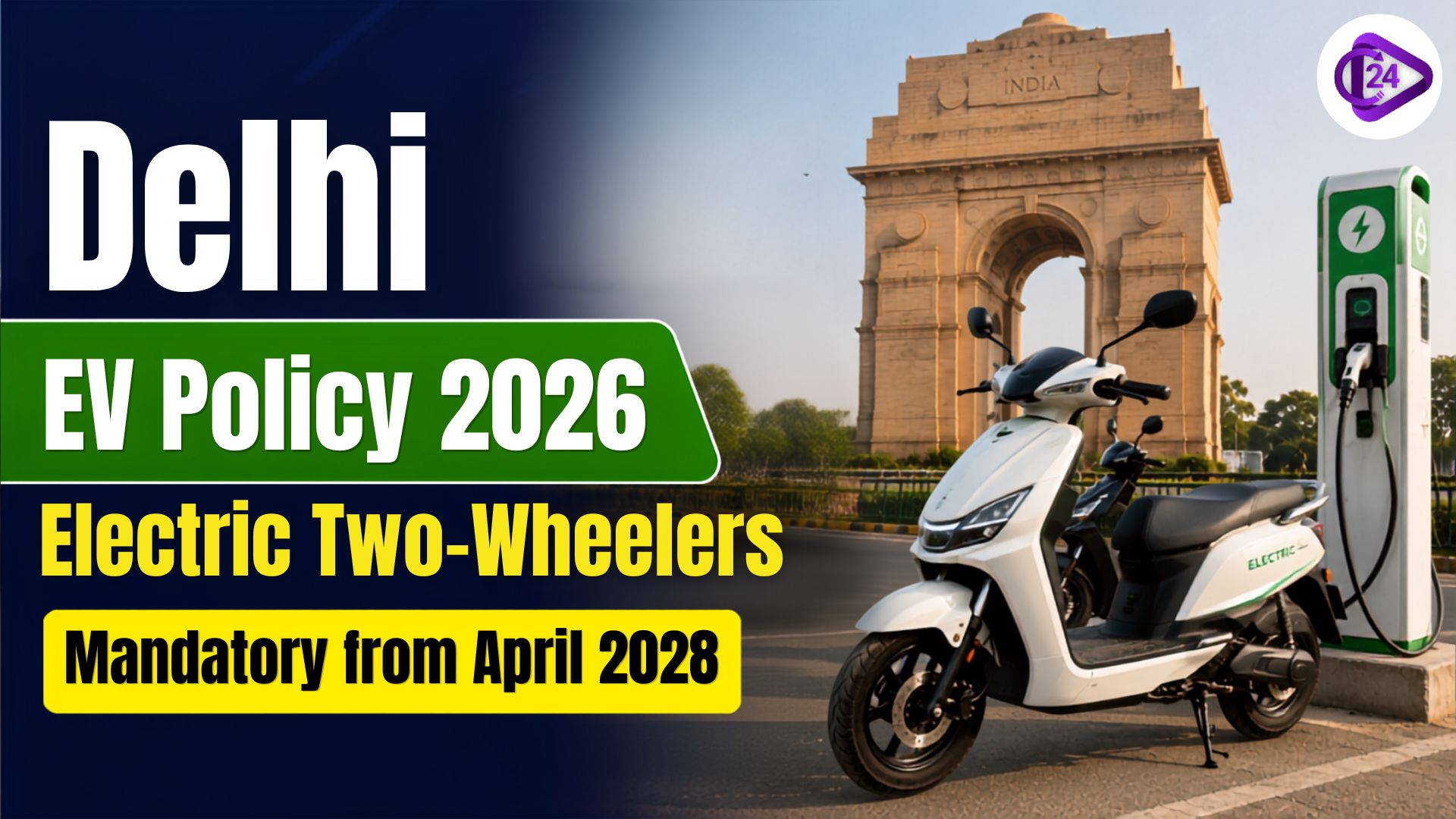
Delhi EV Policy 2026 brings in substantial changes and reforms to promote the penetration of EVs in the National Capital. The move, if implemented, will even see all newly registered two-wheelers being proposed to switch to electric by April 2028, which will help cut vehicular pollution and clean up two-wheelers, a big positive step forward. In addition to promoting the adoption of electric vehicles, the Delhi EV Policy 2026 emphasises creating charging infrastructure, employment opportunities, providing financial incentives, and building a robust EV ecosystem. In this context, Delhi will target becoming one of the best electric mobility centres and improving urban air quality.
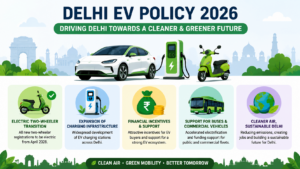
Delhi EV Policy 2026 Highlights
- From April 2028, all new registrations will have to be for an electric two-wheeler
- Concentration on Lowering Vehicle Emissions and Air Pollution
- Expansion of EV charging Infrastructure across Delhi.
- Incentives for electric vehicle buyers.
- Promotion of battery swapping facilities.
- Electric funding for buses and commercial vehicles
- Jobs coming up with EV manufacturing and upkeep
- Adherence to India’s clean energy and climate objectives.
- Encouragement of private investment for EV infrastructure
- Accelerating the shift to sustainable mobility in Delhi.
What is Delhi EV Policy 2026?
The Delhi EV Policy 2026 is the revised electric vehicle policy that the Delhi Government has introduced to enable large-scale adoption of electric mobility. The policy expands previous EV programs while setting tougher electric vehicle adoption targets. The policy also seeks to curb reliance on fossil fuels, enhance air quality and promote an electric vehicle ecosystem spurred by incentives, charging stations and battery-swapping networks.
Aim of the Delhi EV Policy 2026
The Delhi EV Policy 2026 seeks to establish Delhi as a global capital for electric mobility through rapid adoption of electric vehicles and creation of an ecosystem to reduce pollution and build sustainable transport systems. This policy aims to fulfil the following :
- Lower vehicular emissions throughout the city to reduce air pollution.
- Decrease the adoption and use of electric vehicles (EVs) amongst private and commercial users.
- Reduce GHGs in line with India’s climate commitments
- Advocating for clean and sustainable transportation as an alternative to fossil fuel-powered cars.
- Why: Expand access to EV chargers across the country, with both public and private charging stations.
- Create a reliable ecosystem for battery swapping that greatly expedites and improves upon the EV experience.
- Green jobs in EV manufacturing, charging infrastructure, maintenance and battery technology
- Promote sustainable transport solutions for urban mobility,
- Freedom from reliance on petrol and diesel, helping to bolster energy security and cut fuel imports.
- Enhance investment and innovation into the electric mobility sector through favourable policies & incentives
- Cycle saves lives: Cycle-to-work improves public health by reducing harmful vehicular emissions and enhancing air quality
- Advance net-zero and clean energy goals in India through zero-emission transport.
Previous Year Questions (PYQs)
| Exam | Year | Question | Options | Correct Answer |
| UPSC Prelims | 2023 | The FAME India Scheme is primarily associated with the promotion of: | (A) Solar Energy (B) Electric Vehicles (C) Biofuels (D) Hydrogen Fuel | (B) Electric Vehicles |
| UPSC Prelims | 2023 | India’s Panchamrit commitments announced at COP26 include achieving Net Zero emissions by: | (A) 2050 (B) 2060 (C) 2070 (D) 2080 | (C) 2070 |
| UPSC Prelims | 2021 | The National Hydrogen Mission aims to promote the production and use of: | (A) Blue Hydrogen only (B) Green Hydrogen (C) Grey Hydrogen (D) Brown Hydrogen | (B) Green Hydrogen |
| UPSC Prelims | 2022 | Which of the following is the nodal ministry for implementing the FAME India Scheme? | (A) Ministry of Road Transport and Highways (B) Ministry of Heavy Industries (C) Ministry of Power (D) Ministry of Environment | (B) Ministry of Heavy Industries |
| SSC CGL | 2023 | What is the primary objective of the PM E-DRIVE Scheme? | (A) Promote road construction (B) Accelerate electric vehicle adoption (C) Expand railway electrification (D) Improve fuel quality | (B) Accelerate electric vehicle adoption |
| UPSC Prelims | 2022 | Which international agreement aims to limit global warming well below 2°C above pre-industrial levels? | (A) Kyoto Protocol (B) Montreal Protocol (C) Paris Agreement (D) Ramsar Convention | (C) Paris Agreement |
| State PSC | 2023 | Which greenhouse gas is emitted in the largest quantity due to fossil fuel combustion? | (A) Methane (B) Carbon Dioxide (C) Nitrous Oxide (D) Ozone | (B) Carbon Dioxide |
| SSC CGL | 2022 | Battery swapping is primarily associated with: | (A) Diesel Vehicles (B) Electric Vehicles (C) Hybrid Vehicles (D) Hydrogen Vehicles | (B) Electric Vehicles |
| UPSC Prelims | 2023 | PM-KUSUM Scheme mainly promotes: | (A) Wind Energy (B) Solar Energy in Agriculture (C) Electric Cars (D) Hydropower | (B) Solar Energy in Agriculture |
| RRB NTPC | 2022 | Which ministry launched the National Green Hydrogen Mission? | (A) Ministry of Heavy Industries (B) Ministry of New and Renewable Energy (C) Ministry of Power (D) Ministry of Coal | (B) Ministry of New and Renewable Energy |
| UPSC Prelims | 2021 | India’s National Action Plan on Climate Change (NAPCC) originally consists of how many national missions? | (A) 6 (B) 8 (C) 10 (D) 12 | (B) 8 |
| SSC CHSL | 2023 | Which vehicle produces zero tailpipe emissions? | (A) Petrol Vehicle (B) Diesel Vehicle (C) Battery Electric Vehicle (BEV) (D) CNG Vehicle | (C) Battery Electric Vehicle (BEV) |
| State PSC | 2023 | Which scheme provides incentives for electric vehicle manufacturing in India? | (A) PM Gati Shakti (B) FAME India Scheme (C) Smart Cities Mission (D) PMAY | (B) FAME India Scheme |
| UPSC Prelims | 2022 | Carbon neutrality means: | (A) Zero carbon production (B) Net Zero carbon emissions by balancing emissions and removals (C) Complete ban on fossil fuels (D) Zero industrial activity | (B) Net Zero carbon emissions by balancing emissions and removals |
| DSSSB | 2023 | Which fuel is considered the cleanest among the following? | (A) Petrol (B) Diesel (C) Green Hydrogen (D) Furnace Oil | (C) Green Hydrogen |
World’s Best School Prizes 2026
Conclusion on Delhi EV Policy 2026 Approved
Delhi EV Policy 2026 is a groundbreaking initiative that promotes electric mobility across the National Capital. The policy sets the tone for a cleaner and more sustainable transport system by mandating electric two-wheelers from April 2028; ramping up charging infrastructure, promoting battery swapping and fostering commercial EV Policy adoption. Furthermore, the Delhi EV Policy 2026 is consistent with India’s environmental objectives, opening up new economic paths and tackling Urban air pollution. If executed correctly, it could serve as a template for other states looking to go electric on a broader scale.