

Daily Quizzes
Mock Tests
No tests attempted yet.
Select Category
Words to Enhance Your Vocabulary: Meaning & Examples

Enquire Now
A strong vocabulary makes it easier to understand English, express ideas clearly, and communicate with confidence. For students, vocabulary is especially useful in reading comprehension, descriptive writing, interviews, competitive exams, and everyday conversations. However, improving vocabulary does not mean memorising hundreds of difficult words without understanding how they are used.
The better approach is to learn a few useful words regularly and understand their meaning, synonyms, antonyms, and usage in sentences. This helps you remember words naturally and use them in the right context. In this article, we will explore useful words to enhance your vocabulary and simple techniques that can make vocabulary learning easier.
Why Is a Strong English Vocabulary Important?
Vocabulary affects almost every part of language learning, from understanding a passage to writing an answer. Knowing more useful words also helps you communicate ideas without repeatedly using the same expressions.
A better vocabulary can help you:
- Understand reading comprehension passages more easily.
- Express your thoughts clearly in writing.
- Improve communication during interviews and conversations.
- Understand newspapers, books, and articles.
- Recognise synonyms and antonyms in competitive exams.
- Choose more accurate words while speaking.
- Reduce repetition in essays and descriptive answers.
For example, instead of always saying "very good," you may use words such as excellent, impressive, or remarkable, depending on the context.
Useful Words to Enhance Your Vocabulary
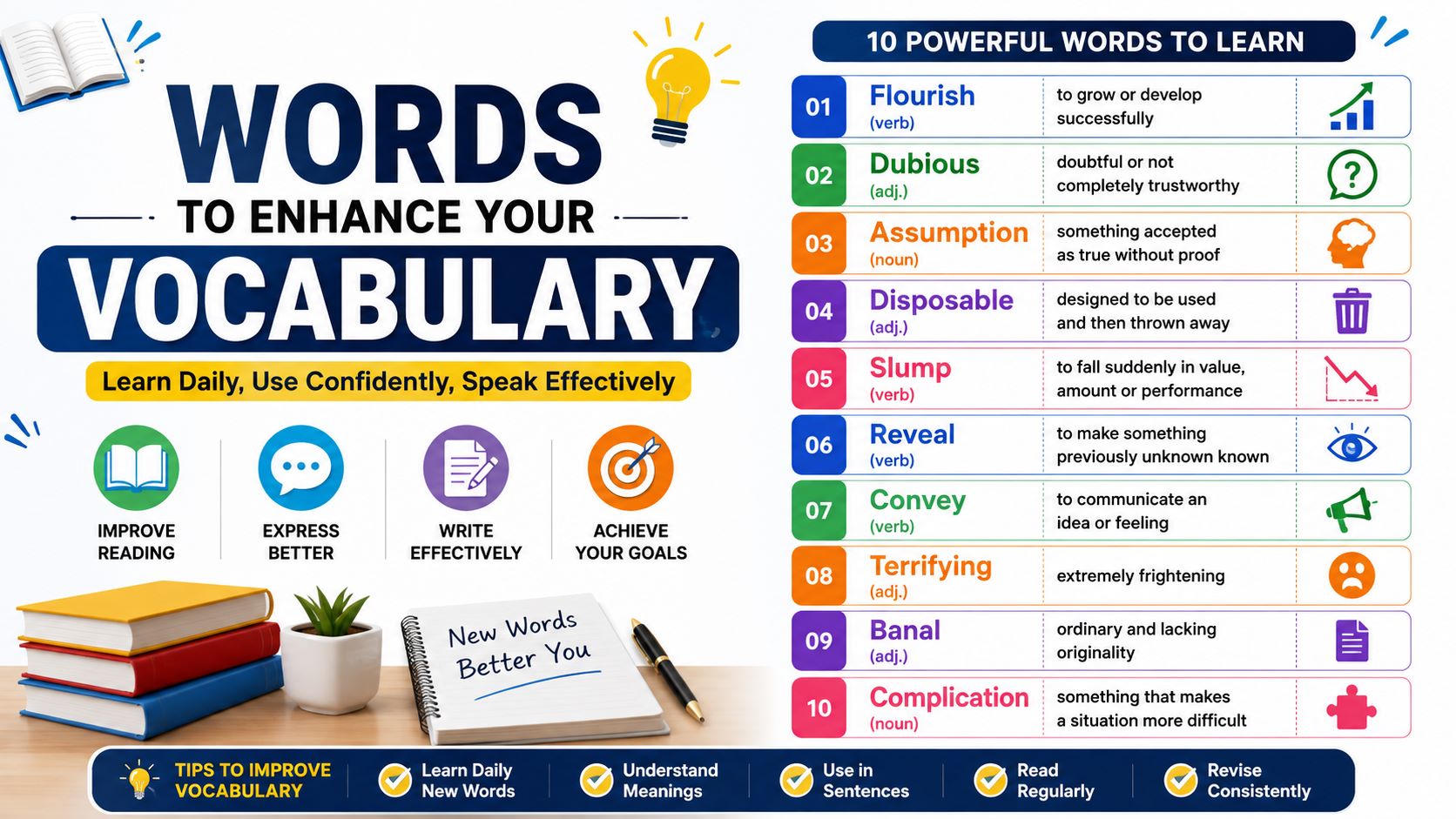
Learning words with their meanings and examples makes them easier to remember. The following table contains practical vocabulary words that students can use in reading, writing, and everyday communication.
| Word | Meaning | Synonym | Antonym | Example |
|---|---|---|---|---|
| Flourish | To grow or develop successfully | Thrive, Prosper | Decline, Fail | Small businesses can flourish with proper support. |
| Dubious | Doubtful or not completely trustworthy | Doubtful, Suspicious | Certain, Trustworthy | I was dubious about the accuracy of the claim. |
| Assumption | Something accepted as true without proof | Supposition, Belief | Fact, Certainty | His decision was based on an incorrect assumption. |
| Disposable | Designed to be used and then thrown away | Expendable, Single-use | Reusable | The hospital uses disposable gloves. |
| Slump | To fall suddenly in value, amount, or performance | Decline, Drop | Rise, Increase | Sales experienced a slump during the month. |
| Reveal | To make something previously unknown known | Disclose, Uncover | Conceal, Hide | The report may reveal important information. |
| Convey | To communicate an idea or feeling | Communicate, Express | Withhold, Conceal | Her speech clearly conveyed the main message. |
| Terrifying | Extremely frightening | Frightening, Scary | Reassuring, Comforting | They described the storm as a terrifying experience. |
| Banal | Ordinary and lacking originality | Commonplace, Unoriginal | Original, Fresh | The discussion became repetitive and banal. |
| Complication | Something that makes a situation more difficult | Difficulty, Problem | Simplicity, Solution | Bad weather created another complication for the journey. |
These words are more useful when you understand their context rather than memorising their definitions alone. Try creating your own sentence with every new word you learn.
How to Learn New Vocabulary Words Effectively
Learning ten words today and forgetting them tomorrow will not improve your vocabulary. A better method combines understanding, usage, revision, and repeated exposure to words in different situations.
Learn Words in Context
Avoid learning a word only through its dictionary definition. Read the complete sentence in which the word appears.
Suppose you learn the word "reveal."
Instead of memorising:
Reveal = Disclose
Learn it through a sentence:
The investigation revealed several previously unknown facts.
Now you understand both its meaning and how it can be used naturally.
Make Your Own Sentences
After learning a word, create a sentence related to your own experiences or familiar situations.
For example:
Word: Flourish
Sentence: Plants flourish when they receive enough sunlight and water.
Creating your own examples requires you to think about the meaning, which can make the word easier to remember.
Learn Synonyms and Antonyms
Synonyms and antonyms expand your vocabulary around a single word. They are also useful for many competitive examination questions.
For example:
Dubious
- Synonyms: doubtful, suspicious, uncertain
- Antonyms: certain, trustworthy, definite
Instead of learning only one word, you become familiar with several related words at the same time.
Best Daily Routine to Improve English Vocabulary
You do not need to spend hours memorising vocabulary every day. A short but consistent routine can be more manageable and effective than trying to learn too many words together.
The following routine provides a simple structure students can adjust according to their available study time and current English level.
| Activity | What to Do |
|---|---|
| Learn New Words | Select 5–10 useful words |
| Understand Meaning | Check the meaning and context |
| Synonyms & Antonyms | Learn 1–2 useful alternatives |
| Sentence Practice | Write your own sentence |
| Reading Practice | Notice new words while reading |
| Revision | Review previously learned words |
| Weekly Test | Test yourself without looking at notes |
The exact number of words is less important than remembering and using them correctly. If ten words feel difficult, start with five and gradually increase the number.
How Reading Helps Enhance Your Vocabulary
Reading exposes you to words as they are naturally used. Instead of seeing an isolated definition, you understand how a word fits into a sentence and what meaning it carries.
You can read:
- Newspapers
- Editorials
- Short stories
- English magazines
- Exam passages
- Biographies
- Informative blogs
- Previous-year comprehension passages
Whenever you encounter an unfamiliar word, first try to guess its meaning from the surrounding sentence. Then check the dictionary to see whether your interpretation was correct.
This method develops both vocabulary and reading comprehension skills.
Use a Vocabulary Notebook for Better Revision
A simple vocabulary notebook can prevent newly learned words from disappearing from memory. Instead of writing only the word and meaning, record enough information to understand its actual usage.
You can follow this format:
Word: Convey
Meaning: To communicate or make an idea known
Synonym: Express, communicate
Antonym: Conceal, withhold
Example: The graph conveys the information clearly.
My Sentence: I found it difficult to convey my idea during the discussion.
Review the notebook regularly and mark words that you can use without checking their meanings.
Common Mistakes While Learning Vocabulary
Many students put considerable effort into vocabulary but struggle to remember words because their learning method focuses too heavily on memorisation.
Avoid these common mistakes:
- Memorising long lists without examples.
- Learning too many difficult words in one day.
- Ignoring the context in which a word is used.
- Never revising previously learned words.
- Learning synonyms without understanding differences in usage.
- Focusing only on rare or complicated vocabulary.
- Reading meanings without writing or speaking the words.
- Using difficult words unnecessarily to make sentences sound impressive.
The objective is not to use the most complicated English possible. It is to choose the right word for the right situation.
Vocabulary Words for Competitive Exams
Vocabulary questions are common in the English sections of many competitive examinations. Depending on the exam, students may encounter questions involving synonyms, antonyms, contextual vocabulary, idioms, or reading comprehension.
While preparing vocabulary for exams, focus on:
- Synonyms and antonyms
- One-word substitutions
- Contextual meanings
- Commonly confused words
- Idioms and phrases
- Phrasal verbs
- Words appearing in previous-year papers
- Vocabulary from reading comprehension passages
Previous-year questions are particularly useful because they show what type and level of vocabulary the examination actually tests.
How to Remember Vocabulary Words for Longer
Revision is essential because simply understanding a word once does not guarantee that you will remember it several weeks later. Use active recall instead of repeatedly reading the same list.
Try this method:
Day 1: Learn the word and create a sentence.
Day 2: Recall its meaning without checking your notes.
Day 4: Revise its synonym, antonym, and example.
Day 7: Use the word in a new sentence.
Later: Review it again if you struggle to recall it.
You can also make flashcards. Write the word on one side and its meaning with an example on the other.
How to Use New Vocabulary in Daily Life
A word becomes part of your active vocabulary when you can use it naturally instead of only recognising it in a question. Therefore, practise new words beyond your vocabulary notebook.
You can:
- Use one new word in a conversation.
- Write short paragraphs using recently learned words.
- Replace repetitive words with suitable alternatives.
- Explain a new word to someone else.
- Create your own examples.
- Notice learned words while reading newspapers.
- Keep a weekly list of words you successfully used.
For instance, instead of writing "The business grew quickly," you might write "The business flourished," when that meaning fits the context.
Conclusion
Learning useful words to enhance your vocabulary can improve reading, writing, comprehension, and communication skills. The key is not to memorise the maximum number of words but to understand and repeatedly use the words you learn.
Start with a small daily target, learn each word with its meaning, synonym, antonym, and example, and revise it regularly. Combine vocabulary practice with reading and sentence writing. Over time, words that initially seem unfamiliar can become a natural part of your everyday English.
Let's connect with CLASS24
🚀 Download the Class24 App here:
Frequently Asked Questions