

Daily Quizzes
Mock Tests
No tests attempted yet.
Select Category
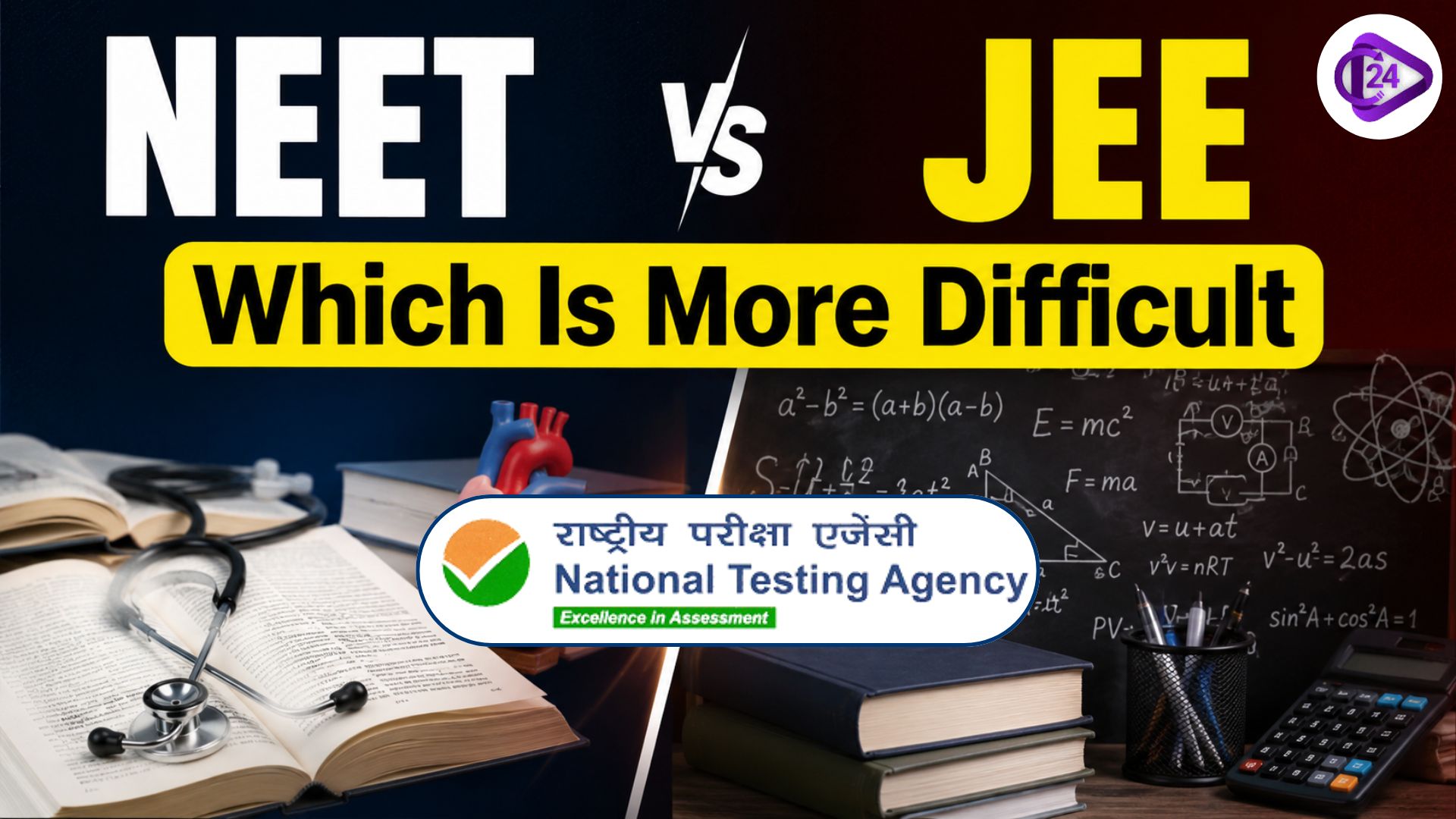
NEET vs JEE: Which Is More Difficult?

Enquire Now
Every year, students finishing Class 12 face one important question—should they prepare for NEET or JEE? While both are among India's toughest entrance exams, they lead to completely different careers. Understanding their syllabus, competition, difficulty level, and career opportunities can help you make the right decision.
What is the NEET Exam?
NEET UG (National Eligibility cum Entrance Test) is the one entrance exam for admission to medical entrance courses like MBBS, BDS, AYUSH courses, all over India. It includes Physics, Chemistry, and Biology, and has a heavier weightage on the study of Biology. The exam is given by NTA and is based on the NCERT exam pattern.
What is the JEE Exam?
The JEE Main and JEE Advanced are National Level Entrance Examinations conducted for admission to Engineering entrance programmes at IITs/NITs/Other Engineering Colleges. JEE Physics, Chemistry and Mathematics emphasize conceptual and analytical thinking. The JEE Advanced cut-off is very tough as it determines admission to the IITs only.
NEET vs JEE: Difficulty Comparison Table
| Parameter | NEET Exam | JEE Exam |
|---|---|---|
| Subjects | Physics, Chemistry, Biology | Physics, Chemistry, Mathematics |
| Conceptual Difficulty | Moderate to High | High to Very High (especially JEE Advanced) |
| Syllabus Volume | Very High (Biology-heavy) | Moderate to High (Maths-intensive) |
| Competition Level | Extremely High due to a large number of aspirants | Very High, especially for IIT admissions |
| Question Type | Mostly NCERT-based, concept and memory-oriented | Application-based, analytical, and multi-concept problem solving |
| Number of Attempts | Multiple attempts (subject to current eligibility rules) | JEE Main: Multiple attempts across sessions; JEE Advanced: Limited attempts |
| Time Pressure | High due to a large number of questions in limited time | High because of lengthy analytical problems, especially in JEE Advanced |
| Toughest Stage | Securing a top rank because of intense competition and high cut-offs | JEE Advanced due to its complex, multi-step problem-solving questions |
Key Differences Between NEET and JEE
Here are the important points highlighting the difference between NEET and JEE difficulty levels:
- The NEET syllabus is huge, especially Botany and Zoology, requiring heavy memorization.
- Logical reasoning and problem-solving skills are a must in the JEE syllabus.
- The weightage of biology in NEET is quite high, around 50% of the paper.
- In JEE Physics and Maths questions, the analytical and tricky questions are more in the case of JEE Advanced.
- The elevated NEET cutoff is because of the large number of students appearing for the exam to get admission to medical colleges.The
- NEET exam is rated as one of the toughest exams in India.
- JEE Exam Pattern has both Multiple Choice Questions and questions of numerical values which demand thorough concept clarity.
- It is predicted to be huge for the NEET exam pattern as the study is more NCERT-based.
Why is JEE Considered Harder Than NEET?
Many experts consider the toughest exam in India to be JEE, particularly JEE Advanced, due to the clarity of concepts for Physics and Maths. The questions here, as with many of the questions, are not of the recall type, requiring students to think more intensely on how to apply the knowledge in the problem than they need to do in NEET.
Why is NEET Competition Tougher Than JEE?
On the other hand, the NEET competition is considered brutal because of the massive number of applicants versus the very limited medical college admission seats. This is pushing the NEET cut-off to a very high level every year and hence the NEET preparation vs JEE preparation challenge is a subject of debate among students and teachers alike.
NEET and JEE Syllabus Comparison
| Feature | NEET Syllabus | JEE Syllabus |
|---|---|---|
| Core Subjects | Physics, Chemistry, Botany, Zoology | Physics, Chemistry, Mathematics |
| Main Focus | Biology-focused with a detailed theoretical understanding | Mathematics-focused with conceptual and analytical problem solving |
| Coverage | A vast syllabus requiring strong memory and concept retention | Moderate to high syllabus emphasizing conceptual depth |
| Question Approach | Mostly NCERT-based with direct concept application | Multi-concept, application-based, and calculation-intensive |
| Preparation Style | Revision, memorization, and NCERT mastery | Concept building, practice, and advanced problem solving |
| Common Subjects | Physics and Chemistry | Physics and Chemistry |
| Key Difference | Biology is the deciding subject | Mathematics is the deciding subject |
| Overall Nature | Detail-oriented and memory-intensive | Concept-oriented and application-intensive |
Exam Pattern: NEET vs JEE
| Feature | NEET Exam Pattern | JEE Exam Pattern |
|---|---|---|
| Exam Mode | Offline (Pen & Paper) | JEE Main: Computer-Based Test (CBT); JEE Advanced: Computer-Based Test |
| Question Format | Multiple Choice Questions (MCQs) | MCQs, Numerical Value Questions, and analytical questions |
| Total Questions | 200 questions (180 to be attempted under the current pattern) | JEE Main: Subject-wise MCQs and Numerical Questions; JEE Advanced: Variable pattern |
| Difficulty Level | Moderate with high competition | Moderate to Very High, especially JEE Advanced |
| Question Style | Mostly NCERT-based and concept-focused | Application-based, logical reasoning, and multi-step calculations |
| Negative Marking | Yes | Yes (pattern varies across JEE Main and JEE Advanced) |
| Time Duration | 3 Hours | Generally, 3 Hours per paper |
| Previous AIIMS Pattern | AIIMS MBBS had a separate exam earlier but was merged into NEET UG from 2020 | Not applicable |
Which Exam Should You Choose?
Choosing between NEET and JEE should depend on your interest in medical vs engineering career options rather than just difficulty level. For those who have a passion for Biology and wish to take up a career in Medicine, NEET is the way to go. JEE is suitable for Physics, Maths and problem-solving enthusiasts. If you are planning to reattempt both of them, call for a dedicated NEET dropper strategy or JEE dropper strategy.
IIT JEE Preparation Tips
To crack the IIT JEE Preparation, it is important to have a clear understanding of the concepts in Physics, Chemistry, and Mathematics, as well as practice problem-solving regularly. Students should learn first the basics from the NCERT and then the advanced application-based questions should be learned. Mock tests and time management practice play a pivotal role in solving the JEE Advanced cut-off; this is one of the most challenging cut-off criteria among competitive exams in India.
Drop Year Strategy for NEET and JEE Aspirants
Many students take a drop year in order to raise their scores, but the strategy varies for each test:
- NEET dropper strategy: Thorough revision of NCERT, improving accuracy in Biology, and solving NCERT papers based on the previous year's exam pattern.
- JEE dropper strategy: Concentrate on building up weak concepts in Physics and Maths, solving higher-level questions, and going through the errors made in the last effort.
- For both approaches, a planned timeframe and periodic self-evaluation are essential to preventing the recurrence of previous mistakes.
Exam Success Rate in India
The exam success rate in India for both NEET and JEE remains quite low due to the huge gap between applicants and available seats. Both the exams are highly selective, as only a small percentage of NEET aspirants get a seat in the top medical colleges and only a smaller number of JEE Advanced qualifiers make it to the total JEE Main applicants.
Also Read
| JEE Main Syllabus | NEET Biology Paper Analysis |
| NEET Cut Off | JEE Main Cut Off |
| NEET 2025 Question Paper Analysis | NEET Exam Last Minute Tips |
| JEE Mains Registration Form | NEET Question Paper with Solution |
Conclusion
In the debate of NEET vs JEE, which is more difficult, there is no single correct answer. JEE Advanced is conceptually difficult, while NEET is difficult because of the huge competition and syllabus. The exam you choose should be based on both your interests and strengths, and your long-term career plans, not only on the difficulty tag associated with either of the exams.
Frequently Asked Questions