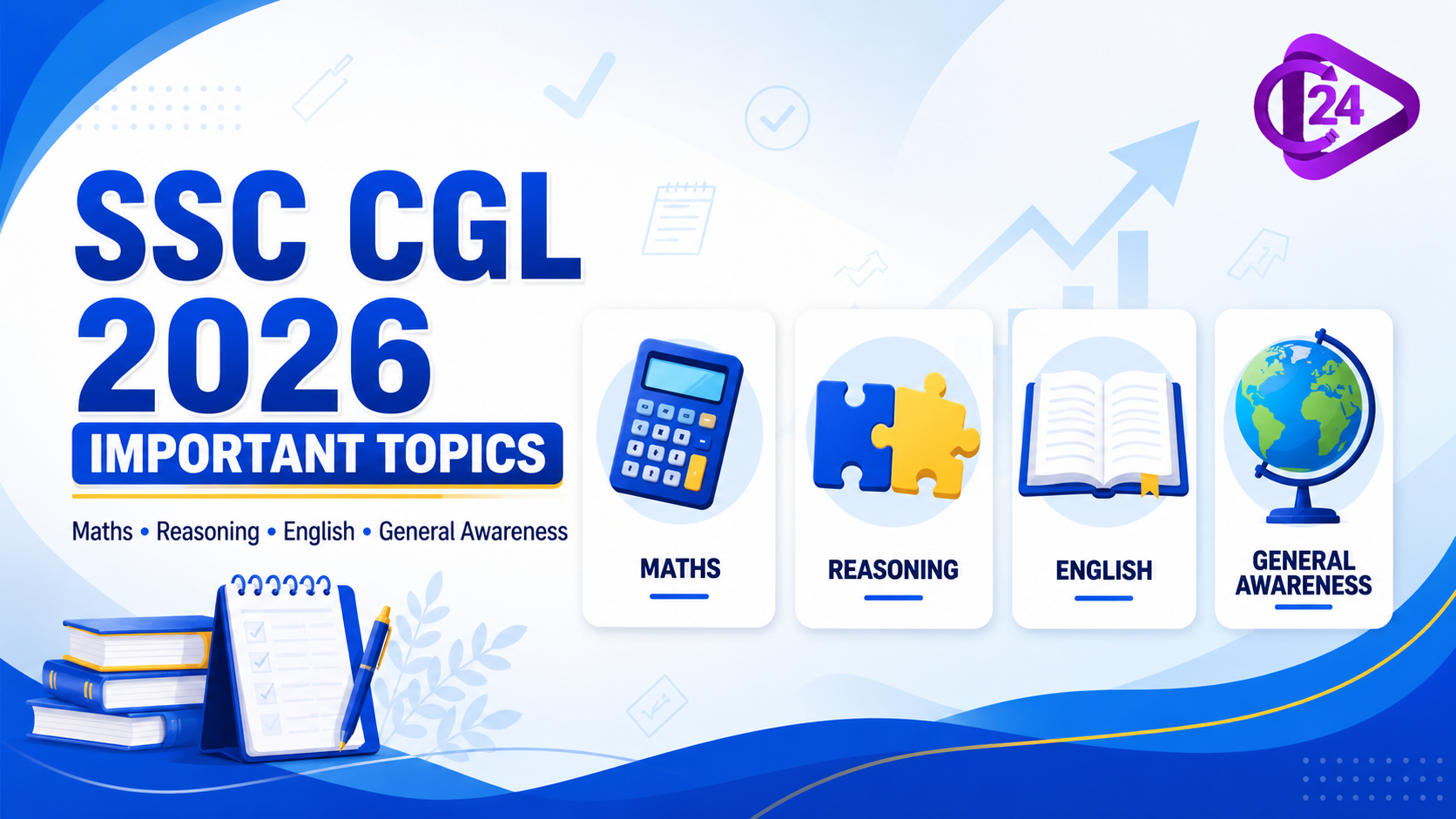
SSC CGL 2026 is one of the most competitive exams for Group B and Group C posts in Central Government departments, and the SSC CGL 2026 notification was released on 21st May 2026 with around 12,256 vacancies announced across departments. If you are preparing for this exam, you don't need to jump between ten different websites to understand the syllabus, important topics, weightage, and strategy- everything you need is covered right here in one place.
SSC CGL 2026 Exam Overview
Before diving into important topics, it helps to understand the basic structure of the exam.
| Particular |
Details |
| Conducting Body |
Staff Selection Commission (SSC) |
| Exam Name |
SSC CGL 2026 (Combined Graduate Level) |
| Notification Date |
21 May 2026 |
| Total Vacancies |
12,256 (approx., across Group B & C posts) |
| Selection Stages |
Tier 1 and Tier 2 |
| Tier 1 Questions/Marks |
100 Questions / 200 Marks |
| Tier 2 Questions/Marks |
150 Questions / 450 Marks (Paper 1) |
| Exam Mode |
Online (Computer Based Test) |
| Exam Medium |
English and Hindi (except English section) |
| Negative Marking (Tier 1) |
0.50 mark per wrong answer |
| Negative Marking (Tier 2) |
1 mark per wrong answer |
| Tier 1 Duration |
60 minutes (15 min per section- new sectional timing) |
Key change in 2026: SSC has introduced sectional timing of 15 minutes per section in Tier 1, and added Paper 3 (Finance & Economics) in Tier 2 for AAO posts. This means you can no longer "borrow time" from one section to finish another- each section must be completed within its own 15-minute window, so speed and discipline both matter now.
SSC CGL 2026 Exam Pattern (Tier 1 & Tier 2)
Tier 1 Exam Pattern
| Section |
No. of Questions |
Marks |
Time |
| General Intelligence & Reasoning |
25 |
50 |
15 minutes |
| General Awareness |
25 |
50 |
15 minutes |
| Quantitative Aptitude |
25 |
50 |
15 minutes |
| English Comprehension |
25 |
50 |
15 minutes |
| Total |
100 |
200 |
60 minutes |
Tier 2 Exam Pattern (Paper 1- Compulsory for All)
| Section |
Module |
Questions |
Marks |
Duration |
| Section I |
Module 1: Mathematical Abilities |
30 |
90 |
1 hour (combined) |
| Section I |
Module 2: Reasoning & General Intelligence |
30 |
90 |
|
| Section II |
Module 1: English Language & Comprehension |
45 |
135 |
1 hour (combined) |
| Section II |
Module 2: General Awareness |
25 |
75 |
|
| Section III |
Module 1: Computer Knowledge Test |
20 |
60 |
15 minutes |
| Section III |
Module 2: Data Entry Speed Test (DEST) |
1 Task |
Qualifying |
15 minutes |
Tier 2 Paper 2 (Statistics) is only for candidates applying for Junior Statistical Officer (JSO)- 100 questions, 200 marks, 2 hours. Tier 2 Paper 3 (Finance & Economics) is only for AAO post candidates.
SSC CGL 2026 Important Topics- Quantitative Aptitude
Quantitative Aptitude is considered the toughest section by most students but it is also highly scoring once you master the core chapters. It tests basic mathematics up to the Class 10 level, but speed and accuracy matter most.
Number System, Arithmetic & Algebra
| Topic |
Why It's Important |
| Percentage, Profit & Loss, Discount |
Forms the base for many other arithmetic questions; asked almost every year. |
| Ratio, Proportion & Partnership |
Frequently combined with profit-loss and mixture questions in exams. |
| Simple & Compound Interest |
Direct formula-based questions; easy to score if formulas are clear. |
| Time, Speed & Distance, Time & Work |
High-weightage arithmetic chapters; practice boosts speed significantly. |
| Averages & Mixture-Alligation |
Common in both Tier 1 and Tier 2; conceptual clarity saves time. |
| Algebraic Identities & Elementary Surds |
Tests basic algebra manipulation; important for Tier 2 difficulty level. |
Geometry, Mensuration & Trigonometry
| Topic |
Why It's Important |
| Triangles, Circles, Quadrilaterals |
One of the highest-weightage topics across both tiers; 4-5 questions common. |
| Mensuration (2D & 3D Figures) |
Cone, cylinder, sphere, prism-based questions appear regularly. |
| Trigonometric Ratios & Identities |
Height & Distance problems are a favourite in SSC exams. |
| Coordinate Geometry Basics |
Occasionally tested, especially in Tier 2. |
Data Interpretation & Statistics
| Topic |
Why It's Important |
| Bar Graph, Pie Chart, Line Graph |
DI sets carry 4-5 questions together; practising speed calculation here saves overall time. |
| Mean, Median, Mode, Standard Deviation |
Basic statistics questions appear more in Tier 2 Mathematical Abilities module. |
Quant Priority List:
| Rank |
Topic |
Priority Level |
| 1 |
Geometry & Mensuration |
High |
| 2 |
Arithmetic (Profit-Loss, Percentage, SI-CI) |
High |
| 3 |
Algebra |
Medium-High |
| 4 |
Trigonometry |
Medium |
| 5 |
Data Interpretation |
Medium |
| 6 |
Statistics Basics (mainly Tier 2) |
Medium |
SSC CGL 2026 Important Topics- General Intelligence & Reasoning
Reasoning is the most scoring and least time-consuming section if you practice regularly, since it does not need heavy formula memorisation- it needs pattern recognition and practice.
Verbal Reasoning
| Topic |
Why It's Important |
| Analogy (Semantic, Number, Figural) |
Almost always asked, usually 2-3 questions; quick to solve with practice. |
| Classification (Odd One Out) |
Simple pattern-based questions, high accuracy possible. |
| Series (Number, Alphabet, Figural) |
One of the highest-weightage reasoning topics; practice patterns save time. |
| Coding-Decoding |
Frequently repeated question types across years; a must-master topic. |
| Blood Relations & Direction Sense |
Common 1-2 question topics; needs diagram practice. |
| Syllogism & Statement-Conclusion |
Logic-based, needs Venn diagram practice for accuracy. |
Non-Verbal & Analytical Reasoning
| Topic |
Why It's Important |
| Mirror & Water Images |
Visual topics, quick to answer once the trick is understood. |
| Paper Folding & Punched Holes |
Needs visualisation practice; scoring once pattern is clear. |
| Embedded Figures & Figure Completion |
Common in Tier 1; needs regular practice with picture-based questions. |
| Venn Diagrams |
Logic-visual hybrid questions, appear in both tiers. |
| Puzzle & Seating Arrangement |
More common in Tier 2; needs dedicated practice for accuracy under time pressure. |
Reasoning Priority List:
| Rank |
Topic |
Priority Level |
| 1 |
Coding-Decoding & Series |
High |
| 2 |
Analogy & Classification |
High |
| 3 |
Puzzles & Seating Arrangement (Tier 2) |
High |
| 4 |
Blood Relations & Direction Sense |
Medium-High |
| 5 |
Syllogism & Statement-Conclusion |
Medium |
| 6 |
Non-Verbal Topics (Mirror, Paper Folding, Embedded Figures) |
Medium |
SSC CGL 2026 Important Topics- English Language
English tests grammar, vocabulary, and comprehension. Reading habit and daily practice matter more than memorising rules here.
Grammar & Sentence-Based Topics
| Topic |
Why It's Important |
| Error Spotting & Sentence Correction |
Regularly asked, tests grammar rules like tense, subject-verb agreement. |
| Fill in the Blanks |
Tests both grammar and vocabulary together; frequent topic. |
| Active-Passive Voice & Narration |
Rule-based, scoring once concepts are clear. |
| Sentence Improvement & Rearrangement |
Common in both tiers; practice with previous papers helps a lot. |
Vocabulary-Based Topics
| Topic |
Why It's Important |
| Synonyms & Antonyms |
High-frequency topic; build a word list daily. |
| One Word Substitution |
2-3 questions almost guaranteed every year. |
| Idioms & Phrases |
Common topic, needs regular revision of a fixed list. |
| Spelling Correction |
Quick-scoring topic if you read regularly. |
Comprehension-Based Topics
| Topic |
Why It's Important |
| Reading Comprehension |
Carries around 5 questions; needs daily reading practice (newspapers/editorials). |
| Cloze Test |
Passage-based fill-in-the-blanks; tests both vocabulary and grammar together. |
English Priority List:
| Rank |
Topic |
Priority Level |
| 1 |
Reading Comprehension & Cloze Test |
High (~15-20% weightage) |
| 2 |
Vocabulary (Synonyms-Antonyms) |
High (~10-15% weightage) |
| 3 |
Error Spotting & Sentence Correction |
Medium-High |
| 4 |
Idioms & One Word Substitution |
Medium |
SSC CGL 2026 Important Topics- General Awareness
General Awareness is vast, but a large chunk of it is static and can be prepared once and revised repeatedly.
Static GK
| Topic |
Why It's Important |
| Indian History & Culture |
Regularly asked, especially freedom movement and ancient/medieval India. |
| Indian & World Geography |
Physical geography, rivers, and states are common question areas. |
| Indian Polity & Constitution |
Fundamental Rights, Articles, and Constitutional Bodies are frequently tested. |
| Indian Economy |
Basic economic concepts, budget terms, and organisations like RBI, NITI Aayog.
|
Current Affairs & Science
| Topic |
Why It's Important |
| Current Affairs (last 6-8 months) |
4-5 questions on average; covers schemes, appointments, awards, summits. |
| Science & Technology |
Basic Physics, Chemistry, Biology facts at school level; frequently asked. |
| Books & Authors, Sports, Important Days |
Miscellaneous but scoring if revised through a single consolidated list. |
| People in the News & Government Schemes |
Recently launched schemes and key personalities are common targets. |
GA Priority List:
| Rank |
Topic |
Priority Level |
| 1 |
Current Affairs & Static Polity |
High |
| 2 |
History & Economy |
High |
| 3 |
Geography |
Medium-High |
| 4 |
Science |
Medium |
| 5 |
Miscellaneous (Books, Sports, Important Days) |
Medium |
SSC CGL 2026 Tier 2 - Additional Topics
Computer Knowledge (Section III, Module 1- 20 Questions, 60 Marks)
| Topic Area |
Sub-Topics to Cover |
| Computer Basics |
CPU, input/output devices, memory & storage, ports |
| Software Basics |
Windows Explorer, keyboard shortcuts, MS Word/Excel/PowerPoint |
| Internet & Email |
Web browsing, file upload/download, email account management |
| Networking & Security |
Network devices, protocols, viruses/worms/trojans, prevention measures |
Data Entry Speed Test (DEST)
A qualifying-only test where candidates type a passage of about 2000 key depressions in 15 minutes. It does not add marks but must be cleared to remain in the selection process.
Statistics (Tier 2 Paper 2 - JSO Post Only)
| Topic Area |
Sub-Topics |
| Data Collection & Presentation |
Primary/secondary data, tabulation, graphs, frequency distribution |
| Measures of Central Tendency & Dispersion |
Mean, median, mode, standard deviation, quartile deviation |
| Correlation & Regression |
Scatter diagram, Spearman's rank correlation, regression lines |
| Probability & Distributions |
Bayes' theorem, Binomial, Poisson, Normal distribution |
| Sampling & Statistical Inference |
Sampling techniques, hypothesis testing, Z-test, t-test, Chi-square test |
| Time Series & Index Numbers |
Trend measurement, seasonal variation, cost of living index |
(Statistics is applicable only for candidates applying for the Junior Statistical Officer post- skip this section if you are not applying for JSO.)
SSC CGL 2026 Complete Topic-Wise Weightage Summary
| Subject |
High-Priority Topics |
Medium-Priority Topics |
| Quantitative Aptitude |
Geometry, Mensuration, Arithmetic (Percentage, Profit-Loss, SI-CI) |
Algebra, Trigonometry, Data Interpretation |
| Reasoning |
Coding-Decoding, Series, Analogy, Classification |
Blood Relations, Syllogism, Non-Verbal Reasoning, Puzzles |
| English |
Reading Comprehension, Cloze Test, Vocabulary |
Error Spotting, Sentence Correction, Idioms |
| General Awareness |
Current Affairs, Polity, History |
Geography, Economy, Science |
SSC CGL 2026 Preparation Strategy & Tips
| Tip |
Detail |
| Follow the sectional timing |
Since 2026 has 15-minute sectional locks, practice full mocks under this exact timing so your speed matches the real exam structure. |
| Prioritise high-weightage topics first |
Start with Geometry, Coding-Decoding, Vocabulary, and Current Affairs before moving to lower-weightage topics for better time returns. |
| Solve previous year papers |
Attempt at least the last 5-7 years' papers to understand repeated question patterns and difficulty level trends. |
| Take one full mock test weekly |
Simulated tests build exam temperament, help track speed, accuracy, and highlight weak sections needing more revision. |
| Maintain a current affairs notebook |
Note important events, schemes, and appointments daily so the last two months become easy to revise quickly. |
| Revise formulas daily |
Keep a single formula sheet for Quant and Trigonometry; revise it every morning for 10-15 minutes to retain speed. |
| Read newspapers and editorials |
This improves both English comprehension skills and General Awareness simultaneously, saving preparation time. |
| Analyse mistakes, not just scores |
After every mock, spend more time understanding why an answer was wrong rather than just checking the final score. |
| Balance accuracy and speed |
Since 0.5 negative marking applies, avoid guesswork; attempt only questions you are reasonably confident about first. |
| Stay consistent over long study hours |
Two to three focused hours daily for months build stronger retention than irregular ten-hour study bursts occasionally. |
Best Books for SSC CGL 2026 Preparation
| Subject |
Recommended Book/Author |
| Quantitative Aptitude |
"Quantitative Aptitude" by R.S. Aggarwal |
| Reasoning |
"A Modern Approach to Verbal & Non-Verbal Reasoning" by R.S. Aggarwal |
| English |
"Objective General English" by S.P. Bakshi |
| General Awareness |
Lucent's "General Knowledge" |
| Practice Sets |
Previous Year Papers compilations by any standard SSC coaching publisher |
Suggested Weekly Study Plan
| Day |
Focus Area |
| Monday |
Quant (Arithmetic) + Current Affairs revision |
| Tuesday |
Reasoning (Verbal) + Vocabulary building |
| Wednesday |
Quant (Geometry & Mensuration) + Reading Comprehension |
| Thursday |
Reasoning (Non-Verbal & Puzzles) + Grammar rules |
| Friday |
General Awareness (Static GK) + Error Spotting practice |
| Saturday |
Full-length mock test (Tier 1 pattern with sectional timing) |
| Sunday |
Mock analysis + weak topic revision + light current affairs reading |
Final Word
SSC CGL 2026 rewards consistent, topic-focused preparation over random, scattered studying. Use the weightage tables above to decide where your next study hour should go, follow the weekly plan, and revise using the FAQs whenever you need a quick recap. With the new sectional timing in place, practising under real exam conditions matters just as much as knowing the syllabus itself.
Frequently Asked Questions
Geometry, Algebra, Data Interpretation, Series, Coding-Decoding, Reading Comprehension, Cloze Test, Current Affairs, Polity, and Science are considered the most important based on previous year trends.
All four sections carry equal weightage - 25 questions and 50 marks each. However, Quant is considered toughest while English is considered most scoring if prepared well.
On average, 4-5 questions are asked from Current Affairs, generally covering the last 6-8 months before the exam.
Tier 1 is qualifying in nature only. Final merit and post allocation depend entirely on Tier 2 performance, though clearing Tier 1 is compulsory to appear for Tier 2.
SSC has introduced sectional timing of 15 minutes per section in Tier 1, and added Paper 3 (Finance & Economics) in Tier 2, applicable only for AAO post candidates.
No. Statistics (Tier 2 Paper 2) is compulsory only for candidates who have applied for the Junior Statistical Officer (JSO) post.
Practice typing regularly to comfortably type around 2000 key depressions within 15 minutes, since DEST is qualifying and does not add marks but must be cleared.
Focus first on Geometry, Coding-Decoding, Vocabulary/Synonyms-Antonyms, and Current Affairs, since these consistently carry high weightage across recent exams.
Tier 1 deducts 0.50 marks for every wrong answer, while Tier 2 deducts 1 mark per wrong answer, so accuracy matters as much as speed.
Combine daily current affairs reading with a fixed static GK source like Lucent's GK, and revise both regularly using short notes rather than re-reading entire books.