

Daily Quizzes
Mock Tests
No tests attempted yet.
Select Category
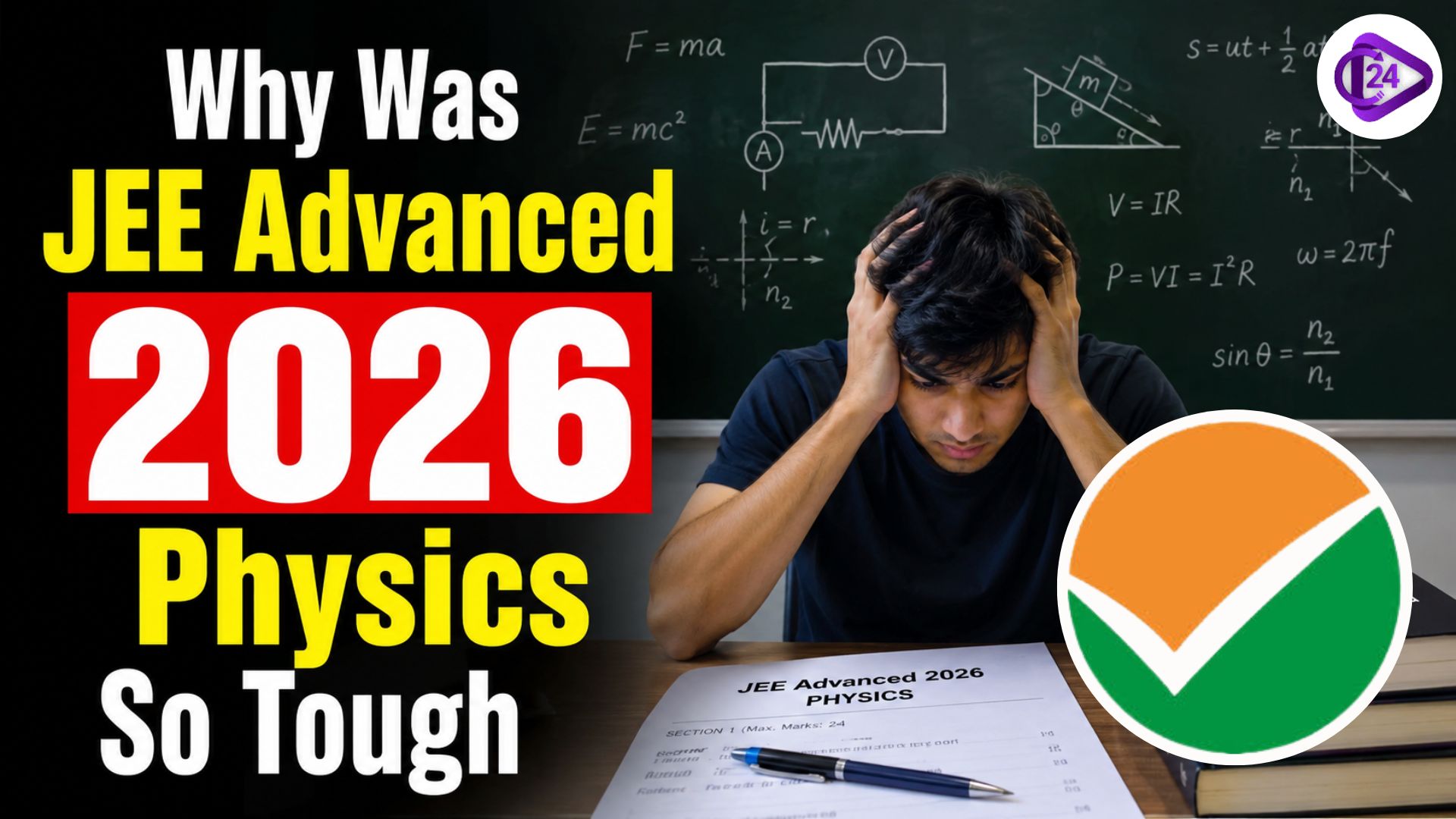
Why Was JEE Advanced 2026 Physics So Tough
Enquire Now
JEE Advanced Physics is the topic that stayed in the news for thousands of IIT aspirants when the exam was announced under JEE Advanced 2026. Most candidates found Chemistry easy and Mathematics moderately difficult, but most found Physics really difficult. In this blog, we will explore the reasons behind the difficulty of the JEE Advanced 2026 Physics paper, how it was different from the previous years, and offer some tips on how to prepare smarter for the next attempt to the exam with the help of JEE Advanced 2026 Physics paper analysis.
JEE Advanced 2026 Subject-Wise Marks Distribution
First, it is important to understand the weightage of marks in JEE Advanced 2026 Physics to understand why it is so tough. Paper 1 and Paper 2 were both worth 180 marks and were split into equal parts: Physics, Chemistry and Mathematics. This equal weighting influenced the overall score of most of the boys, as the Physics section was hard.
| Subject | Paper 1 Marks | Paper 2 Marks | Total Marks |
|---|---|---|---|
| Physics | 60 | 60 | 120 |
| Chemistry | 60 | 60 | 120 |
| Mathematics | 60 | 60 | 120 |
| Total | 180 | 180 | 360 |
JEE Advanced 2026 Physics Difficulty Level
Students and coaching experts gave a moderate to high rating to the difficulty level of the Physics paper in the JEE Advanced 2026. There was a focus on deep concept understanding in both Papers 1 and 2, not just on formula memorisation. Almost all the students from the country indicated that Physics was more time-consuming, patient and precise than Chemistry and even Mathematics.
According to reviews collected right after the exam, JEE Advanced Physics stood out as the toughest of the three subjects. Many students reported having to go back to questions they had left out the first time and so could not follow the best time management strategy during the exam.
Why Was JEE Advanced 2026 Physics So Difficult?
The major reason for the difficulty of JEE Advanced 2026 Physics was the multiple topics being bundled into a single question. The paper tested a combination of chapters instead of a single chapter, such as Fluid Mechanics with SHM and Rotation, Thermodynamics with Heat Conduction, etc. It required the necessary base knowledge and made quick cracking of the multi-concept questions of JEE Advanced 2026 Physics tough.
| Factor | Impact on Difficulty |
|---|---|
| Multi-topic Combined Questions | Increased Conceptual Load |
| Lengthy Numerical Calculations | Consumed Extra Exam Time |
| Deep Conceptual Clarity Required | Reduced Attempt Rate |
| Less Reliance on Direct Formulas | Lowered Scoring Speed |
| High Fatigue in Paper 2 | Affected Accuracy in Later Questions |
JEE Advanced 2026 Paper 1 vs Paper 2 Physics
One of the frequently asked questions by students is whether JEE Advanced 2026 Paper 1 or Paper 2 Physics was tougher. Paper 1 was very much conceptual, multi-topic, especially the questions involving Modern Physics, Electrostatics and combined mechanics questions. On the other hand, Paper 2, after Paper 1, was tiring due to the length of the Electrodynamics and Mechanics problems, which were not just tests of knowledge but tests of patience too.
- Paper 1: Physics conceptually dense, tricky questions of Modern Physics and Electrostatics.
- Paper 2 Physics: Long and wordy problems, plus the tiredness of the exam.
- Both papers: Much emphasis on applications, not memory
- Verdict: Paper 2 was timed and tiring, while Paper 1 had more difficult questions, but overall it was tougher.
JEE Advanced 2026 Physics Paper Analysis
A detailed analysis of the Physics paper of JEE Advanced 2026 reveals that this year's paper was among the conceptually richest physics papers in JEE history as per the ratings of the faculty and experts. Of the total number of questions that were posed, the majority of them were based on standard questions; however, the way the questions were phrased made it much more difficult to solve correctly under time pressure.
Key topics that appeared frequently and added to the difficulty include:
- Fluid Mechanics with SHM and Rotation
- Thermodynamics and Heat Conduction
- Rolling Motion involving relative angular velocity
- Optics questions mixing up Prism and Mirror
- Two-chamber fluid flow problems requiring integration
JEE Advanced 2026 Marks vs Rank and Expected Cutoff
Since JEE Advanced Physics was tough this year, raw scores are expected to be lower than usual, but this does not necessarily mean a lower rank — a tough paper is tough for everyone, so the marks vs rank curve adjusts accordingly. Students are advised to consider their percentile marks instead of absolute scores while predicting their chances of getting admission to IIT.
- A difficult Physics exam tends to bring down the overall cut-off.
- Category-wise cutoffs (General, OBC-NCL, SC, ST, EWS) are expected to be released along with results
- Once the results are announced, the students can use official college predictor tools that will give them an idea about which IIT they are likely to be selected into based on their score and category.
- Marks vs rank comparisons from previous years are only indicative, since the difficulty level varies each year
JEE Advanced 2026 Physics Student Reactions
The feedback from the students of JEE Advanced 2026 Physics was quite similar at different coaching institutes and social media platforms. The majority of the aspirants stated that Physics demanded a good foundation of concepts and not a last-minute revision of the formulae. Several students reported that they felt questions that they had practised in the modules gave them insight into patterns, although they still found the required level of reasoning to be a constraint.
Common feedback included:
- "Physics questions were tough to crack; needed strong conceptual clarity."
- Chemistry was seen as the highest-scoring and NCERT-based section.
- The mathematics involved was more predictable, but required heavy calculations.
- Physics required more steps than applying the formula.
Is JEE Advanced 2026 Physics Harder Than 2025?
Many students are asking, is JEE Advanced 2026 Physics harder than 2025? This year's Physics paper was found to be more demanding than the one from the previous year based on expert reviews and paper-level comparisons. The question pattern in the exams has seen a complete change with the introduction of multi-concept, integrated questions, which required students to use their understanding and application skills instead of rote learning.
| Aspect | JEE Advanced 2025 Physics | JEE Advanced 2026 Physics |
|---|---|---|
| Question Style | Mostly Single-Concept | Multi-Concept, Integrated |
| Calculation Length | Moderate | Lengthy and Time-Consuming |
| Conceptual Depth | Standard | Significantly Higher |
| Overall Difficulty | Moderate | Moderate to Difficult |
| Toughest Topics | Modern Physics, Electrostatics | Fluid Mechanics + SHM, Thermodynamics + Heat Conduction |
JEE Advanced 2026 Physics Expert Review
The Physics expert analysis for JEE Advanced 2026 by faculty members of top coaching institutes regarded this year's paper as one of the well-designed papers in the context of testing genuine understanding of the students in the Physics subject. Those students who concentrated on concept-first learning throughout the year seemed to do better than those who relied on memorization of formulas and shortcuts, experts commented.
How to Prepare for JEE Advanced Physics Going Forward
The JEE Advanced 2026 Physics paper was quite a result, and the students who cleared it with their hard work were the exception.The JEE Advanced 2026 Physics paper was quite a result, and the students who cleared it with their hard work were the exception, and this is because they weren't simply trying to memorise the formulas. It is now a must to establish solid basics on chapters and solve integrated multi-topic problems in order to be able to deal with the changing examination pattern with confidence.
- Practice conceptual understanding rather than formula manipulation, particularly in Mechanics, Thermodynamics and Electrodynamics.
- Solve a lot of combined problem questions of more than one concept, apart from chapter-wise questions.
- Solve previous years' JEE Advanced Physics papers to develop speed and accuracy under timed conditions.
- Focus on weaker topics such as Fluid Mechanics, Rotation, Heat Conduction, etc., that are increasingly combined in the test.
- Make thorough changes in the NCERT as it serves as a base even for tricky and application-based questions.
- Manage time by trying simulated tests that include the same format as Paper 1 and Paper 2.
Important Links
Conclusion
To sum up, why was JEE Advanced 2026 Physics so tough comes down to a mix of factors: multi-concept questions, lengthy calculations, and the mental fatigue of a demanding two-paper format. Chemistry was the easiest and highest-scoring subject but JEE Advanced Physics was a test of the depth of preparation of the IIT aspirants. Students intending to retake the paper should generate good conceptual understanding and not only practice the papers, as the paper patterns are definitely changing towards integrated application-based questioning.
Frequently Asked Questions