
Daily Quizzes
Mock Tests
No tests attempted yet.
Select Category
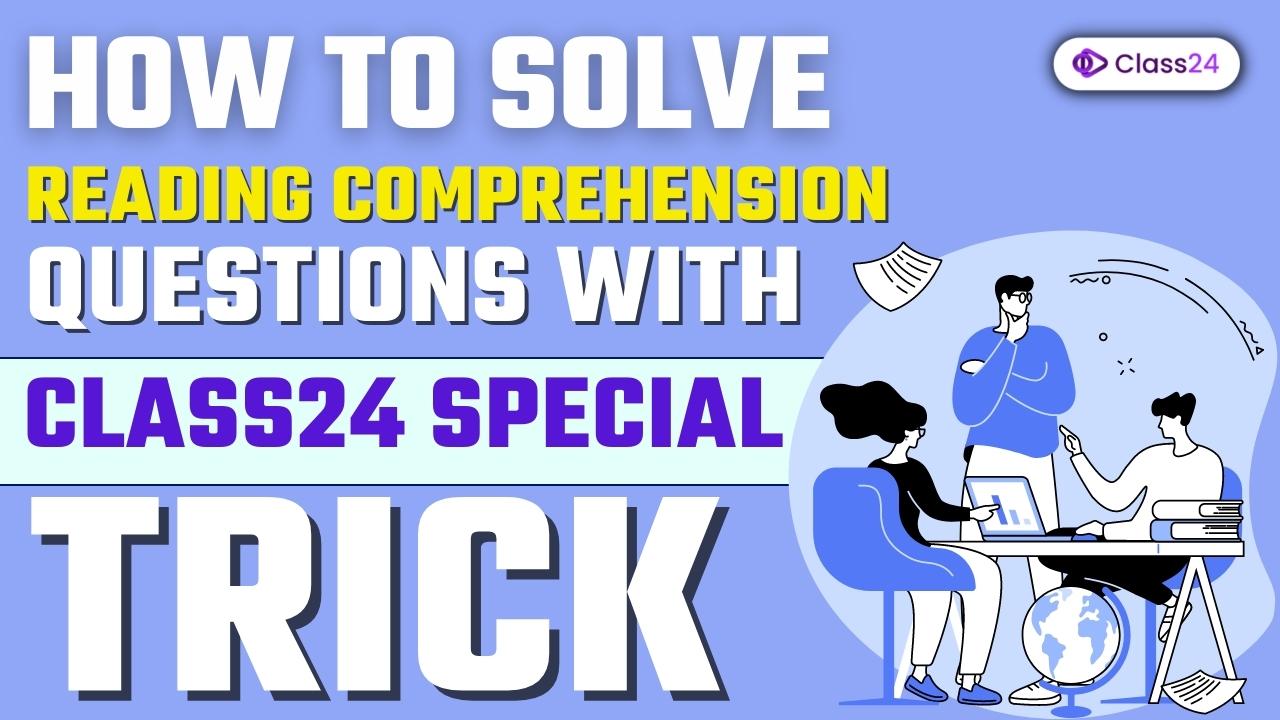
How to solve reading comprehension questions with special trick
Enquire Now
Reading Comprehension is an important part of English sections in many competitive exams. Students are given a passage followed by questions that test their understanding, vocabulary, inference, and ability to identify important information. The challenge is not only reading the passage correctly but also answering questions within limited time.
If you often read the entire passage but still struggle to find the correct answers, changing your approach can help. Instead of trying to remember every sentence, focus on the main idea, keywords, context, and evidence available in the passage. This guide explains how to solve Reading Comprehension questions with practical tricks that can improve both speed and accuracy.
What is Reading Comprehension?
Reading Comprehension is the ability to read a passage, understand its meaning, identify important information, and answer questions based on it. In competitive exams, questions may test the central idea, factual details, vocabulary, inference, tone, or the author's purpose.
A good RC strategy does not require you to memorize the complete passage. You need to understand its structure well enough to know where to look for an answer when you read a question.
Types of Reading Comprehension Questions
Before learning how to solve Reading Comprehension questions, understand the different question types. Identifying the type helps you decide whether to locate a direct fact, interpret context, or understand the passage as a whole.
| Question Type | What You Need to Find | Best Approach |
|---|---|---|
| Factual Questions | Information directly stated in the passage | Locate keywords and reread the relevant lines |
| Main Idea | Central message of the passage | Focus on introduction, conclusion, and repeated ideas |
| Vocabulary | Meaning of a word in context | Read the sentence and surrounding lines |
| Inference | Information suggested but not directly stated | Use evidence from the passage |
| Author's Tone | Writer's attitude toward the topic | Notice word choice and overall writing style |
| Title-Based Questions | Best heading for the passage | Identify the broad central theme |
| True/False Statements | Whether a statement matches the passage | Verify every important part of the statement |
Special Trick to Solve Reading Comprehension Questions
A useful trick is to follow the Question → Keyword → Locate → Verify → Answer method. It reduces unnecessary rereading because you know exactly what information you are searching for inside the passage.
Step 1: Quickly Check the Questions
Before deeply reading a long passage, quickly scan the questions. Do not spend too much time solving them yet. Your purpose is simply to understand what information you may need to find.
For example, if a question asks about the reason behind an event, remember the main keyword related to that event.
Step 2: Identify Keywords in the Question
Pick one or two meaningful words from each question. Names, dates, events, technical terms, places, and uncommon words usually work better than generic words.
For example:
Question: Why did the government introduce the new policy?
Useful keywords can be government, new policy, and introduced.
Now look for these words or related ideas in the passage.
Step 3: Locate the Relevant Part of the Passage
Scan the passage for the keyword or its synonym. Once you find the relevant sentence, do not immediately mark an answer.
Read one or two sentences before and after it because the complete meaning may depend on surrounding information.
Step 4: Verify Before Selecting an Option
This is one of the most important Reading Comprehension tricks. An option may contain the same words as the passage and still be incorrect.
Ask yourself:
- Is the complete statement supported by the passage?
- Has the option changed the meaning?
- Is it making a stronger claim than the author?
- Is it based on my knowledge rather than the passage?
Choose an option only when the passage provides enough evidence for it.
How to Solve Different RC Questions
Different Reading Comprehension questions require different approaches. Using the same trick for every question can lead to mistakes, especially when moving from direct factual questions to inference or vocabulary questions.
Factual Questions
These are usually the easiest because their answers are directly available in the passage.
Use keywords from the question, locate the relevant paragraph, and match the information carefully.
Special trick: Don't rely on memory. Even if you think you remember the answer, verify it from the passage.
Main Idea Questions
The main idea represents what the passage is primarily discussing, not just one interesting detail.
To find it:
- Check the opening paragraph.
- Notice ideas repeated throughout the passage.
- Read the concluding lines carefully.
- Eliminate options that cover only one small part.
A correct main idea should represent most of the passage.
Vocabulary Questions
Do not select a meaning simply because you know the dictionary definition of a word. Competitive exams often test its meaning within the given context.
Replace the word with each possible option and check which one preserves the meaning of the sentence.
Inference-Based Questions
Inference questions require more care because the answer may not be directly written.
The correct inference should logically follow from information given in the passage.
Important: Avoid assumptions based on personal experience or outside knowledge. If the passage does not support the conclusion, do not choose it.
Author's Tone Questions
To identify the author's tone, observe how the writer discusses the subject.
Common tones include:
- Critical
- Optimistic
- Pessimistic
- Neutral
- Analytical
- Concerned
- Appreciative
- Sarcastic
Look at the author's choice of words across the complete passage rather than judging tone from a single sentence.
Reading Comprehension Time Management Strategy
Speed matters in competitive exams, but rushing can reduce accuracy. The objective should be to minimize unnecessary reading while spending enough time verifying answers from the passage.
| Activity | Suggested Approach |
|---|---|
| Question Scan | Quickly identify what information is being asked |
| Passage Reading | Understand the central idea and paragraph structure |
| Direct Questions | Attempt these first when answers are easy to locate |
| Difficult Questions | Return after completing easier questions |
| Final Check | Verify doubtful answers with the passage |
The exact time required depends on the passage length, difficulty, and exam pattern. Therefore, practise under timed conditions instead of following one fixed time limit for every RC.
Common Mistakes While Solving Reading Comprehension
Many incorrect answers occur because students depend on assumptions rather than evidence from the passage. Avoiding a few common habits can significantly improve your Reading Comprehension approach.
- Reading too fast: Speed without understanding forces you to reread the passage.
- Using outside knowledge: Answer according to the passage, even when you know more about the topic.
- Choosing familiar-looking options: Similar wording does not automatically make an option correct.
- Ignoring words such as NOT and EXCEPT: These words can completely reverse the question.
- Spending too long on one question: Skip a difficult question temporarily and return later.
- Overthinking direct questions: If the passage clearly supports an answer, don't create unnecessary interpretations.
- Ignoring context in vocabulary questions: A word can have different meanings depending on how it is used.
How to Improve Reading Comprehension Speed and Accuracy
Reading Comprehension improves through consistent practice rather than shortcuts alone. The goal is to develop the ability to identify the central idea quickly and locate supporting information without repeatedly reading everything.
Try these habits during preparation:
- Read English articles, editorials, and short passages regularly.
- After reading a paragraph, summarize its main idea in one sentence.
- Practise locating keywords and their synonyms.
- Maintain a notebook for unfamiliar vocabulary.
- Solve previous-year Reading Comprehension questions.
- Analyse every incorrect answer instead of only checking the correct option.
- Practise with a timer to understand your average solving speed.
- Gradually include difficult passages from science, economics, history, and social issues.
Best Order to Attempt Reading Comprehension Questions
There is no compulsory order that works for every student. However, attempting questions with clearly identifiable evidence first can save time and build confidence before moving to interpretation-based questions.
A practical order can be:
Factual Questions → Vocabulary Questions → True/False Questions → Inference Questions → Main Idea/Title → Author's Tone
If main-idea questions are easier for you, you can change this sequence. The important point is to develop an approach that gives you the best accuracy under exam conditions.
Quick Reading Comprehension Trick for Competitive Exams
When time is limited, remember this simple formula:
Read Question → Pick Keyword → Locate Information → Read Context → Eliminate Wrong Options → Verify Answer
Suppose the passage says:
Regular exercise may improve concentration and help students maintain a consistent study routine.
And the question asks:
What benefit of exercise is mentioned in the passage?
You should locate exercise, read the complete sentence, and select the option related to improved concentration or maintaining a study routine. Do not select another generally known benefit of exercise unless the passage mentions it.
Conclusion
Learning how to solve Reading Comprehension questions with special trick is mainly about reading strategically rather than reading every line repeatedly. Use the Question → Keyword → Locate → Verify → Answer method to find relevant information quickly and confirm each answer with evidence from the passage.
At the same time, practise different question types such as factual, vocabulary, inference, main idea, and author's tone questions. With regular timed practice and careful analysis of mistakes, students can gradually improve their Reading Comprehension speed, accuracy, and confidence.
- Download Class24 App for Updated Current Affairs, Free Topic-Wise Quizzes, and Free Mini Mocks
- Download Free Study Material Here
Frequently Asked Questions