

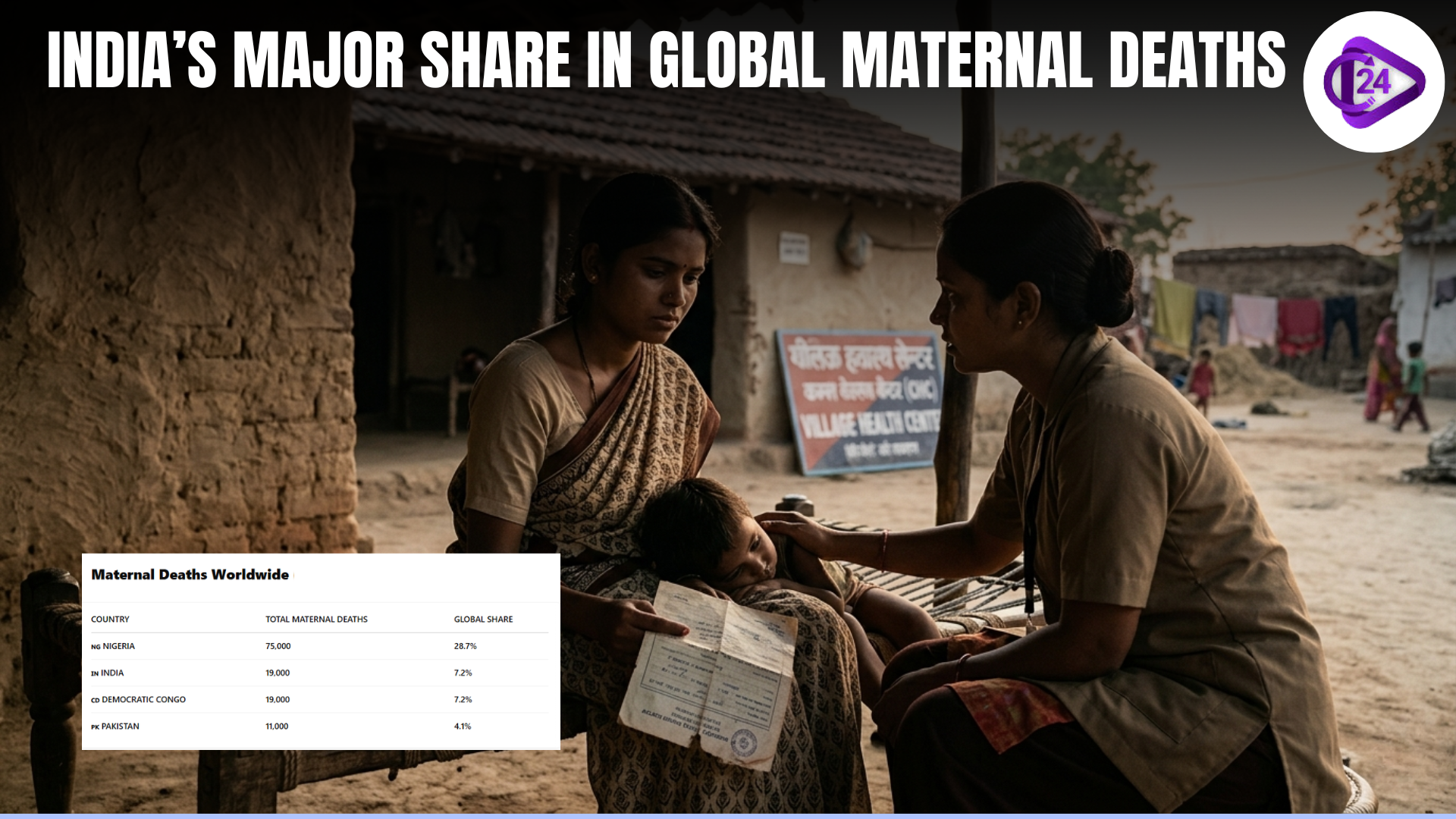
India has a significant proportion of maternal deaths in the world; hence, maternal health is an important priority of public health. According to estimates by international organisations such as the World Health Organisation and UNICEF, the majority of maternal deaths occur in developing countries, such as India. Despite the gradual improvement in the Maternal Mortality Ratio (MMR) in the country, there are several challenges that the country still faces. There is still limited access to quality healthcare, malnutrition, and regional inequalities. Maternal mortality reduction is fundamental to meet the Sustainable Development Goals and provide women in the country with improved health and well-being.
India’s Share in Global Maternal Deaths: Data, Causes & Key Facts
-
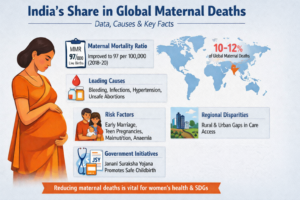
India contributes a notable share (around 10–12%) to total maternal deaths worldwide.
-
Maternal mortality includes deaths caused by pregnancy, childbirth, or complications after delivery.
-
According to the World Health Organisation, nearly 260,000 women die globally each year due to maternal causes.
-
India’s Maternal Mortality Ratio (MMR) has reduced to about 97 per 100,000 live births (2018–20).
-
Recent estimates suggest further improvement to around 80–93 per lakh live births.
-
The country has shown major progress, reducing MMR from 384 in 2000 to nearly 100 by 2020.
-
However, due to its large population, India still records a high absolute number of maternal deaths.
-
Leading causes include severe bleeding, infections, hypertension, and unsafe abortions.
-
There are big regional and rural-urban differences in access to maternal healthcare.
-
Early marriage and teenage pregnancies significantly increase health risks.
-
Widespread issues like anaemia and poor nutrition contribute to maternal mortality.
-
Access to institutional deliveries and prenatal care has improved but remains uneven.
-
Government initiatives such as Janani Suraksha Yojana (JSY) aim to promote safe childbirth.
-
India aims to reduce the MMR to below 70 per 100,000 live births by 2030, in line with SDG targets.
-
Continued focus on health infrastructure, awareness, and skilled care is necessary for further improvement.
Important Schemes for Maternity
| Scheme Name | Launched By | Year | Key Objective | Key Benefits |
|---|---|---|---|---|
| Janani Suraksha Yojana (JSY) | Government of India | 2005 | Reduce maternal and neonatal mortality | Cash incentives for institutional delivery |
| Pradhan Mantri Matru Vandana Yojana (PMMVY) | Government of India | 2017 | Provide financial support to pregnant women | ₹5,000 cash benefit for first child |
| Janani Shishu Suraksha Karyakram (JSSK) | Government of India | 2011 | Ensure free maternal & child healthcare | Free delivery, medicines, diagnostics, transport |
| POSHAN Abhiyaan | Government of India | 2018 | Improve the nutritional status of women & children | Focus on reducing anaemia and malnutrition |
| LaQshya Programme | Ministry of Health & Family Welfare | 2017 | Improve the quality of care in labour rooms | Better facilities and trained staff |
| Indira Gandhi Matritva Sahyog Yojana | Government of India | 2010 | Support pregnant & lactating women | Conditional cash transfer scheme |
| SUMAN Scheme | Government of India | 2019 | Assured dignified maternal care | Free and respectful maternity services |
| Anaemia Mukt Bharat | Government of India | 2018 | Reduce anaemia among women & children | Iron supplementation & awareness |
Krishi Sakhi Initiative Launched
Conclusion – India’s Role in the Global Maternal Death Crisis
India is a key player in the solution to the global maternal death crisis, as it has a considerable proportion of the total cases. Although gradual gains have been recorded due to the government’s efforts and the provision of better healthcare facilities, some problems such as inequality within a specific region and insufficient access, still exist. The initiatives that are consistent with the objectives that the World Health Organisation has are necessary to continue supporting the reduction of maternal death and guarantee safe childbirth in the entire country.