

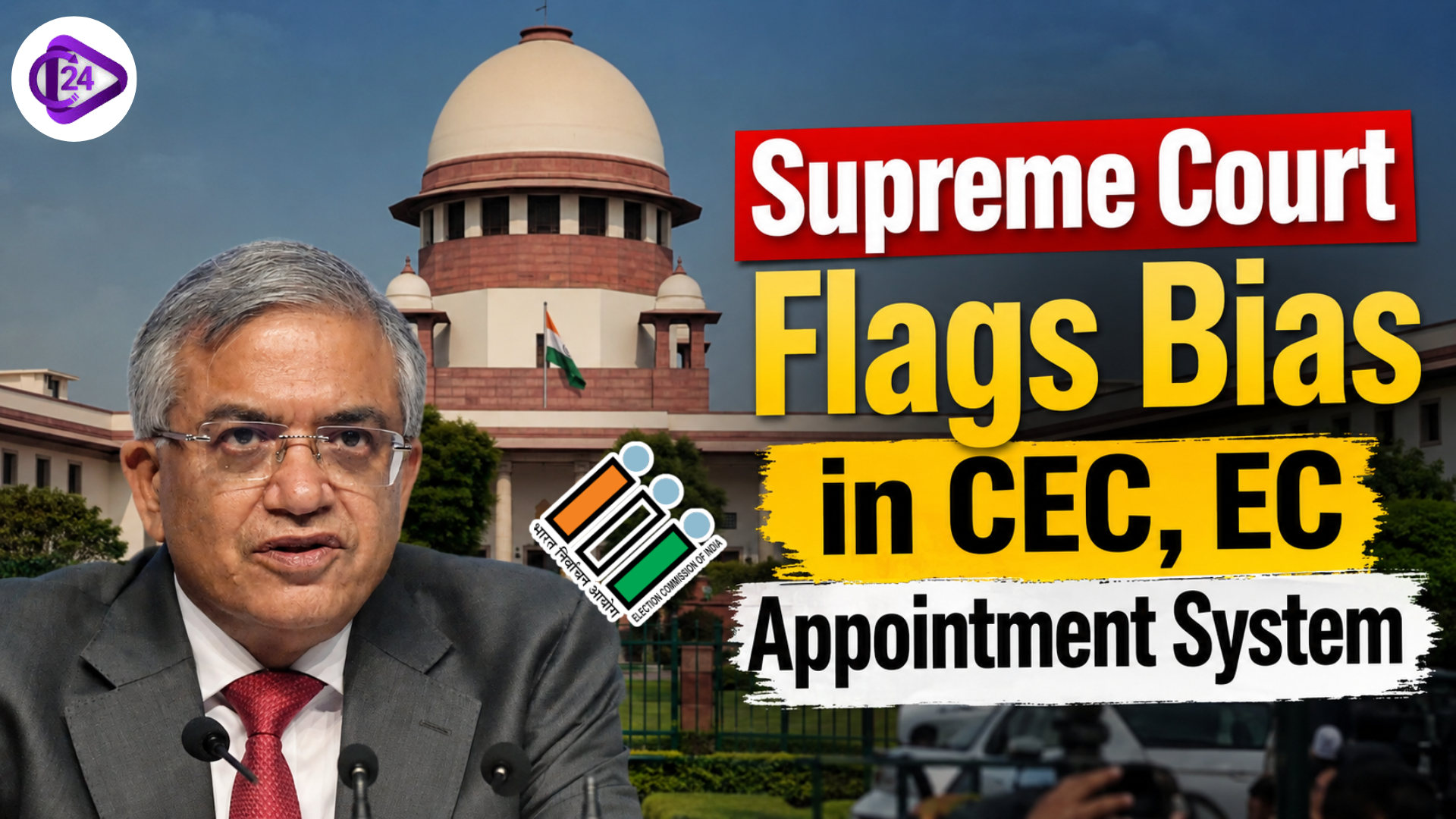
The Chief Election Commissioner (CEC) and Election Commissioners (ECs) of the Election Commission of India have been highlighted as possible candidates in the bias complaints journey by the Supreme Court of India recently expressing concerns over the process by which the Chief Election Commissioner and Election Commissioner are appointed with the Union Government has a majority stake in this process. In court proceedings on the petitions challenging the 2023 appointment law, the Court had also raised doubts about the exclusion of the Chief Justice of the India of the panel from selection, as it could create a situation of compromise to the institution. In response to this, petitioners noted that the majority in the panel given to the executive will dilute the spirit of independence of the elections. The Centre contended that the law was constitutional as Parliament had the constitutional power to frame appointment procedures under Article 324(2) of the Constitution.
Supreme Court Questions Independence in CEC and EC Appointment Process
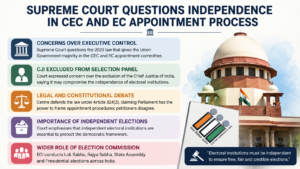
- The issue of appointment of Election Commissioners by the executive has been a concern in the Supreme Court of India.
- The problem is with the Amendment to the Chief Election Commissioner and Other Election Commissioners (Appointment, Conditions of Service and Term of Office) Act, 2023.
- The new legislation adds the Prime Minister, a Union Cabinet Minister and the Lok Sabha’s leader of opposition to the committee.
- Previously, in 2023, the Supreme Court of India had issued a mandate to obtain the Chief Justice of India (CJI) to have the CJI join the selection committee till the Parliament passes a law.
- Petitioners say that the CJI’s removal leave the government a “free hand” in appointments.
- The Court noted that electoral institutions should be independent in order to guarantee the democratic system.
- The Indian National Leadership gives the President the authority to appoint Election Commissioners in line with Article 324 of the Constitution.
- Parliament may legislate so as to determine the procedures for appointment, under Article 324(2).
- The Centre contended that the lawmaking power of Parliament as conferred by the Constitution can not be challenged based on a ‘policy’ consideration.
- The election commission conducts Lok Sabha, Rajya sabha, State Assembly and the Presidential elections.
- The Court asked questions about the structure of the selection committees and if there are adequate checks and balances in place.
- Petitioners emphasised on the need for neutrality and transparency in constitutional appointments.
- The government argued that the law would ensure democratic and accountable process.
- The hearing highlighted a potential threat to the credibility of free and fair elections by the interference of executive control.
- Legal experts feel that the judgment could have implications for upcoming reforms in the electoral process in India.
- The Court has not ruled on the legality of the law and more hearings are scheduled.
PYQs on Election Commission and Constitutional Bodies
| Exam Name & Year | Question | Options | Correct Answer |
| UPSC Prelims 2017 | Article 324 of the Constitution is related to which institution? | A) UPSC B) Finance Commission C) Election Commission D) CAG | C) Election Commission |
| SSC CGL 2022 | Who appoints the Chief Election Commissioner of India? | A) Prime Minister B) Parliament C) President D) Supreme Court | C) President |
| UPSC Prelims 2020 | Which constitutional body conducts elections in India? | A) NITI Aayog B) Election Commission C) UPSC D) Law Commission | B) Election Commission |
| CDS Exam 2021 | Which Article deals with superintendence of elections in India? | A) Article 32 B) Article 280 C) Article 324 D) Article 356 | C) Article 324 |
| State PCS 2023 | The Election Commission of India is a: | A) Statutory Body B) Constitutional Body C) Judicial Body D) Executive Agency | B) Constitutional Body |
India Gets Its First Alzheimer’s Therapy
Conclusion – CEC, EC
The Chief Election Commissioner and Election Commissioners are subject of a controversial appointment, it is crucial that they remain independent. The Supreme Court of India has reiterated that “neutrality and autonomy” of the Election Commission of India is key to the public trust in the electoral process. Although the government claims that Parliament has no constitutional restrictions on its power to draw up the appointment rules, critics say that if the process gives too much of an edge to the executive it would tear away the democratic checks and balances. The judgment of the Court might help define the contours of constitutional appointments in the future, and help to bolster debate on electoral reforms, transparency and democratic accountability in India.