

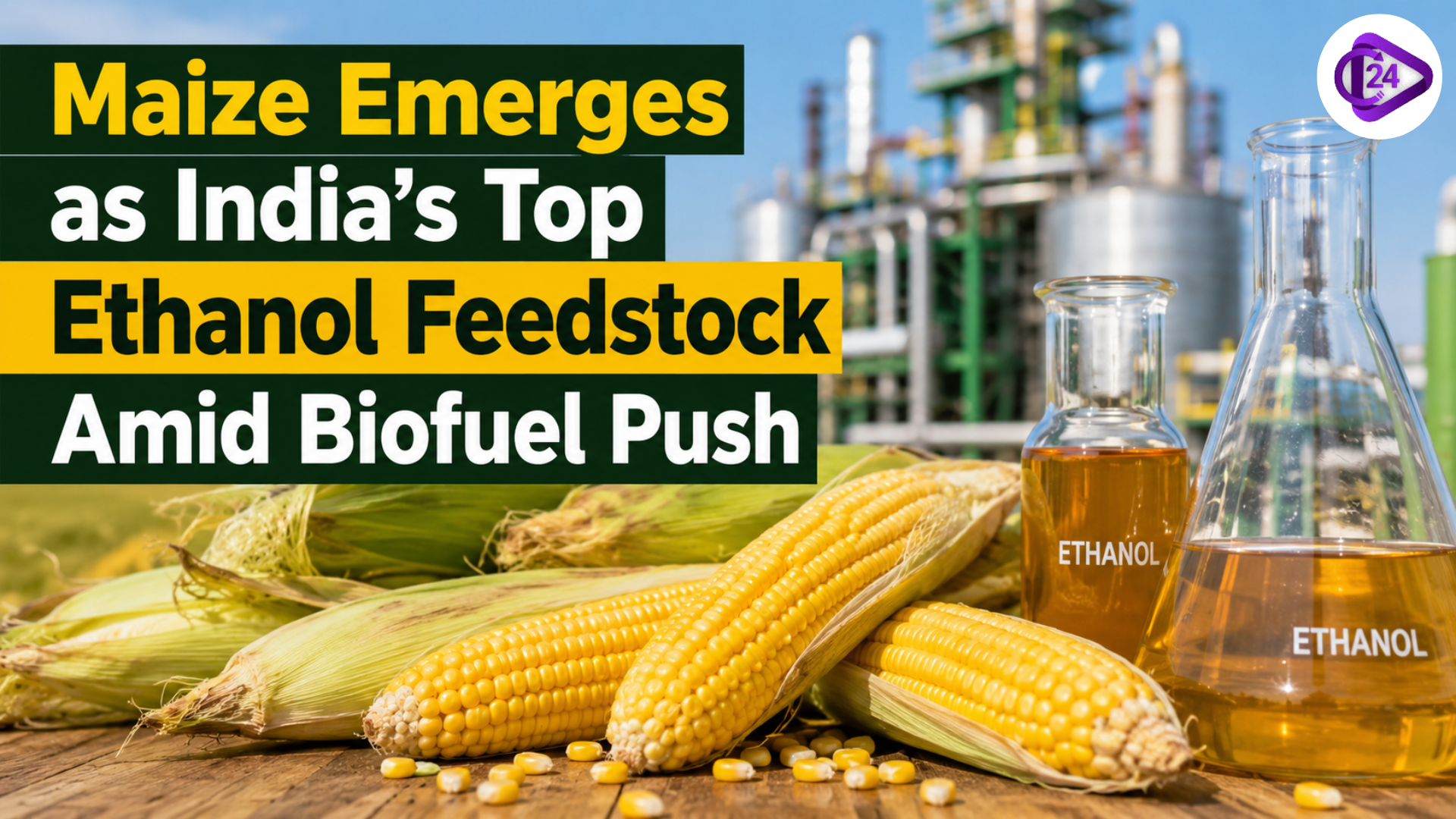
Maize has become the top source of ethanol for the country and India’s ethanol blending programme has seen a total transformation. The usual raw materials for ethanol production have been sugar cane and molasses. Maize consumption has picked up since ethanol demand for energy has increased, however, and concerns about sugar sugar surpluses have also boosted usage, as have government subsidies for grain-based ethanol distillers. Maize is now playing a pivotal role in ethanol production in the country through the Ethanol Blended Petrol (EBP) Programme, government data shows. In this move, India’s intent to cut imports of crude oil and move towards energy security is supported. Maize-based ethanol, experts believe, will not only bolster the biofuel industry, but also offer new opportunities for farmers and the agriculture industry.
Why Maize Is Becoming India’s Preferred Ethanol Feedstock
- Maize is emerging as one of the biggest sources for ethanol in India.
- The Ethanol Blended Petrol (EBP) Programme is a campaign to encourage the use of ethanol-petrol mixtures as a means to cut fossil fuel consumption.
- India will boost ethanol blending to cut carbon emissions and crude oil imports.
- In earlier times, sugarcane molasses was the predominant feedstock of ethanol production.
- Weather threats and the increasing demand for sugar prompted a shift into ethanol made from grains.
- Maize production for ethanol production has been encouraged with suitable policy interventions by the Government of India.
- Distilleries of this type have been rapidly growing in the last few years in multiple states utilizing grain.
- Maize is considered suitable due to its high starch content to be efficiently converted to ethanol.
- Production of ethanol using maize is an extra market for farmers.
- If maize demand rises, that will improve the income of the farmers in the major producing States.
- Karnataka, Bihar, Madhya Pradesh and Maharashtra are significant maize producing states.
- Ethanol blending is a means to reduce greenhouse gas emissions from vehicles.
- Alternative to fossil fuels – biofuels are thought to be cleaner options.
- India was able to reach almost 20% ethanol blending much before its earlier target year.
- The National Policy on Biofuels encourages the utilization of agriculture products in producing biofuels.
- Ethanol made from maize can play a role in regaining price stability for grain in the years when there is a surplus.
- In addition to ethanol production, by-products are produced in animal feed industries as well.
- It is not a premium to food security, experts warn, to balance fuel production and food security.
- Indian efforts on expansion of biofuels are in sync with global efforts for sustainable energy transition.
- Major investments in agriculture and renewable energy industries are expected to be seen in the ethanol sector.
Ethanol & Biofuel PYQs for Competitive Exams
| Exam Name | Year | Question | Options | Answer |
| UPSC Prelims | 2022 | The Ethanol Blended Petrol Programme is mainly related to: | (A) Food Security (B) Renewable Fuel (C) Water Conservation (D) Tourism | (B) Renewable Fuel |
| SSC CGL | 2021 | Ethanol is commonly blended with which fuel in India? | (A) Diesel (B) Petrol (C) LPG (D) CNG | (B) Petrol |
| RRB NTPC | 2020 | Which crop is increasingly used for ethanol production in India? | (A) Cotton (B) Wheat (C) Maize (D) Tea | (C) Maize |
| State PCS | 2023 | The National Policy on Biofuels aims to reduce dependence on: | (A) Imports of crude oil (B) Gold imports (C) Textile exports (D) Tourism revenue | (A) Imports of crude oil |
| SSC CHSL | 2022 | Ethanol blending helps reduce: | (A) Air pollution (B) Soil fertility (C) Rainfall (D) Population | (A) Air pollution |
| NABARD Grade A | 2021 | Which of the following is a biofuel crop? | (A) Maize (B) Rubber (C) Tea (D) Coffee | (A) Maize |
Conclusion: Maize Strengthens India’s Renewable Energy Mission
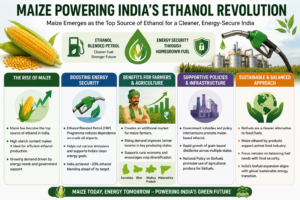
As India starts to change how it uses renewable energy sources, it is moving from being dependent on sugarcane towards maize as its main feedstock for ethanol. Adopting maize-based ethanol can help India to cut its crude oil dependence, carbon emissions, and improve the country’s energy security. The transition also brings agricultural benefits to farmers and farmers’ enterprises. As fuel production grows, however, policy makers need to ensure that a balance exists between food security and fuel production. Maize is projected to be a key player in India’s clean energy future and return of the nation’s long-term success of the Ethanol Blended Petrol Programme, in the years to come, with an increasingly supportive government and growing biofuel infrastructure.