

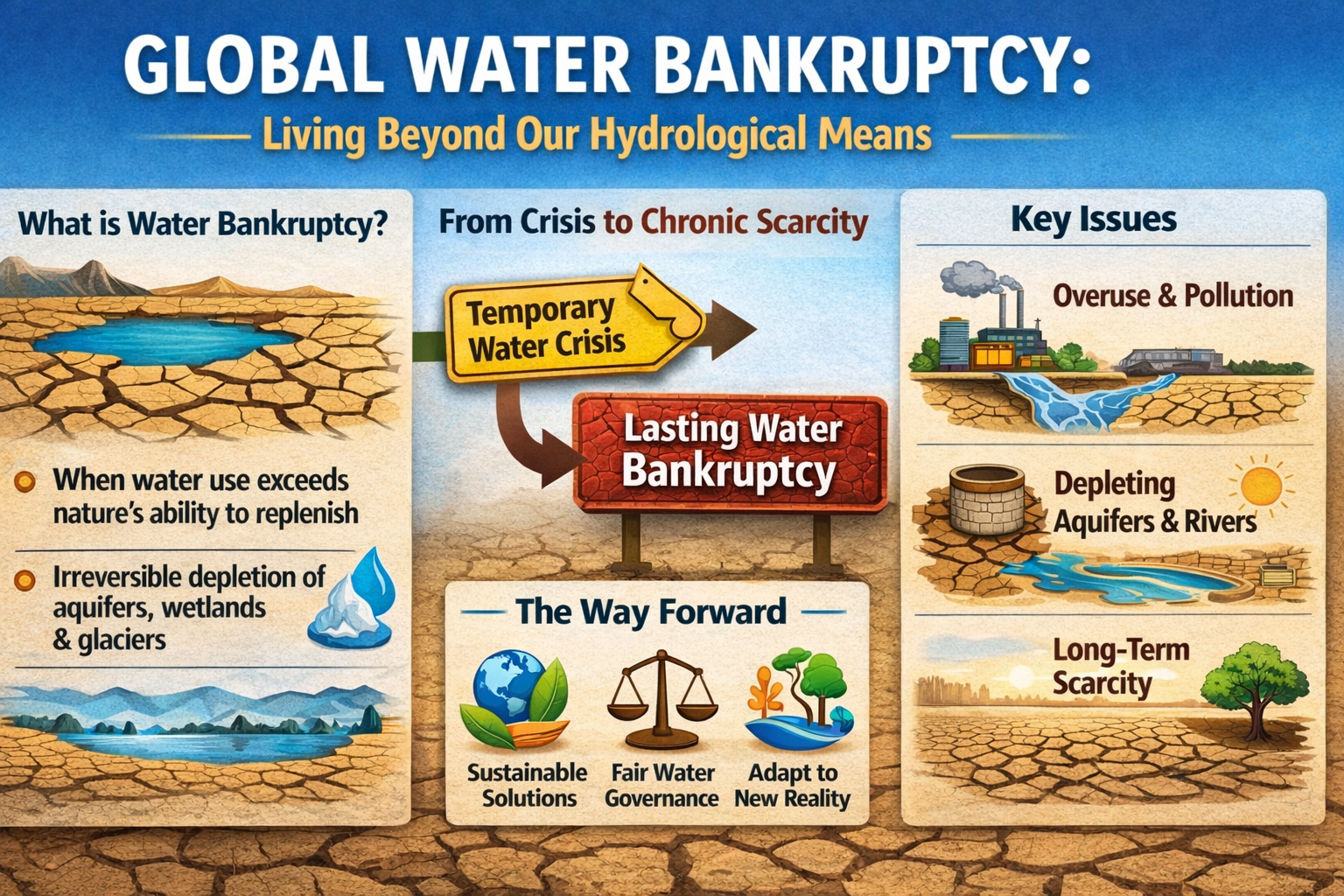
The Global Water Bankruptcy Report- Global Water Bankruptcy: Living Beyond Our Hydrological Means in the Post-Crisis Era, is a landmark study by the United Nations University, which states that most of the world's freshwater systems have passed a new boundary between a temporary crisis and a lasting water bankruptcy. This happens when societies consume more water than nature replenishes, and important sources such as aquifers, wetlands, and glaciers are drained to the extent that they can never be replenished. The report cautions against relying on old models of water crisis, but recommends a systemic overhaul of the world water governance system, with sustainability and fairness at the core, and adaptation to a new long-term reality of scarcity.
Global Water Bankruptcy: Living Beyond Our Hydrological Means
-
The concept of water bankruptcy is defined as a situation lasting a long time, when the power of consumption and pollution of water surpasses the powers of the nature to restore and renew the freshwater systems and results into irreversible or highly expensive losses of the systems.
-
The concept signifies the change of discussing water scarcity as a short-term emergency to a chronic condition of hydrologic overshoot.
-
Most of the areas are depleting groundwater and surface water at rapid rates compared to recharge and permanently lowering the amount of water.
-
The water storage systems in nature, like aquifers, glaciers, wetlands, rivers and soil moisture, are being destroyed or compromised.
-
Climate change increases water bankruptcy in the form of rising temperatures, changing rain patterns, glaciers melting and increased droughts.
-
Land degradation, deforestation and urban sprawl further decrease the capacity of the landscape to store and control water.
-
Water pollution worsens scarcity by making the available water resources unfriendly or unusable by the ecosystems and human purposes.
-
Excessive water demand is largely caused by agriculture, energy production and urban development.
-
Water bankruptcy endangers the food security, economic stability, human health and the resilience of the ecosystem across the globe.
-
Weak and poor populations are also overly burdened by the reduced availability and quality of water.
-
The conventional methods of water management, which primarily aimed at the expansion of short-term supply, are no longer adequate.
-
The report recommends the need to reset the world water governance model, with the primary focus being on sustainability rather than extraction.
-
The accents are made on the demand of the water, the restoration of the ecosystems, and the safeguarding of the natural water capital.
-
The principles of equity, resilience, and adaptation are identified as the key guidelines of living within the hydrological boundaries of a post-crisis period.
Conclusion
Water bankruptcy is a common phenomenon in which freshwater resources are overused and degraded at a rate that nature is unable to restore them. It is the transition to a new stage of water crises, which are long-term and based on the shortage of groundwater and the drying of rivers and glaciers, as well as the effects of climate change. There is an urgent need for sustainable and equitable management of water.