

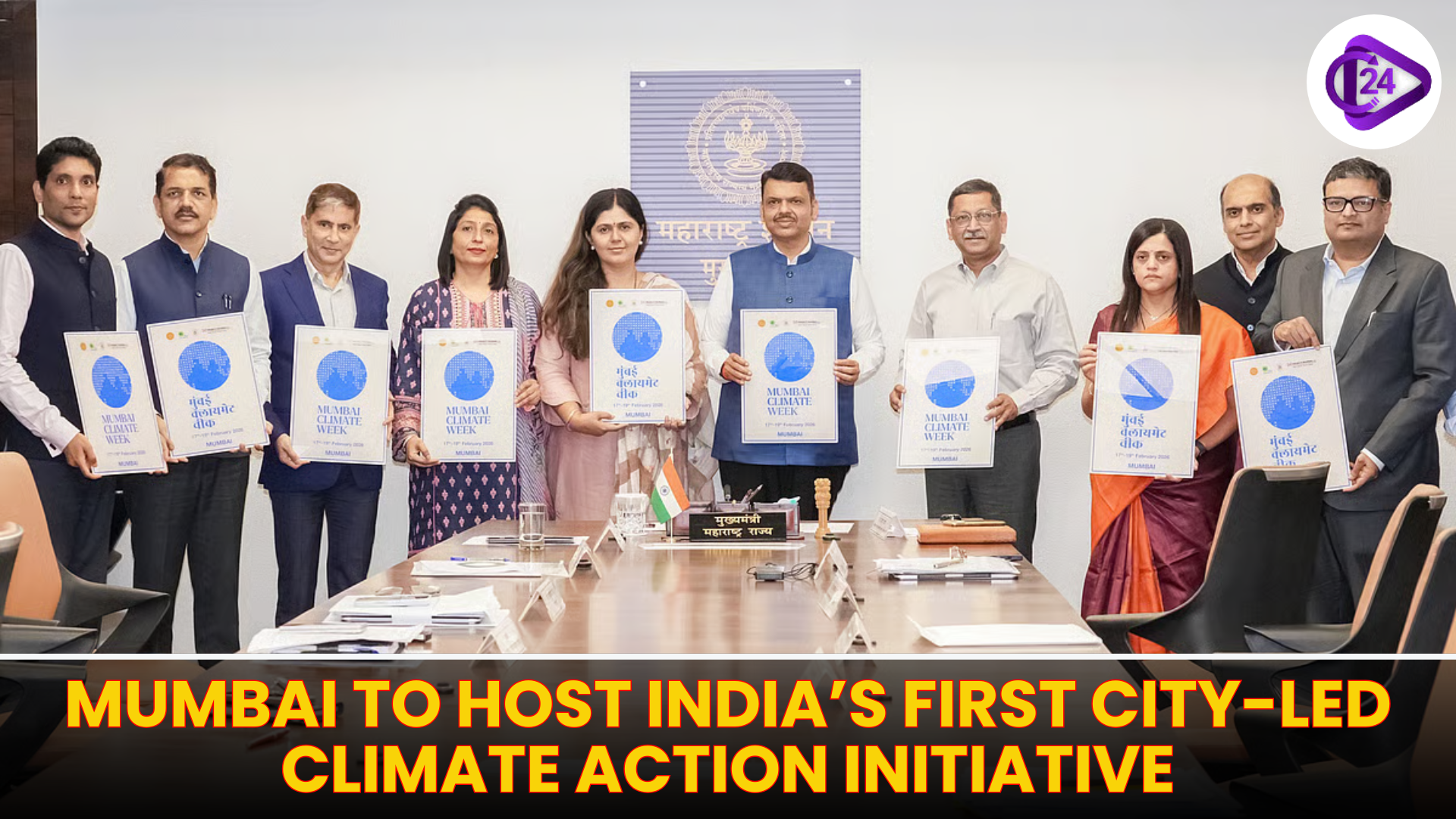
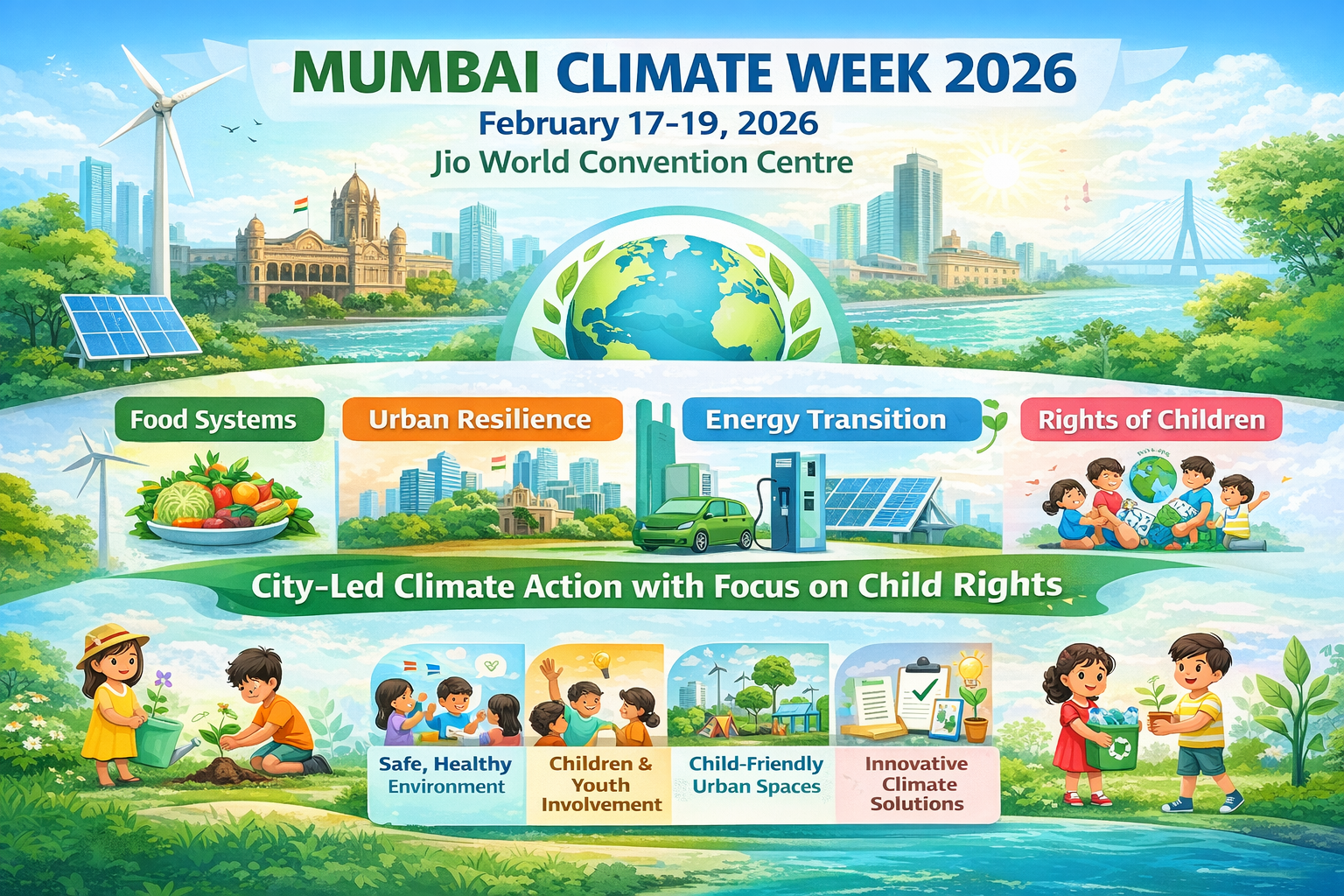
The first city-led program in the history of the country to exhibit climate action, Mumbai Climate Week 2026, will be hosted in the city, between 1719 February 2026, in the Jio World Convention Centre. The programme was conceived in collaboration with the Maharashtra government's Environment and Climate Change Department and in partnership with Project Mumbai. With the support of the Brihanmumbai Municipal Corporation, the global climate leaders, policymakers, citizens, innovators, and youth will come together and jointly develop solutions to the global climate issues with specific attention to food systems, urban resilience, and energy transition. It seeks to make Mumbai and India urban climate governance and action leaders in the global south.
City-Led Climate Action with a Focus on Child Rights
-
City-led climate action acknowledges the fact that children are among the most susceptible to climate risks, including heatwaves, floods, air pollution, and water shortage.
-
The policies of urban climate are developed to consider the right of children to a healthy, educational, nutritious, and safe environment.
-
Cities are venturing into child-friendly cities, which entail green spaces, secure movements, and robust schools.
-
The initiatives of climate promote active involvement of children and youth in the city-level decision-making.
-
A child lens right ensures equity, inclusion, and intergenerational justice in local climate action.
-
These strategies can enhance the resilience of the city in the long-term and preserve the future of the next generation.
Asked PYQs on Climate Action
| Exam | Year | Question (Greenhouse Gases / Related) | Answer |
|---|---|---|---|
| UPSC CSE Prelims | 2020 | Which of the following gases contributes the most to the greenhouse effect? (MCQ) | Carbon dioxide (CO₂) is the most significant contributor. |
| UPSC CSE Prelims | 2021 | Which gas has the highest global warming potential (GWP)? (MCQ) | Nitrous oxide (N₂O) has the highest GWP compared to CO₂ and CH₄. |
| UPSC CSE Prelims | 2021 | Which of the following is a major contributor to global warming? (MCQ) | Carbon dioxide (CO₂) is a major greenhouse gas contributing to global warming. |
| UPSC CSE Mains | 2019 | Evaluate the impact of increased greenhouse gas emissions on the Indian subcontinent. (Descriptive) | Increased GHG emissions cause erratic weather, heatwaves, floods, droughts, and affect agriculture, water resources, and public health. |
| UPSC CSE Mains | 2018 | Discuss the impact of increased carbon dioxide concentrations on global climate patterns and biodiversity. (Descriptive) | Elevated CO₂ alters climate patterns, melts ice, raises sea levels, and disrupts ecosystems; mitigation requires renewables and emission control. |
| UP Police Constable Re-Exam | 2024 | What is a greenhouse gas? (MCQ) | A gas that absorbs and emits infrared radiation in the atmosphere. |
| RRB NTPC (CBT-I) | 2016 (Mar 29) | Gases causing the greenhouse effect include water vapour, CO₂, CH₄, N₂O, and ozone — identify them. | Water vapour, CO₂, CH₄, N₂O, Ozone |
| SSC CGL Tier-I | 2016 (Sept 4) | Besides CO₂, the other greenhouse gas is (a) CH₄ (b) N₂ (c) Ar (d) O₂ | (a) CH₄ (Methane) |
| RRB NTPC (Mock/Official) | Various Shifts | Which among the following cannot be included among greenhouse gases? (a) N₂O (b) CO₂ (c) CH₄ (d) Phosphine | (d) Phosphine |
| RRB NTPC (CBT-I) | 2016 (Apr) | Greenhouse gases allow short-wavelength solar radiation to enter but absorb long-wavelength radiation — what does this imply? | Greenhouse gases absorb long-wave infrared radiation from Earth. |
Conclusion (Mumbai To Host India's First City-Led Climate Action)
Mumbai's city action plan on climate is a historic move of urban leadership on climate action. The city can show the way cities can respond to climate change locally but with a global contribution by prioritising sustainable solutions, revitalisation, and citizen participation. This project is a precedent for other cities in India.