
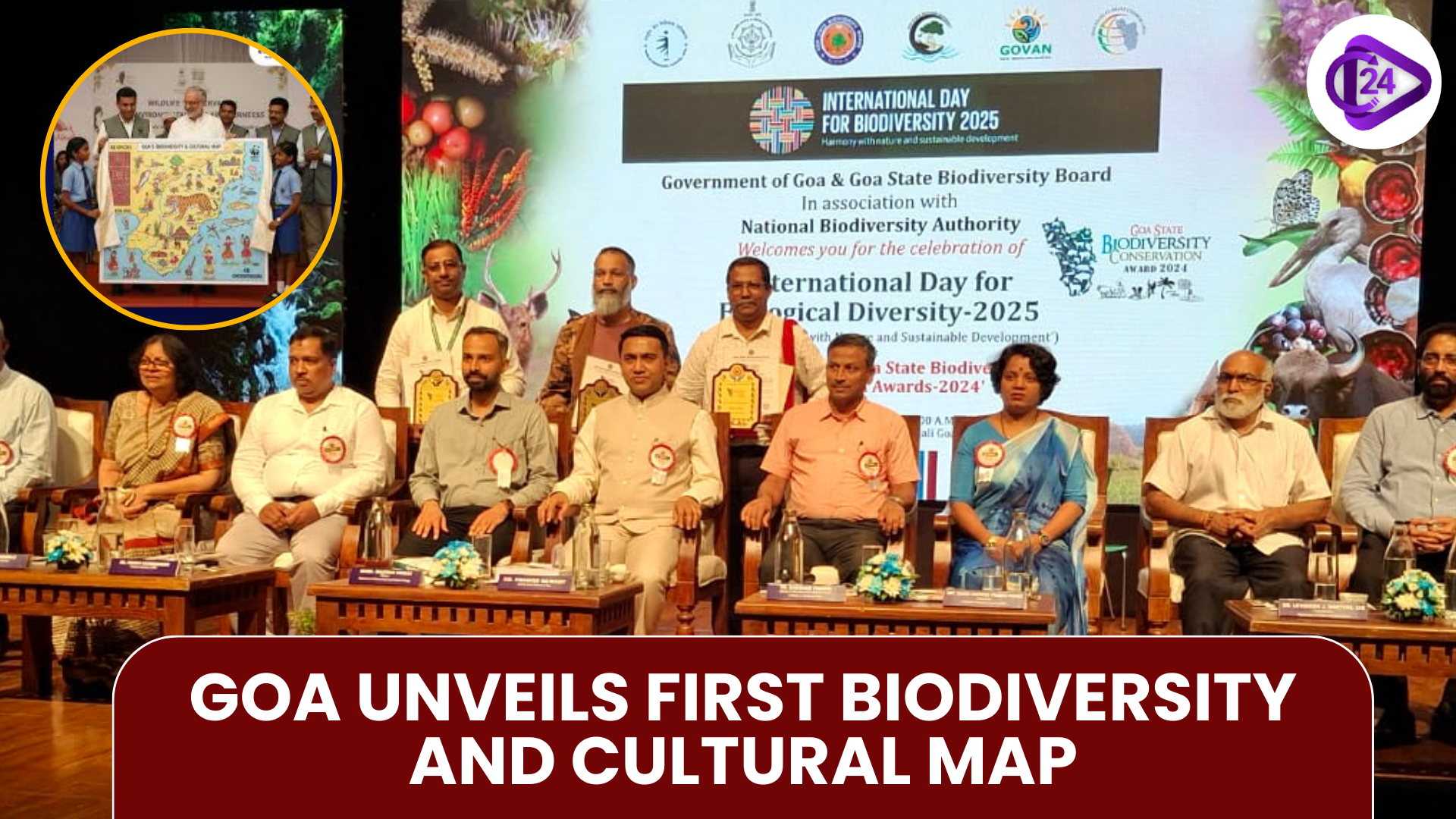
The first biodiversity and cultural map has officially been released in Goa, which was done through the support of WWF India. The new visual guide points out 48 species that are commonly distributed throughout the state, including catfish and mangroves as well as tigers and local birds, and matches them with the elements of the traditional Goan culture, such as Kaavi art. The map will be kid-friendly and distributed to the schools both electronically and physically as part of a larger initiative of reinforcing the environmental consciousness and relating the young learners to the natural and cultural heritage of the region.
Goa’s 1st biodiversity map on 48 species
-
Goa has also introduced the first biodiversity and cultural map in the state, which was created with the help of WWF-India.
-
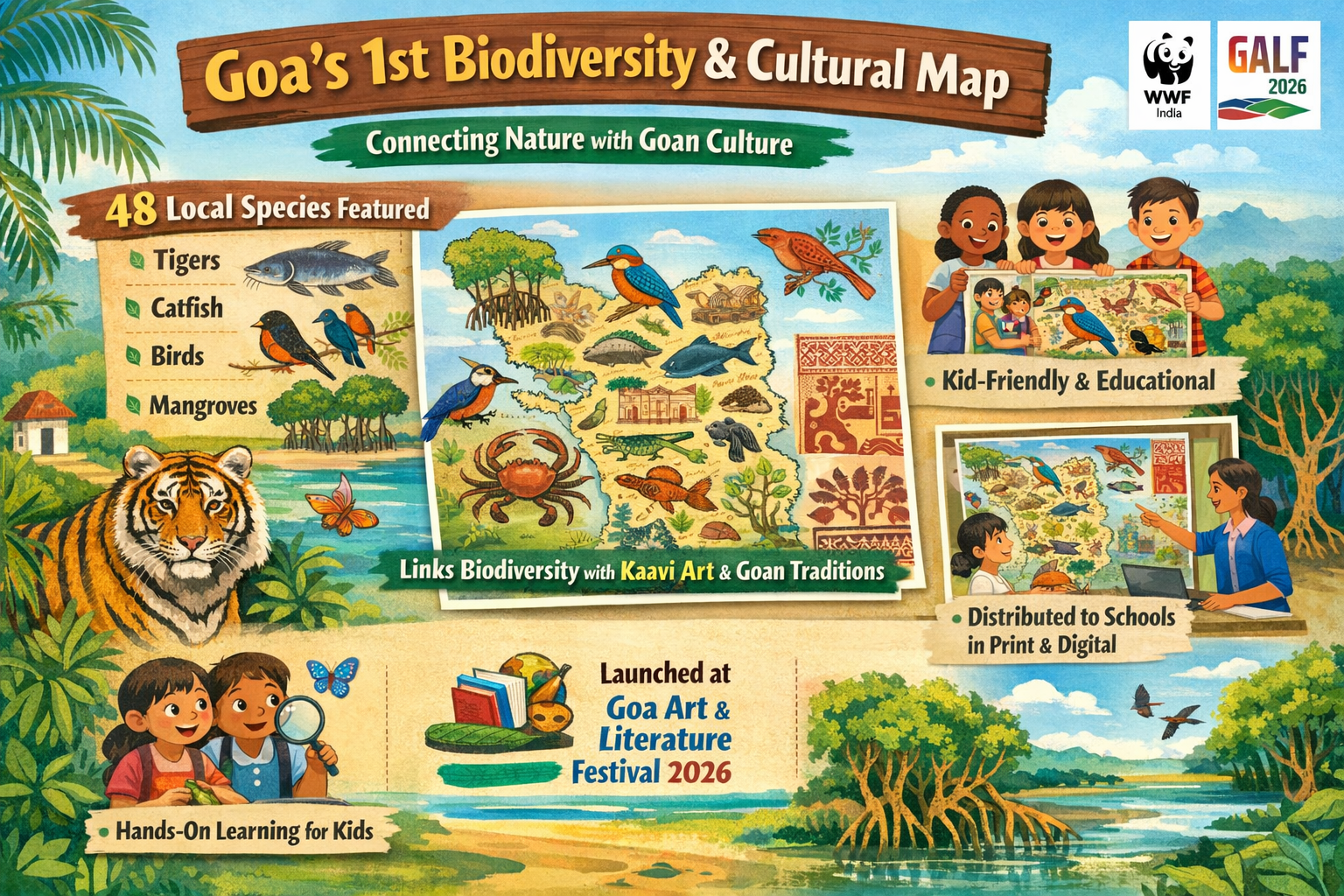
The map includes 48 of the most frequent local species, including aquatic life, like catfish; mammal species, like tigers; several species of birds; insects; and mangrove species.
-
It links biodiversity to the Goan cultural heritage, including elements of Kaavi art.
-
The map is also kid-friendly, and this aspect will motivate children to be environmentally conscious and observe.
-
It was announced at the Goa Art and Literature Festival (GALF) 2026.
-
The copies will be distributed to Goan schools in print and electronic copies.
-
They are also offering large wall-sized versions to government and aided schools at no cost.
-
The chosen species are those that children are supposed to see in their natural environments.
-
The programme will be used to awaken interest and encourage a hands-on learning experience in classrooms.
-
It is also through the engagement of the teachers that WWF-India is assisting in making the map part of the environmental education initiatives.
PYQs on Biodiversity and Cultural
| Exam | Year | Question | Options | Answer |
|---|---|---|---|---|
| SSC CGL | 2022 | The conservation of species outside their natural habitat is known as | (A) In-situ conservation (B) Ex-situ conservation (C) Biosphere reserve (D) Wildlife corridor |
(B) Ex-situ conservation |
| SSC CHSL | 2021 | The Red Data Book contains information about: | (A) Medicinal plants (B) Endangered species (C) Forest cover (D) Polluted rivers |
(B) Endangered species |
| SSC CGL | 2020 | Which of the following is an example of in situ conservation? | (A) Zoo (B) Botanical garden (C) National park (D) Seed bank |
(C) National park |
| Railway NTPC | 2021 | Lichens are considered good indicators of: | (A) Water pollution (B) Soil fertility (C) Air pollution (D) Noise pollution |
(C) Air pollution |
| Railway Group D | 2019 | The term “ecosystem” was first used by: | (A) Charles Darwin (B) A.G. Tansley (C) Mendel (D) Odum |
(B) A.G. Tansley |
| RRB JE | 2022 | Jim Corbett National Park is located in: | (A) Rajasthan (B) Madhya Pradesh (C) Uttarakhand (D) Assam |
(C) Uttarakhand |
| SSC CPO | 2018 | Biodiversity hotspots are regions with: | (A) Low species diversity (B) High endemic species and high threat (C) Desert vegetation (D) High rainfall only |
(B) High endemic species and high threat |
| Railway NTPC | 2020 | Which of the following is a biodiversity hotspot in India? | (A) Western Ghats (B) Thar Desert (C) Indo-Gangetic Plain (D) Deccan Plateau |
(A) Western Ghats |
Biodiversity in India, Listed in UNESCO Sites
| Name of Site | Location | Importance (Biodiversity Significance) | Year Listed by UNESCO |
|---|---|---|---|
| Kaziranga National Park | Assam | Home to the world’s largest population of one-horned rhinoceros; rich grassland ecosystem with tigers and elephants | 1985 |
| Manas Wildlife Sanctuary | Assam | Habitat of rare species like the golden langur and the pygmy hog, located in the Himalayan foothills | 1985 |
| Keoladeo National Park | Rajasthan | Important wetland and bird sanctuary; major migratory bird habitat | 1985 |
| Sundarbans National Park | West Bengal | Largest mangrove forest in the world; habitat of the Royal Bengal Tiger | 1987 |
| Nanda Devi and Valley of Flowers National Parks | Uttarakhand | Alpine meadows with endemic Himalayan flora and fauna | 1988 (extended 2005) |
| Western Ghats | Maharashtra, Karnataka, Kerala, Tamil Nadu | One of the world’s biodiversity hotspots with high endemic species | 2012 |
| Great Himalayan National Park | Himachal Pradesh | Rich alpine biodiversity; habitat of the snow leopard and Himalayan species | 2014 |
Conclusion
The initial Biodiversity and Culture Map of Goa is a significant move towards ensuring that people, particularly the students, are linked with the natural resources and culture of the state. The act of highlighting 48 local species together with traditional forms of art brings about awareness, pride, and responsibility, which reinforce environmental education and long-term conservation due to community involvement.