


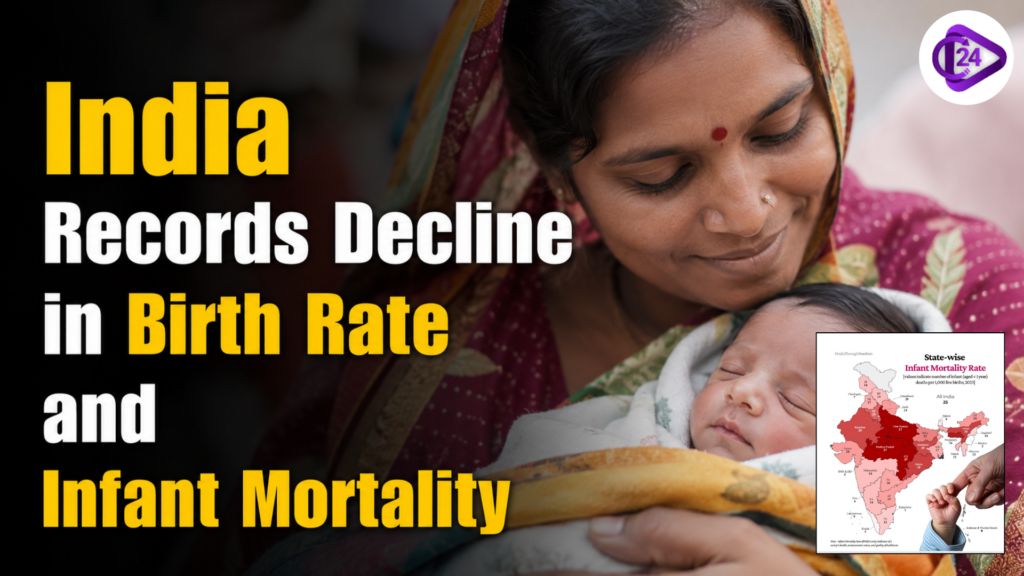
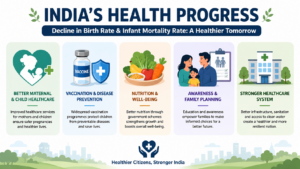
Maternal care, healthcare and improvements in vaccination coverage, nutrition and awareness programmes have contributed to dramatic reductions in the birth rate and infant mortality rate in India. The Registrar General of India, in its latest Sample Registration System (SRS) Statistical Report released by the Ministry of Home Affairs, shows that the birth rate and infant mortality indicators of a country have improved over the last few years. The report points out India’s achievements in the public health and demographic transitions. High infant mortality rates suggest that either the health care for children is substandard or institutional delivery is not being fostered. Reduction in birth rate is attributed to better education, awareness of family planning, and urbanisation. These trends are seen as significant ones that are shaping socio-economic development and healthcare advancement in the country.
Birth Rate and Infant Death Rate Decline in India: Key Highlights
- There has been a continuous downward trend in the birth rate over the years in India.
- The data was published by the Registrar General of India under the Sample Registration System (SRS) Statistical Report.
- The rate of birth is the number of live births in a year per 1,000 people.
- Infant Mortality Rate (IMR) is the number of deaths that occur among infants under 1 year of age per 1,000 live births.
- There has been a significant decrease in India’s Infant Mortality Rate as well because of better health care facilities.
- Improved maternal and child health care services led to reduced infant mortality rates.
- Extending vaccination programmes improved the situation in terms of reducing instances of preventable disease among children.
- Government health promotion policies led to a rise in institutional deliveries.
- The maternal and child nutrition in the context of schemes (Janani Suraksha Yojana and POSHAN Abhiyaan) was enhanced.
- Family planning knowledge helped to reduce birth rates.
- Other factors related to urbanisation and education affected the demography. Other related factors due to urbanisation and a higher rate of literacy in women also affected the demography.
- A more highly developed healthcare system was found to be associated with a lower infant mortality rate.
- The infant mortality rate remained one of the lowest in Kerala, India.
- Rural areas continue to have a higher-than-average infant mortality rate compared to urban areas.
- The slowdown in the birth rate is attributed to a phenomenon that India is experiencing as a part of the demographic transition, characterised by a reduction in the size of their families.
- Reducing the incidence of IMR is regarded as an important indicator of progress in healthcare by public health experts.
- Low infant mortality rates lead to increased life expectancy and improved human development outcomes.
- The programmes working in the framework of the National Health Mission made it easier to access healthcare.
- Good results were also noted with respect to improvements in sanitation, access to safe drinking water and nutrition programmes.
- The demographic indicators play a significant role in policy formation, healthcare handling, and economic development in India.
PYQs on Birth Rate and Infant Mortality
| Exam Name | Year | Question | Options | Correct Answer |
| UPSC Prelims | 2023 | Infant Mortality Rate (IMR) refers to: | A. Death of mothers during childbirth B. Death of infants below one year per 1,000 live births C. Total deaths per year D. Child malnutrition rate | B. Death of infants below one year per 1,000 live births |
| SSC CGL | 2022 | Which report provides demographic indicators like birth rate and infant mortality in India? | A. Economic Survey B. Census of India C. Sample Registration System Report D. Human Development Report | C. Sample Registration System Report |
| RRB NTPC | 2021 | Which factor mainly helps reduce infant mortality? | A. Poor sanitation B. Vaccination and healthcare services C. Air pollution D. Deforestation | B. Vaccination and healthcare services |
| State PCS | 2020 | Birth rate is calculated per how many population? | A. 100 B. 500 C. 1,000 D. 10,000 | C. 1,000 |
| SSC CHSL | 2019 | Which programme is associated with maternal and child healthcare in India? | A. Make in India B. Janani Suraksha Yojana C. Smart Cities Mission D. Digital India | B. Janani Suraksha Yojana |
India-Africa Forum Summit Postponed Due to Ebola Virus
Conclusion
The decreasing birth and infant mortality rates are a sign of India’s improvement in healthcare, education, and socio-economic development. Enhanced maternal care, vaccination programmes, institutional delivery, and nutrition have greatly contributed to the decrease in infant deaths. Rising literacy levels, urbanisation, and awareness about family planning have helped to reduce birth rates concurrent with this. These demographic shifts reflect a gradual shift to a healthier and more well-developed society. The disparities in access to healthcare and nutrition still exist in the region, though. Building on these strong demographic trends over the next few years will require ongoing investments in public health facilities, child welfare and maternal health services.