


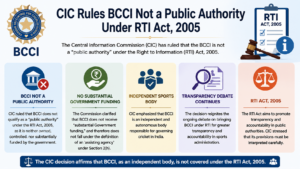
The Central Information Commission (CIC) has ruled that BCCI is not a “public authority” covered by the Right to Information (RTI) Act, 2005. The resolution arrived during the course of hearing appeals for information about the working and administration of the cricket board. The CIC said that the BCCI is not substantially financed by or under the direct control of the government and thus does not fall within the definition of an ‘assisting agency’ in Section 2(h) of the RTI Act. It has again brought into focus the issue of transparency and accountability in sports administration, particularly in the case of BCCI, which has important public functions in relation to the governance of cricket in India.
Key Highlights of CIC Decision on BCCI and RTI Act
- CCI has decided that the BCCI is not a public authority under the RTI Act, 2005.
- It took this decision based on the interpretation of Section 2(h) of the RTI Act.
- CIC pointed out that BCCI does not receive “substantial Government funding”.
- BCCI is an independent sports body as argued by the Commission.
- Applications were filed in appeal to the court for information on how BCCI was run and administered.
- Authorities owned, controlled or funded substantially by the government have their own application of the RTI Act.
- BCCI is the authority of cricket in India.
- The BCCI’s call to come under RTI has been a topic of discussion for a few years.
- The Lodha Committee had earlier called for adequate transparency in Cricket Administration.
- In other instances, the Supreme Court in India has looked at BCCI governance issues before.
- RTI inclusion supporters have said that BCCI functions as a public body and represents India internationally.
- Opponents say that the BCCI is a private, independent organisation and not controlled by the government.
- The CIC also highlighted that the provisions of the law under the RTI Act should be carefully read.
- Please note that the RTI Act came into force in 2005 and aims to strengthen the principles of transparency and accountability in public authorities.
- The Central Information Commission is the leave-granted appellate body under the RTI regime.
- The definition of public authority as given in Section 2(h) of the RTI Act.Definition of public authority as given in RTI Act 2005, Section 2(h)
- BCCI is the organiser of national and international cricket tournaments in India.
- The move has reignited concerns over sports governance and public accountability.
- Polity, governance, and sports administration are important.
- Issues of RTI, Constitutional bodies, Sports governance, etc., feature regularly in Competitive Examinations.
PYQs Related to RTI Act and CIC
| Exam Name & Year | Question | Options | Answer |
| UPSC Prelims 2020 | The Right to Information Act in India came into force in which year? | A. 2002 B. 2005 C. 2007 D. 2010 | B. 2005 |
| SSC CGL 2022 | Which body acts as the apex appellate authority under the RTI Act? | A. Election Commission B. Finance Commission C. Central Information Commission D. UPSC | C. Central Information Commission |
| State PCS 2021 | Section 2(h) of the RTI Act defines which term? | A. Citizen B. Public Authority C. Information D. Complaint | B. Public Authority |
| SSC CHSL 2023 | Who appoints the Chief Information Commissioner of India? | A. Prime Minister alone B. President of India C. Parliament D. Chief Justice of India | B. President of India |
| UPSC Prelims 2019 | The RTI Act mainly aims to promote which principle? | A. Centralisation B. Transparency and Accountability C. Emergency Powers D. Judicial Activism | B. Transparency and Accountability |
Increase the Strength of Supreme Court Judges
Conclusion
The CIC has, once again, brought the tension between autonomy and transparency in sports administration into a spotlight by declaring BCCI to be an autonomous body, not a ‘public authority’ under the RTI Act. The Commission began with a discussion on the legal definition of the “public authority” under Section 2(h) of the RTI Act, yet many experts believe there is a need for more accountability on the part of organizations engaged in crucial public activities. The move, moreover, highlights the importance of transparency in public bodies and Government institutions which are provided by the RTI Act.