


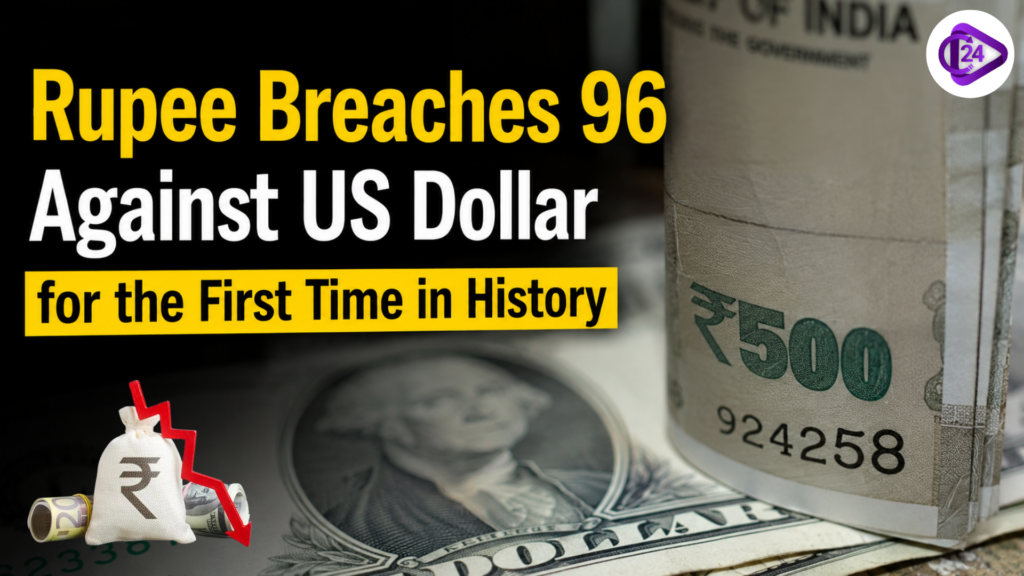
The Indian Rupee breached the historic 96-mark against the US Dollar for the first time, highlighting growing pressure on India’s economy and global currency markets. The depreciation of the rupee has been caused by rising crude oil prices, strong demand for the US dollar, foreign investor outflows, and global economic uncertainty. A weaker rupee increases the cost of imports such as petroleum, electronics, and machinery, which may lead to higher inflation in India. At the same time, exporters may benefit because Indian goods become cheaper in international markets. The Reserve Bank of India closely monitors currency fluctuations and may intervene to reduce excessive volatility in the forex market.
Key Highlights of Rupee Crossing 96 Against the US Dollar
- The Indian Rupee crossed 96 against the US Dollar for the first time in history.
- A weaker rupee means more rupees are required to buy one US dollar.
- Rising crude oil prices increased pressure on India’s import bill.
- Strong global demand for the US dollar contributed to rupee depreciation.
- Foreign Institutional Investors (FIIs) withdrawing investments weakened the Indian currency.
- Higher US interest rates attracted global investors toward dollar assets.
- The forex market determines exchange rates based on demand and supply of currencies.
- Rupee depreciation makes imports such as fuel and electronics more expensive.
- Imported inflation may rise because of higher prices of foreign goods.
- Export sectors like IT and textiles may gain due to a weaker rupee.
- The Reserve Bank of India may intervene using foreign exchange reserves to stabilize the market.
- India’s forex reserves play an important role in maintaining currency stability.
- Exchange rate fluctuations impact trade, investment, and economic growth.
- A weaker rupee increases expenses for Indians studying or travelling abroad.
- Economists monitor rupee-dollar movement as an indicator of economic stability.
Recently Asked PYQs
| Exam Name & Year | Question | Options | Answer |
| UPSC Prelims 2021 | Which institution regulates monetary policy in India? | A. SEBI B. RBI C. NABARD D. NITI Aayog | B. RBI |
| SBI PO 2022 | What is meant by foreign exchange reserves? | A. Gold deposits B. Domestic savings C. Foreign currency assets held by a country D. Share market investment | C. Foreign currency assets held by a country |
| SSC CGL 2023 | Which currency is the most traded currency in the world? | A. Euro B. Yen C. US Dollar D. Pound Sterling | C. US Dollar |
| RBI Grade B 2021 | Rupee depreciation generally makes which of the following more expensive? | A. Exports B. Imports C. Taxes D. Savings | B. Imports |
| UPSC Prelims 2019 | Balance of Payments includes which accounts? | A. Current Account B. Capital Account C. Both A and B D. Neither A nor B | C. Both A and B |
| IBPS Clerk 2020 | Who issues currency notes in India except one rupee note? | A. Finance Ministry B. RBI C. SEBI D. SBI | B. RBI |
| SSC CHSL 2022 | What does CAD stand for in economics? | A. Current Account Deficit B. Capital Account Deposit C. Currency Account Deficit D. Central Account Division | A. Current Account Deficit |
| NABARD Grade A 2021 | Higher crude oil prices generally affect India by increasing which deficit? | A. Fiscal Deficit B. Revenue Deficit C. Current Account Deficit D. Primary Deficit | C. Current Account Deficit |
| UPSC Prelims 2018 | Exchange rates are primarily determined by which mechanism in a market economy? | A. Parliament B. RBI alone C. Demand and Supply of Currency D. Election Commission | C. Demand and Supply of Currency |
| RBI Assistant 2023 | Which of the following is used by RBI to stabilize the rupee? | A. Forex Reserves B. GST C. Census D. Repo Tax | A. Forex Reserves |

Conclusion
The rupee breaching 96 against the US dollar marks a significant development in India’s economic and financial landscape. The depreciation reflects global economic uncertainty, rising crude oil prices, strong dollar demand, and foreign capital outflows. A weaker rupee impacts inflation, import costs, foreign education expenses, and overall economic stability, while also providing some advantage to exporters. The Reserve Bank of India plays a crucial role in controlling excessive volatility through monetary measures and forex interventions.