
Daily Quizzes
Mock Tests
No tests attempted yet.
Select Category
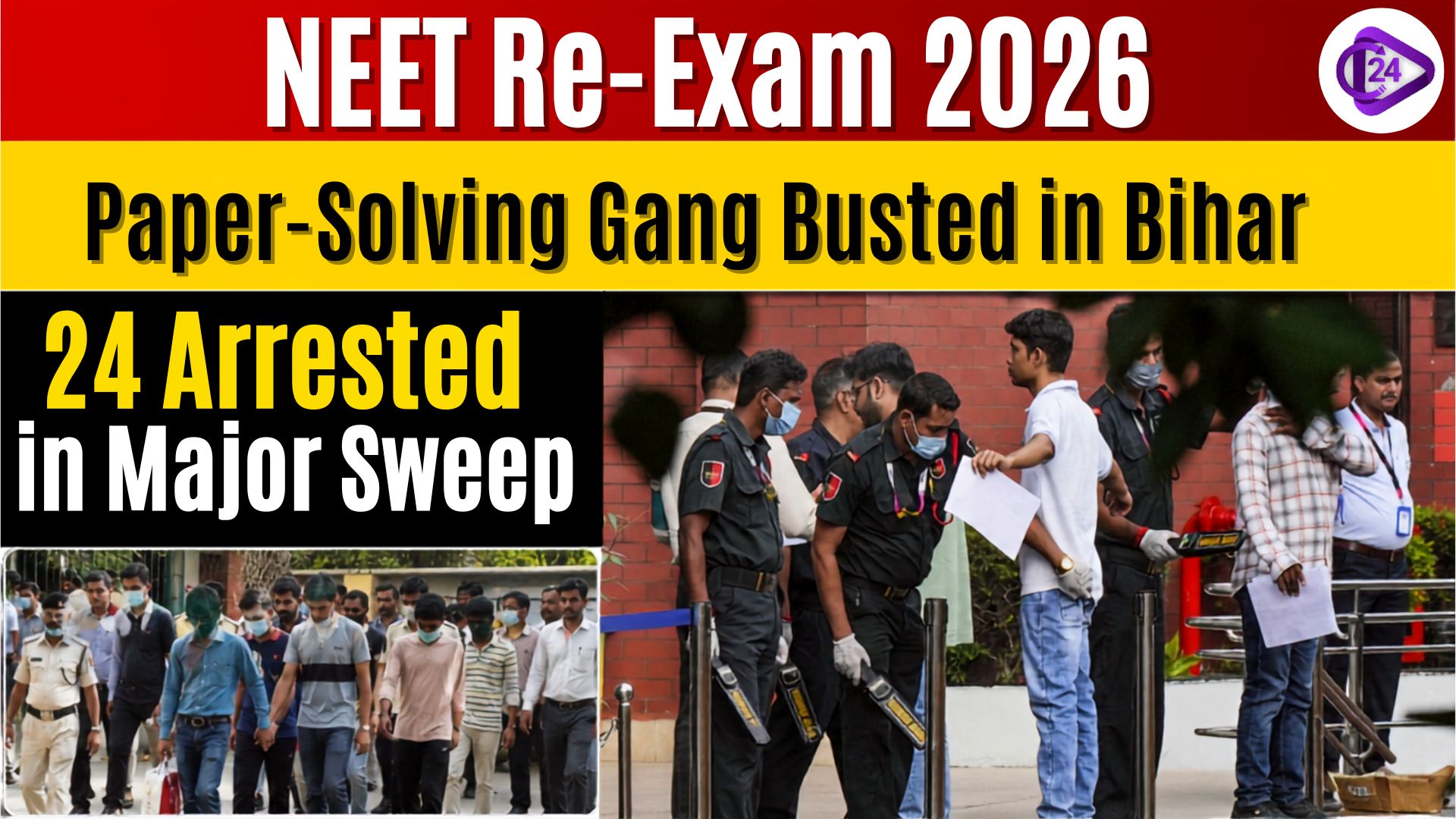
NEET Re-Exam 2026: Paper-Solving Gang Busted in Bihar, 24 Arrested in Major Sweep
Enquire Now
NEET UG is India's largest undergraduate medical entrance examination. The NTA Exam authority tried to regain public trust by conducting a re-test, but in Bihar, a well-coordinated gang of solvers was caught red-handed. Police arrested 24 people in a “one of the most serious cases of NEET cheating network in recent times” by proxying others in examination halls with fake biometric details.
NEET Re-Exam 2026: What Happened in Bihar's Lakhisarai?
Bihar Police cracked a NEET UG 2026 solver gang at Lakhisarai on live verification drives at various exam centres during the NEET Re-Exam 2026 that took place on June 21-22, 2026. The racket involved the substitution of real candidates with trained medical impostors who were able to crack the paper on their behalf; a textbook case of proxy exam candidate fraud in India.
| Detail | Information |
|---|---|
| Event | NEET UG Re-Examination 2026 |
| Location | Lakhisarai, Bihar |
| Total Arrested | 24 |
| Medical Students Arrested | 5 |
| Biometric Company Staff Arrested | 14 |
| Other Suspects | 5 |
| Scam Type | Proxy Candidacy and Biometric Manipulation |
| Investigating Agency | Bihar Police and NTA Officials |
- Police carried out surprise raids on 4 examination centres in Lakhisarai district.
- Proxy candidates replaced real candidates with false biometric information.
- Five medical students were arrested for allegedly acting as proxy candidates, for being paid as dummy candidates in the NEET re-exam 2026.
- 14 workers of the biometric verification company on duty were arrested.
- The company has also been put under investigation for biometric fraud by police.
How Did the NEET Solver Gang Operate? Biometric Fraud Exposed
According to the investigation, the racket operated in three stages. The gang targeted candidates who were not well prepared, took payment from them (up to lakhs of rupees) and then had someone impersonate them to take the exam. Police alleged that biometric verification was manipulated with insider assistance; the Fake biometric verification system, whereby internal staff at the biometric company were able to cross-check fingerprint and photo records to get the proxy exam takers through at the points without detection.
Step 1 – Recruitment: Bad candidates were recruited and were paid to get high scores.
Step 2 – Biometric Manipulation: The biometric verification vendor's employees made changes in the entry data of the candidates on the system.
Step 3 – Proxy Entry: A trained proxy candidate entered the exam hall with fake credentials.
Step 4 – Answer Solving: The proxy candidates attempted the examination on behalf of others.
Step 5 – Cover-Up: Fake papers were created to keep things looking good concerning the verification of documents.
NEET 2026 Bihar Arrest: Who Was Caught and What Charges Apply?
The 24 persons arrested in connection with the NEET re-exam fraud in Bihar come from a variety of professions, ranging from medical students to low-level technicians in the biometric field. This Bihar police education fraud case is being probed under various provisions of the IPC, the NTA Act and the recently enacted Public Examination (Prevention of Unfair Means) Act, 2024. The accused are facing charges of impersonation, forgery and criminal conspiracy.
- 5 students of MBBS (medical) as impersonators and paid students.
- Fourteen staff members of biometric companies, who manipulated the verification system.
- 5 other gang members, allegedly masterminds and middlemen.
- Financial trails are being investigated to determine the payment network.
- The charges are for criminal conspiracy, forgery, impersonation and breaching the Public Examination Act 2024.
NTA Exam Security Breach: How Did It Happen Under Heavy Surveillance?
The NTA re-examination controversy grows as it is revealed that the fraud took place despite several layers of security. Around 1000 candidates were sitting in the four exam centres in Lakhisarai for the NEET Re-Exam. Regularities in the NTA exam from then on have raised serious questions regarding the reliability of third-party vendors hired for failure of biometric verification in the NEET exam post the paper leak.
- The exam was held at 4 centres in Lakhisarai with nearly 1,000 candidates.
- Administration had deployed full biometric verification — yet it was subverted from within.
- The NEET exam security breach points to insider involvement as the key vulnerability.
- NTA is reviewing the role of third-party vendors after the biometric verification failure.
- Surveillance footage from exam halls is being analysed as part of the probe.
NEET Paper Leak & Cheating Network
This incident is not an isolated incident. The cheating network in NEET aspirants' exams has been a long-standing issue that has troubled the medical entrance ecosystem in India. NTA had to schedule another re-test in 2026 after the huge NEET paper leak controversy of 2024, which led to nationwide protests and Supreme Court intervention. Yet, as this case of NEET leak of the Lakhisarai, Bihar medical entrance exam fraud has revealed, and created newer, more advanced techniques, taking advantage of the flaws in the process.
- NEET scams have emerged in various states of India since 2017.
- Admission scam at medical colleges has been a problem in Bihar, Rajasthan and Gujarat.
- In 2024, the NEET paper leak led to examinations being thoroughly overhauled and hearings before the Supreme Court.
- This is a blatant attempt to defy NTA's reforms, which were promised in 2026.
- From paper leaks to biometric impersonation, exam centre cheating has come a long way in India.
NEET UG Malpractice 2026: Impact on Genuine Aspirants
Each time a case of NEET UG scams comes to light, it leaves lakhs of students who have taken years of preparation to sit for this one exam deeply affected. The NEET UG malpractice 2026 not only creates a distortion of merit-based selection but also impacts the trust of the public in a system, which is the only portal through which they can get admission in medical colleges across India. If only a few students can trick in the exam, it is a huge injustice as around 23 lakh students appear for NEET every year.
- The seats go to candidates who got marks by cheating.
- After years of hard preparation, the morale of honest students is badly affected.
- Re-exams and delays hurt the student academically, financially and emotionally.
- A completely digital and AI-driven examination system.
- Experts believe the Public Examination Act 2024 needs to be better enforced.
Important Links
Conclusion
The NEET re-exam paper-solving scam in Bihar serves as a stark reminder of the fact that the paper-solving organisation in India is rooted in the country and still evolving. The Bihar police NEET UG 2026 crackdown and arrest of 24 people, from the inside out of the medical biometric company, to the trained medical students, reveals a complex conspiracy that tainted one of the most important exams in India. The police action is praiseworthy, but as for the rest of the battle against the security breaches in exams, it needs to be taken on a systemic level: independent third-party audits, AI-powered proctoring, accountability of vendors, and speedy legal action under the Public Examination Act 2024. India's aspiring medical students should be picked up on merit — nothing else!
Frequently Asked Questions