

Daily Quizzes
Mock Tests
No tests attempted yet.
Select Category
JEE Main vs JEE Advanced: Complete Difference Guide
Enquire Now
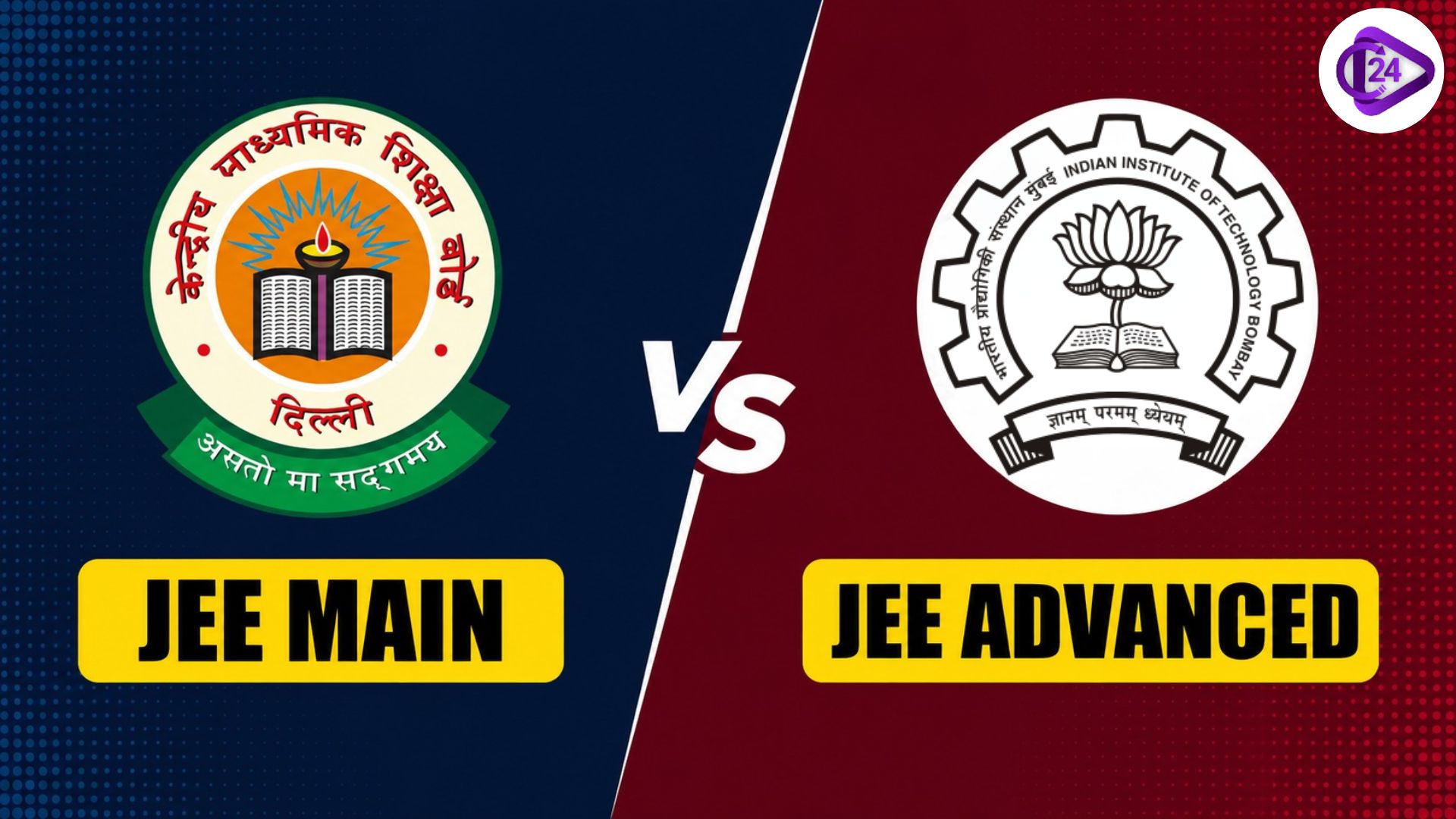
JEE Main vs JEE Advanced: For all engineering entrance exam aspirants in India, knowing the difference between JEE Main and JEE Advanced is indeed necessary. Both are national-level tests, but have different uses and are somewhat different in difficulty for different colleges. This complete guide will provide you with all the necessary details regarding eligibility criteria, syllabus, examination pattern, difficulty level and much more, which will help you plan your JEE preparation smartly.
JEE Main and JEE Advanced: What Are They?
The Joint Entrance Examination (JEE) system is used in India for engineering college admission and consists of two exams: JEE Main and JEE Advanced. These are two different phases, however, with different objectives, organising institutions and college targets. The first step towards your JEE preparation journey is to gain clarity on each exam.
| Feature | JEE Main | JEE Advanced |
|---|---|---|
| Full Name | Joint Entrance Examination Main | Joint Entrance Examination Advanced |
| Conducted By | NTA (National Testing Agency) | IITs (on a rotational basis) |
| Purpose | Admission to NITs, IIITs, and GFTIs | Admission to IITs only |
| Frequency | Twice a year (January & April) | Once a year (May/June) |
| Attempts Allowed | 3 consecutive years (up to 2 attempts per year) | 2 consecutive years (1 attempt per year) |
JEE eligibility: Who Can Apply for JEE Main and JEE Advanced?
The JEE eligibility conditions for both exams are very different. JEE Main has a wider eligibility criterion than JEE Advanced, which is exclusively for the top scorers. Having a basic idea about the requirements beforehand will save you time and confusion in preparing for JEE.
JEE Main Eligibility Criteria
- Candidates appearing for Class 12 in 2024, 2025, or 2026 can apply.
- There is no upper age limit for candidates appearing for the General category.
- All students in Class 12 must study Physics, Chemistry, and Mathematics ( compulsory)
- Can attempt up to 6 times (2 per year for 3 consecutive years)
JEE Advanced Eligibility Criteria
- Only 2,50,000 JEE Main scorers are eligible.
- The date of birth of the General candidates should be after October 01, 1999.
- Age relaxation of 5 years is provided to the SC/ST/PwD candidates.
- A maximum of 2 attempts with a maximum of 2 years of consecutive attempts.
- Should not have attended any of the IITs before.
JEE Main & Advanced Cut-off Trends
| Year | JEE Main General | JEE Main OBC-NCL | JEE Main EWS | JEE Main SC | JEE Main ST | JEE Advanced General Cutoff (%) |
|---|---|---|---|---|---|---|
| 2021 | 87.90 Percentile | 68.02 Percentile | 66.22 Percentile | 46.88 Percentile | 34.67 Percentile | 27.5% |
| 2022 | 88.41 Percentile | 67.01 Percentile | 63.11 Percentile | 43.08 Percentile | 26.77 Percentile | 24.5% |
| 2023 | 90.78 Percentile | 73.61 Percentile | 75.62 Percentile | 51.98 Percentile | 37.23 Percentile | 26.0% |
| 2024 | 93.24 Percentile | 79.67 Percentile | 81.33 Percentile | 60.09 Percentile | 46.69 Percentile | 25.0% |
| 2025 | 93.10 Percentile | 79.43 Percentile | 80.38 Percentile | 61.15 Percentile | 47.90 Percentile | ~25% |
Career Scope: IIT (JEE Advanced) vs NIT (JEE Main)
| Parameter | IIT Graduate | NIT Graduate |
|---|---|---|
| Average Package | ₹20–30 LPA | ₹8–15 LPA |
| Top Package | ₹1 Crore+ (International) | ₹40–50 LPA |
| Top Recruiters | Google, Microsoft, Goldman Sachs | TCS, Infosys, Wipro, Deloitte |
| Research Opportunities | Excellent (IISc, IITs) | Good |
| Entrepreneurship Support | Strong IIT Incubation Cells | Limited |
| Global Recognition | Very High | Moderate to High |
JEE syllabus: Difference Between JEE Main and JEE Advanced Syllabus
The Physics, Chemistry and Mathematics syllabus of JEE is similar for both papers. Physics, Chemistry & Mathematics are taught in both classes 11 and 12. JEE Advanced, however, goes beyond the syllabus of JEE and has some advanced topics that test the deeper concepts. It's one of the most crucial differences that students need to know between JEE and other examinations.
| Subject | JEE Main Exclusive Topics | JEE Advanced Extra Topics |
|---|---|---|
| Physics | Electronic Devices, Communication Systems | Thermal Physics (Advanced), Modern Physics (Deeper Concepts) |
| Chemistry | Environmental Chemistry, Polymers | Electrochemistry (Advanced), Coordination Compounds |
| Mathematics | Sets, Relations, Statistics | Advanced Vectors, 3D Geometry, In-depth Complex Numbers |
JEE pattern: How Is the JEE exam Pattern Different?
One of the most talked-about differences between the two exams is the JEE pattern. NTA JEE Main is structured with MCQ and numerical types. JEE Advanced is more unpredictable as a test of analytical reasoning with multi-concept questions, and thus it is a much tougher JEE exam to attempt.
JEE Main Exam Pattern
- Papers: Paper 1 (B.Tech) | Paper 2A (B.Arch) | Paper 2B (B.Planning)
- Marks: 75 each paper (Physics, Chemistry, Math — 25 marks each)
- Answering the questions requires numerical values and multiple-choice questions (4 answers with 1 correct answer).
- Duration: 3 hours
- Marking Scheme: +4 for correct, -1 for wrong MCQ, no negative for numerical
- Type of Test: Multiple Choice/Matching Questions
JEE Advanced Exam Pattern
- Papers: Papers 1 and 2 (both compulsory)
- Questions: May change from year to year (approximately 54 on each paper)
- Assertion-Reason, MCQ (Single correct Answer & Multiple correct answers), Integer type, Matrix Match are the types of Questions that can be asked.
- Number of Papers: 3 (total 6 hours)
- Marking: Partial marking for multiple correct answers – negative marking applies
- Type of the test: Multiple-choice Questions (MCQs) on a computer (CBT)
Which Exam Is Tougher: JEE Main or JEE Advanced?
If the difficulty level between JEE Main vs JEE Advanced is to be compared, JEE Advanced is definitely tougher. As per the above analysis, JEE Main is a simple examination where direct knowledge of the formulas given in the NCERT is needed, whereas JEE Advanced is one of the most challenging engineering exams in the world and requires multi-concept understanding, high analytical capacity and creative problem-solving.
| Parameter | JEE Main | JEE Advanced |
|---|---|---|
| Level | Moderate | Very High |
| Question Style | Direct, Formula-Based | Multi-Step, Concept-Integrated |
| Analytical Thinking | Moderate Requirement | Very High Requirement |
| Predictability | Relatively Predictable | Unpredictable Format Every Year |
| Qualifying Percentage | Higher | Approximately 25% of Applicants |
How Many Attempts Allowed in JEE Main and JEE Advanced?
One of the frequently asked questions by the aspirants is the number of attempts allowed for JEE Main and JEE Advanced. The approach to attempts is very different for both exams and crucial in your planning for JEE preparation for the years that are to come.
- JEE Main: Candidates can appear in 2 sessions of JEE Main (January and April) for a maximum of 3 years (6 attempts).
- JEE Advanced: The candidate is allowed to appear at the exam twice in two consecutive years. All efforts are very significant!
- To appear in JEE Advanced, one must qualify in JEE Main (i.e. no one can appear in JEE Advanced without getting JEE Main Qualified).
Can I Appear for JEE Advanced Without Clearing JEE Main?
NO — You can't appear in JEE Advanced without clearing JEE Main. JEE Main is an essential requirement. Candidates who have secured positions in the top 2,50,000 of JEE Main as per category are eligible for JEE Advanced. This is the most essential JEE difference between the two exams in terms of their structure.
NTA JEE: Role of NTA JEE in Conducting JEE Main
The National Testing Agency (NTA) is responsible for conducting the JEE Main exams. NTA JEE releases the official notification, admit card and result for JEE Main. On the other hand, IIT JEE Advanced is held by IITS on rotation – this year it is IIT Kanpur. Knowing about the NTA official dates and notifications will help you stay updated with the correct information.
Colleges Accepting JEE Main vs JEE Advanced Scores
While the JEE exam is accepted by several prestigious institutions, the colleges vary for both. The JEE Advanced is accepted only by the IITs (India's premier engineering institutes) while the JEE Main is accepted by a lot of engineering institutes all over the country.
| JEE Main Accepting Colleges | JEE Advanced Accepting Colleges |
|---|---|
| 31 NITs (National Institutes of Technology) | 23 IITs (Indian Institutes of Technology) |
| 25 IIITs (Indian Institutes of Information Technology) | IISc Bangalore (for select programmes) |
| GFTIs (Government Funded Technical Institutes) | IISERs, RGIPT, and a few special institutes |
| State Engineering Colleges (through State Counselling) | Admission through JoSAA Counselling only |
JEE preparation: Tips to Crack Both JEE Main and JEE Advanced
Smart JEE preparation entails a customised approach to JEE Main and JEE Advanced. The difference between JEE Main and JEE Advanced is that JEE Main requires concept clarity and speed, while JEE Advanced requires "deep thinking" and multi-step problem solving. These are some of the tips that are proven to help you prepare for JEE (both stages):
For JEE Main:
- Thoroughly master NCERT - the majority of the questions in the JEE Main exams are based on the NCERT.
- Solve the previous 10 years' JEE board papers regularly.
- Time Management is the key: Do your best to be fast and accurate in NTA JEE Main.
- Attempt both sessions (January & April) for the best score
For JEE Advanced:
- Beyond NCERT — Deep practice using HC Verma, Irodov and Arihant
- Emphasis on multi-concept problem solving for IIT JEE
- Analyse the previous years' question format of JEE Advanced, which changes every year.
- Develop a solid base of the topics of the JEE Syllabus, particularly Calculus, Organic Chemistry and Mechanics.
Also Read
Conclusion: JEE Main vs JEE Advanced
Both JEE Main and JEE Advanced are important milestones on your engineering journey. Your first step is JEE Main - If you crack it with a good rank, then you can go ahead and take the next step of appearing for JEE Advanced and secure a seat in the IITs. There is no doubt about the difference between JEE Main and JEE Advanced: JEE Main is for the masses and JEE Advanced is for the best. This should be incorporated into your JEE preparation - strengthen your foundation using the NTA JEE Main strategy, and fine-tune your analytical skills for the IIT JEE Advanced. Begin early, be consistent, have faith in the process and success with your JEE exam is yours!
Frequently Asked Questions