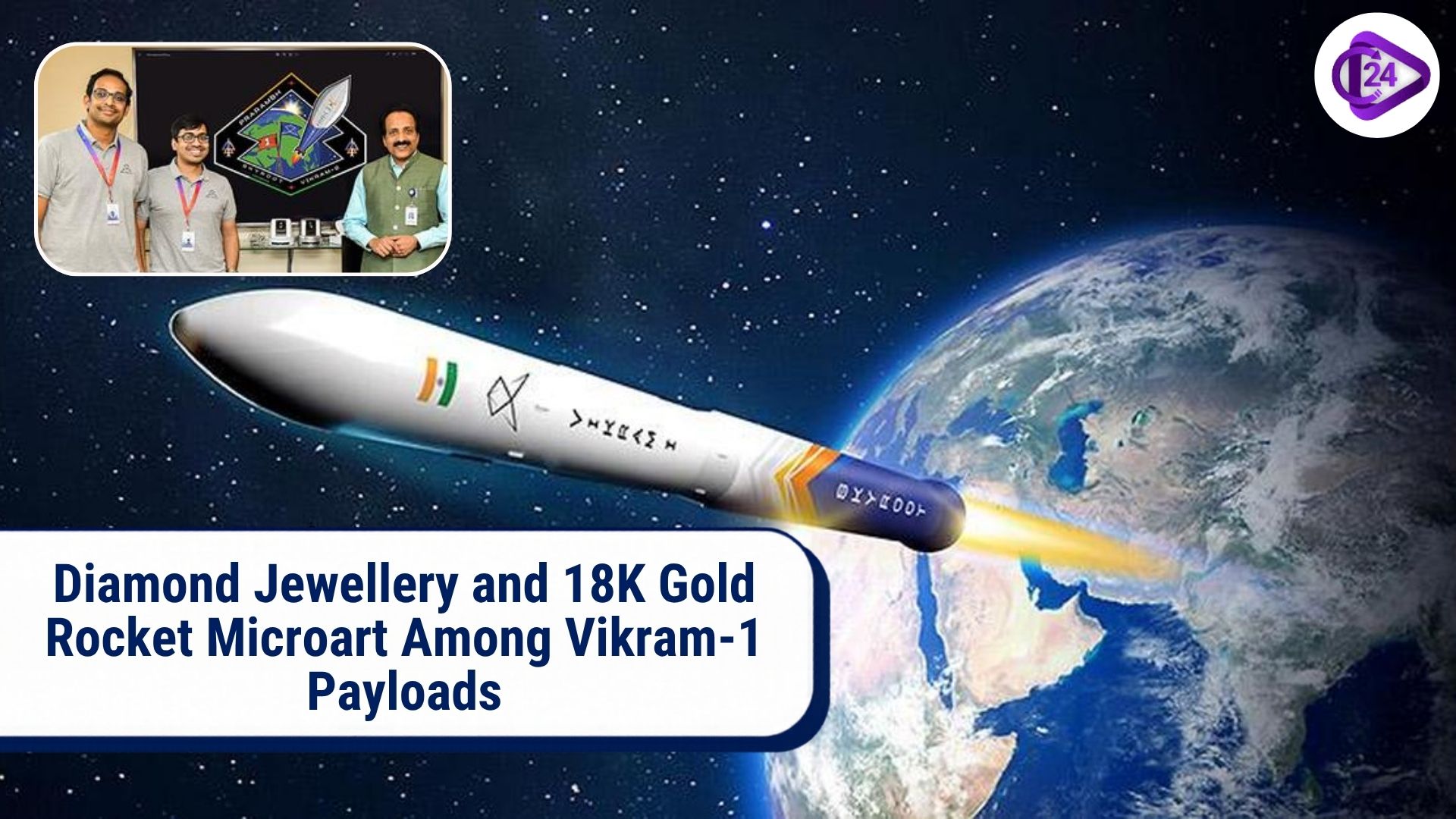


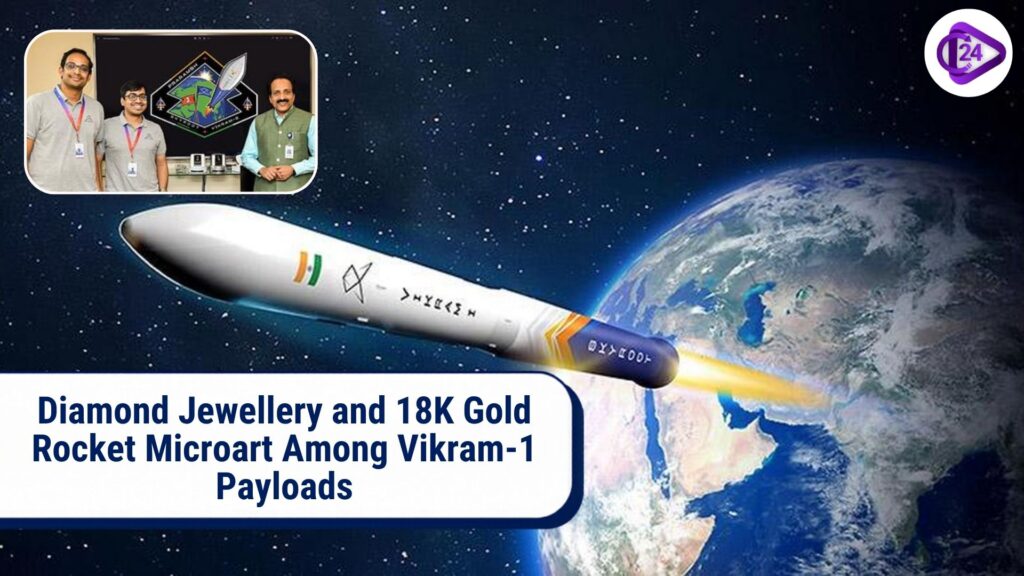
The Vikram-1 Payloads are on everyone’s attention, as India’s first private attempt at an orbital launch vehicle is set to take off on its maiden flight. In addition to scientific and commercial satellites, symbolic payloads, such as 18K-gold rocket microart and diamond jewellery, will take off during the launch. A collection of miniartworks that highlights the emerging ‘Private Space’ industry in India, with examples of the possibilities that commercial space missions afford. Also, as the mission demonstrates, innovative enterprises can benefit from launch services for scientific experimentation and special commemorative payloads.
Why Are Diamond Jewellery and Gold Microart Flying?
- The two rocket microart jewellery items, a diamond jewellery and 18K gold, are part of the commemorative Vikram-1 payloads, demonstrating its ability to carry symbolic items along with scientific payloads on a commercial launch mission.
- These products are created to indicate the country’s development and growth in private space and space technology.
- In the tradition of CubeSat, the payloads show the growing importance of private launch services as a tool for providing customised spaceflight options for industry, institutions, and creators. The payloads reflect the evolving spaceflight role of private launch providers as another way to provide customised spaceflight options for industry, institutions and creators.
- They also point to new applications of space missions other than satellite launches to encourage citizen interest in space exploration.
- The official Indian space launch mission appears to show that they include symbolic payloads as commercial space launch micro-payloads, which reflects the growing sense of commercialisation of space launches and their increasing accessibility.
What Makes Vikram-1 Special?
- Vikram-1 is India’s first privately built orbital lifting vehicle that was designed by the company Skyroot Aerospace, which will help launch small satellites reliably and affordably to orbit.
- The rocket’s design incorporates a three-stage structure with state-of-the-art propulsion systems and lightweight carbon-composite materials, enhancing its efficiency and capabilities.
- It can deliver multiple satellites to Low Earth Orbit (LEO) to offer commercial, remote sensing and educational applications.
- The mission reflects the capabilities of the Indian space sector thanks to reforms in the space industry.
- The official mission details from Skyroot Aerospace highlight the first launch as a crucial step to prove several important technologies for launch and to accommodate a variety of commercial payloads, cementing India’s growing commercial space launch capabilities.
Previous Year Questions
| Exam (Year) | Question | Options | Answer |
| UPSC Prelims (2023) | Which organisation is responsible for India’s civilian space programme? | (A) DRDO
(B) ISRO (C) IN-SPACe (D) HAL |
(B) ISRO |
| SSC CGL (2023) | Who is known as the Father of the Indian Space Programme? | (A) A.P.J. Abdul Kalam
(B) Homi J. Bhabha (C) Vikram Sarabhai (D) Satish Dhawan |
(C) Vikram Sarabhai |
| RRB NTPC (2022) | Chandrayaan-3 was launched using which launch vehicle? | (A) PSLV-XL
(B) GSLV Mk II (C) LVM3 (GSLV Mk III) (D) SSLV |
(C) LVM3 (GSLV Mk III) |
| SSC CHSL (2022) | Which Indian mission successfully landed near the Moon’s south pole? | (A) Chandrayaan-1
(B) Chandrayaan-2 (C) Chandrayaan-3 (D) Aditya-L1 |
(C) Chandrayaan-3 |
| UPSC Prelims (2021) | IN-SPACe was established primarily to: | (A) Build satellites
(B) Regulate and promote private sector participation in space activities (C) Manufacture launch vehicles (D) Train astronauts |
(B) Regulate and promote private sector participation in space activities |
| CDS (2021) | India’s first mission dedicated to studying the Sun is: | (A) AstroSat
(B) Mangalyaan (C) Aditya-L1 (D) RISAT |
(C) Aditya-L1 |
| RRB Group D (2020) | Where is the headquarters of ISRO located? | (A) Hyderabad
(B) Bengaluru (C) Chennai (D) New Delhi |
(B) Bengaluru |
| SSC CGL (2020) | India’s first satellite was: | (A) INSAT-1A
(B) Aryabhata (C) Rohini (D) Bhaskara-I |
(B) Aryabhata |
| NDA (2019) | PSLV is mainly used for launching satellites into: | (A) Geostationary Orbit
(B) Polar Sun-Synchronous Orbit (C) Medium Earth Orbit (D) Lunar Orbit |
(B) Polar Sun-Synchronous Orbit |
| State PSC (2018) | Which was India’s first interplanetary mission? | (A) Chandrayaan-1
(B) Mangalyaan (Mars Orbiter Mission) (C) Aditya-L1 (D) Gaganyaan |
(B) Mangalyaan (Mars Orbiter Mission) |
Conclusion on Vikram-1 to Carry Diamond Jewellery and Gold Rocket
Vikram-1 is a historic event for India’s private space industry as it will carry the payloads. The example of diamond jewellery and an 18K gold rocket microart added to commercial space missions highlights the variety of such commercial missions, along with scientific and commercial satellites. Also, the launch showcases India’s technological prowess and fosters innovation and India’s presence in the global space economy. The successful flight of the Vikram-1 Payloads mission will allow many private orbital ascents to come in the future.
The Vikram-1 Payloads include commercial satellites, scientific experiments, educational payloads, and symbolic items such as diamond jewellery and an 18K gold rocket microart.
The jewellery is a commemorative commercial payload intended to celebrate India's growing private space industry.
The gold rocket microart symbolises India's achievements in space technology and showcases innovative commercial payload opportunities.
Vikram-1 has been developed by Skyroot Aerospace as India's first privately built orbital launch vehicle.
The Vikram-1 Payloads demonstrate India's expanding commercial space capabilities, encourage innovation, and strengthen private participation in the space sector.