



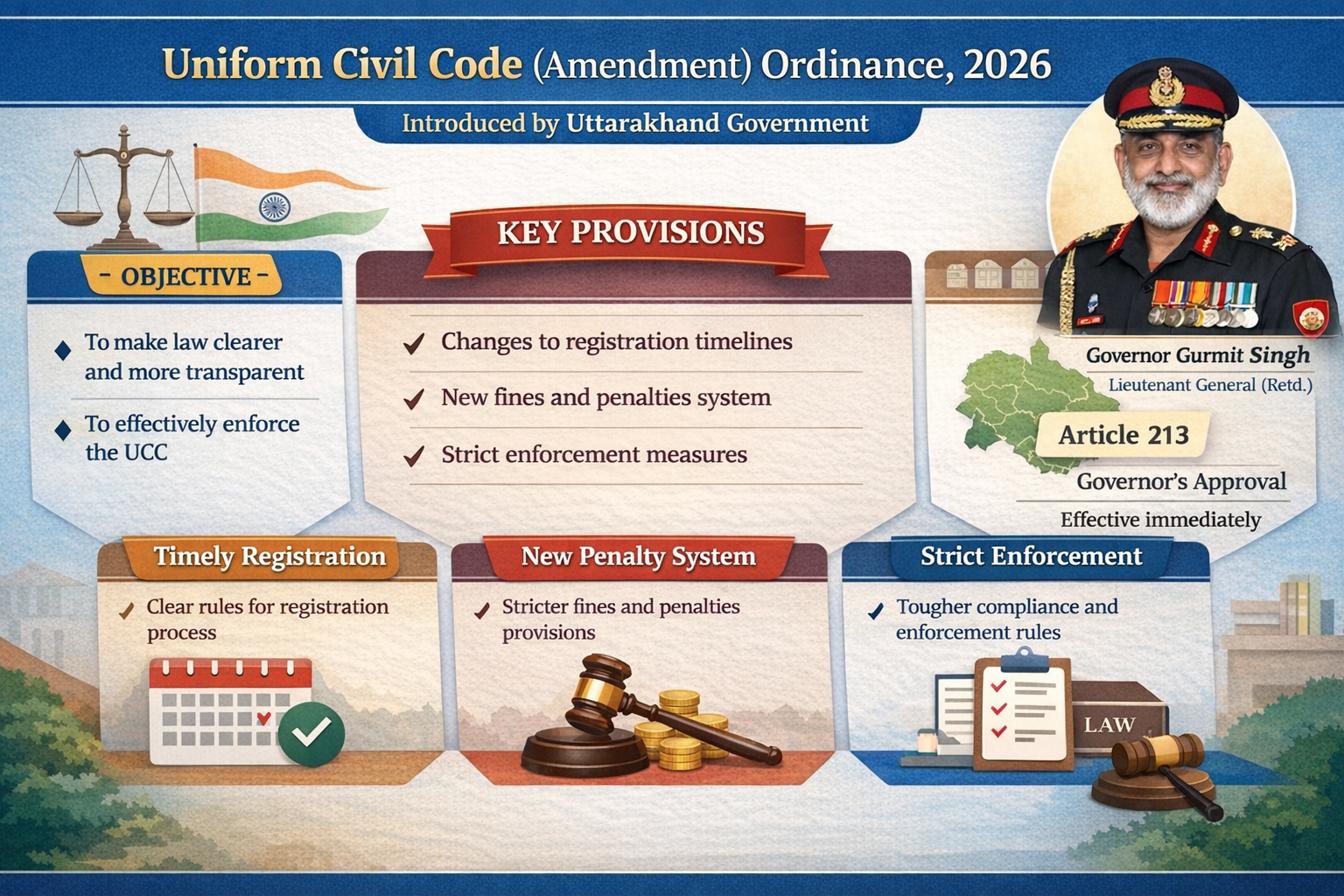
The Uniform Civil Code (Amendment) Ordinance, 2026, has been introduced, and also through the Governor Lieutenant General (Retd) approval, the Uttarakhand Government has introduced the ordinance with immediate effect. Governor Gurmit Singh under Article 213 of the Constitution. The amendment ordinance modifies the current Uniform Civil Code to bring about more understandable procedures and administrative changes, as well as new compliance provisions. In an attempt to enhance transparency and ease civil law proceedings, the ordinance seeks to change some of the timelines, fines, and enforcement provisions to have the UCC in the state properly implemented as part of the overall legal reform agenda in Uttarakhand.
What is the UCC (Amendment) Ordinance, 2026?
-
The UCC (Amendment) Ordinance, 2026, is another amended form of the Uniform Commercial Code in Uttarakhand to enhance the enforcement of the law.
-
The governor approved it and implemented it to make procedures, administrative rules, and compliance requirements under the UCC clear.
-
The amendment renders the registration schedules, fines, and execution measures more accurate and practical.
-
It amends the current provisions to clarify ambiguities and provide more security to the rights of the citizens.
-
The reforms will help make the UCC more efficient and transparent, as well as easier to understand by individuals and officials.
Previous Year Questions (PYQs) on Uniform Civil Code (UCC)
| Exam Name | Year | Question Asked | Answer |
|---|---|---|---|
| UPSC CSE Prelims | 2021 | The Uniform Civil Code (UCC) is provided under which part of the Indian Constitution? A) Fundamental Rights B) Directive Principles of State Policy C) Fundamental Duties D) Preamble |
B) Directive Principles of State Policy (Article 44) |
| UPSC CSE Mains (GS Paper-I) | 2019 | “Examine the impact of the Uniform Civil Code on gender equality and minority rights in India.” Discuss the challenges in its implementation. | UCC aims to ensure equality, especially for women, in matters of marriage, divorce, inheritance, and adoption. Challenges include religious diversity, cultural sensitivities, minority concerns, and lack of political consensus. |
| UPSC CSE Mains (GS Paper-I) | 2015 | Discuss the possible factors that inhibit India from enacting a Uniform Civil Code as envisaged under the Directive Principles of State Policy. | Inhibiting factors include India’s religious and cultural diversity, resistance from communities, federal structure, political sensitivity, and concerns over interference in personal laws. |
Conclusion (UCC (Amendment) Ordinance, 2026)
The UCC (Amendment) Ordinance, 2026, enhances the framework for implementing the Uniform Civil Code to address gaps in procedure and difficulties in enforcement. It is focused on making it clear, legally certain, and more smoothly executed, balancing the constitutional value, the efficiency of the administration, and the rights of citizens.