


The Government of India has made it clear in Parliament that any lowering of the age of consent below 18 years under the Protection of Children from Sexual Offences Act, 2012, may undermine its child protection systems. Officials said that lowering the legal age or adding exemptions would compromise child safety, increase chances of exploitation and lessen legal protection to prevent abuse and manipulation of minors, especially teenage girls. This perception was raised as a reaction to proposals including a so-called Romeo-and-Juliet clause, and the government emphasised that even weakening the consent laws could erode its resolve to protect children against sexual offences.
What are the Objects of Low Age Consent?
-
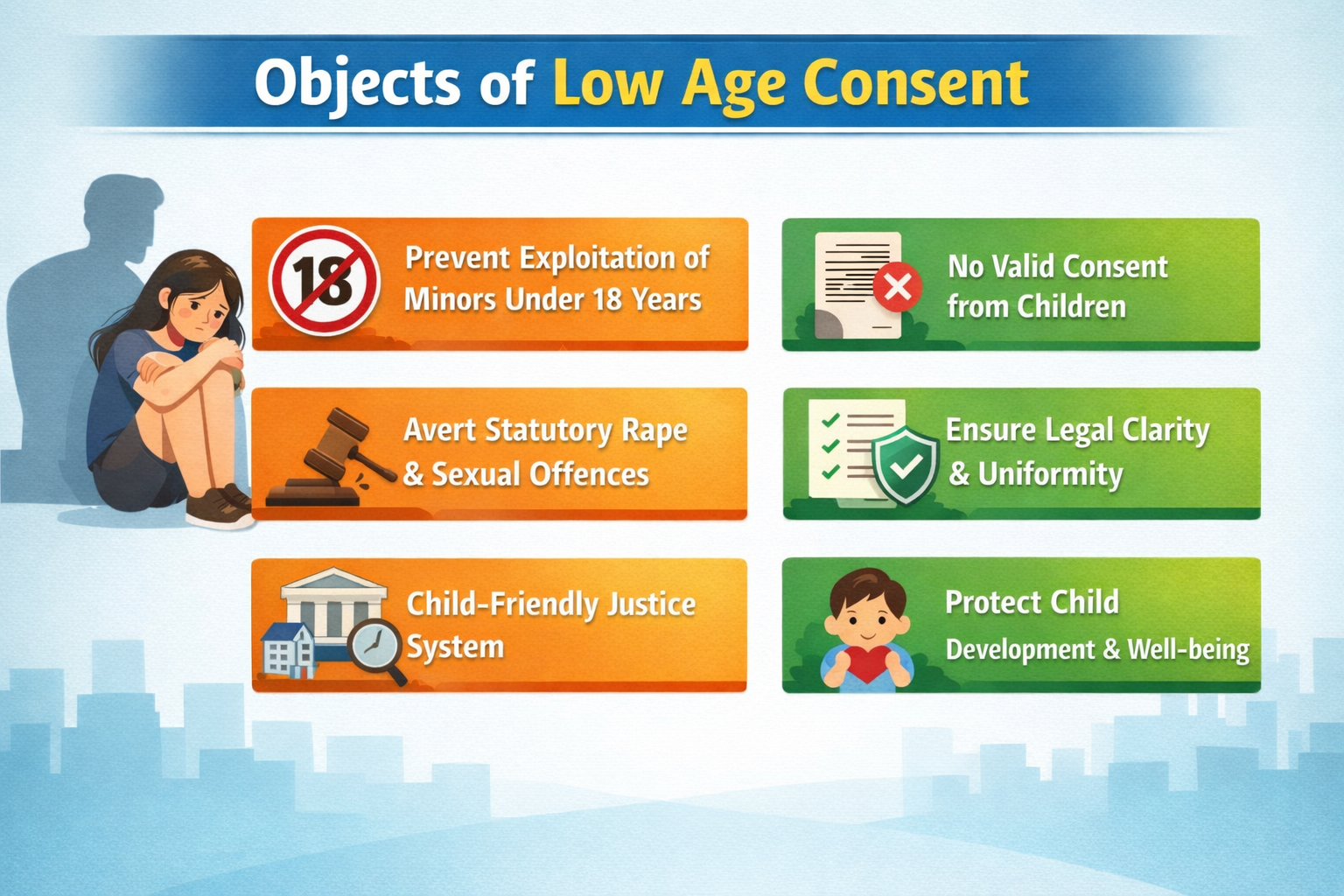
The age of consent has been stipulated to prevent the sexual abuse and exploitation of minors under 18 years, due to which their ability to consent to sexual activity should not be regarded as valid in the law.
-
According to the child protection law, anyone under the age of 18 is considered a child, and any consent made by a minor is not a legal contract.
-
The purpose of the provision is to avert statutory rape and other forms of sexual offences against children.
-
A concrete age of consent will lead to a legal norm that will avoid uncertainty and enforce uniformity.
-
It promotes a child-friendly justice that is protection-based, reporting, investigative and fast-trial aimed.
-
The law aims at protecting the physical, emotional and psychological growth of children.
-
The arguments put forward by the authorities to fight against lowering the age of consent have been that it will dilute the law that protects against exploitation.
Previous Year Questions on Child Marriage
| Exam | Year | Question (MCQ) | Options | Correct Answer |
|---|---|---|---|---|
| UPSC Prelims | 2014 | Under the Prohibition of Child Marriage Act, 2006, a girl is considered a child if she is below the age of: | (A) 16 years (B) 17 years (C) 18 years (D) 21 years | (C) 18 years |
| UPSC Prelims | 2020 | The Prohibition of Child Marriage Act, 2006, replaced which earlier law? | (A) Hindu Marriage Act (B) Dowry Prohibition Act (C) Child Marriage Restraint Act, 1929 (D) Indian Penal Code | (C) Child Marriage Restraint Act, 1929 |
| CDS | 2019 | The Child Marriage Restraint Act, 1929, is also known as: | (A) Sharda Act (B) Sarda Act (C) Nehru Act (D) Malaviya Act | (B) Sarda Act |
| NDA | 2021 | Which act prohibits child marriage in India? | (A) Indian Penal Code (B) POCSO Act (C) Prohibition of Child Marriage Act, 2006 (D) Juvenile Justice Act | (C) Prohibition of Child Marriage Act, 2006 |
| SSC CGL | 2018 | Under the Prohibition of Child Marriage Act, 2006, a child marriage is: | (A) Fully valid (B) Automatically void (C) Voidable at the option of the minor (D) A civil offence only | (C) Voidable at the option of the minor |
| SSC GD | 2020 | Who can file a complaint to prevent or report a child marriage? | (A) Only the victim (B) Parents only (C) Any person or organisation (D) Only the police | (C) Any person or organisation |
| State PSC (UPPSC) | 2016 | Who is appointed at the district level to prevent child marriages? | (A) Sub-Divisional Magistrate (B) Child Welfare Officer (C) Child Marriage Prohibition Officer (D) District Judge | (C) Child Marriage Prohibition Officer |
Conclusion
By reducing the age of consent, the law would be undermined to teach children to protect against exploitation and abuse. Current legislation accepts the vulnerability of the minors and strives to provide safeguards and well-being. Any watering down of this will put at risk the normalisation of unequal power relations and the eradication of hard-acquired protection of children.