

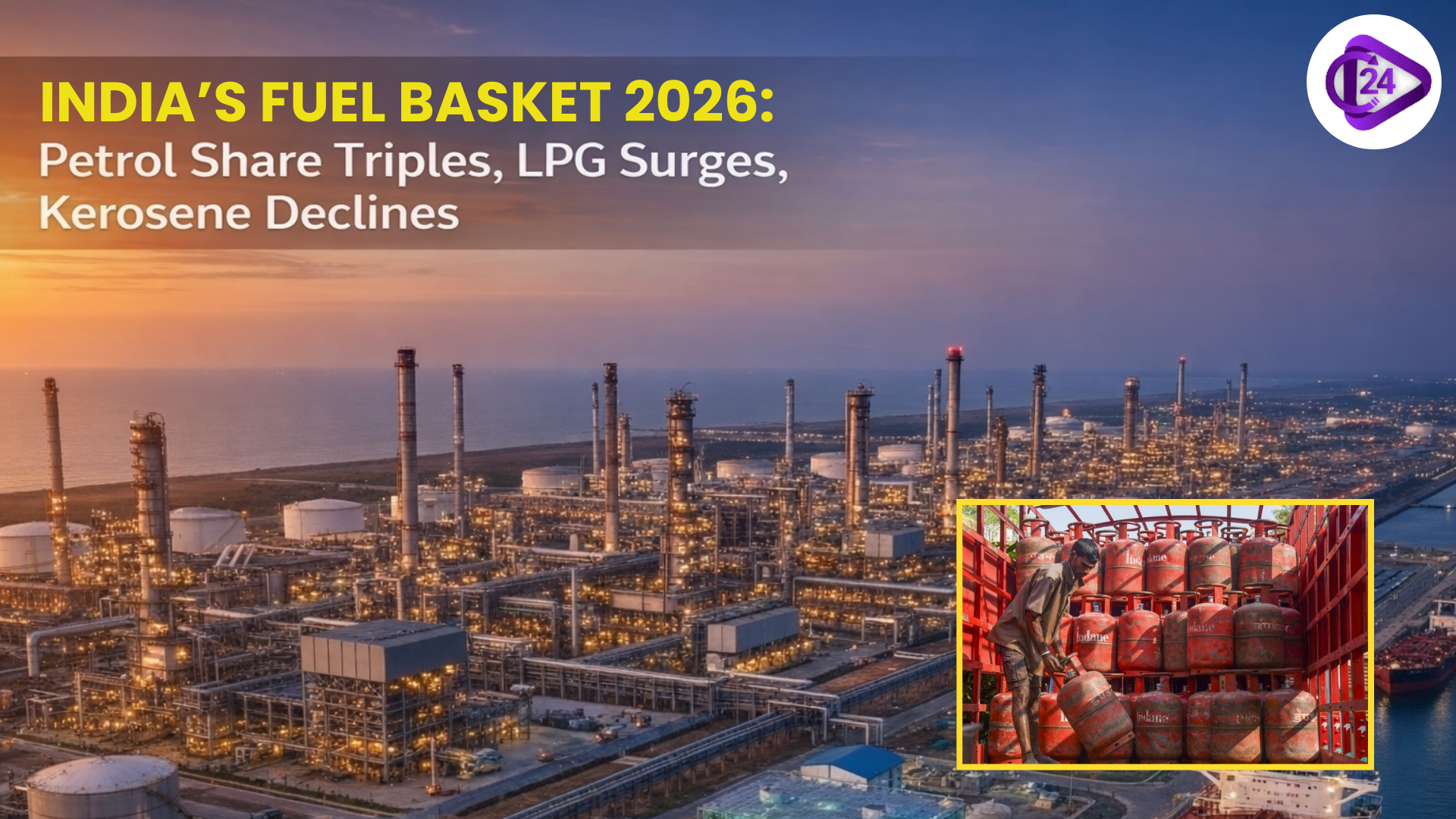
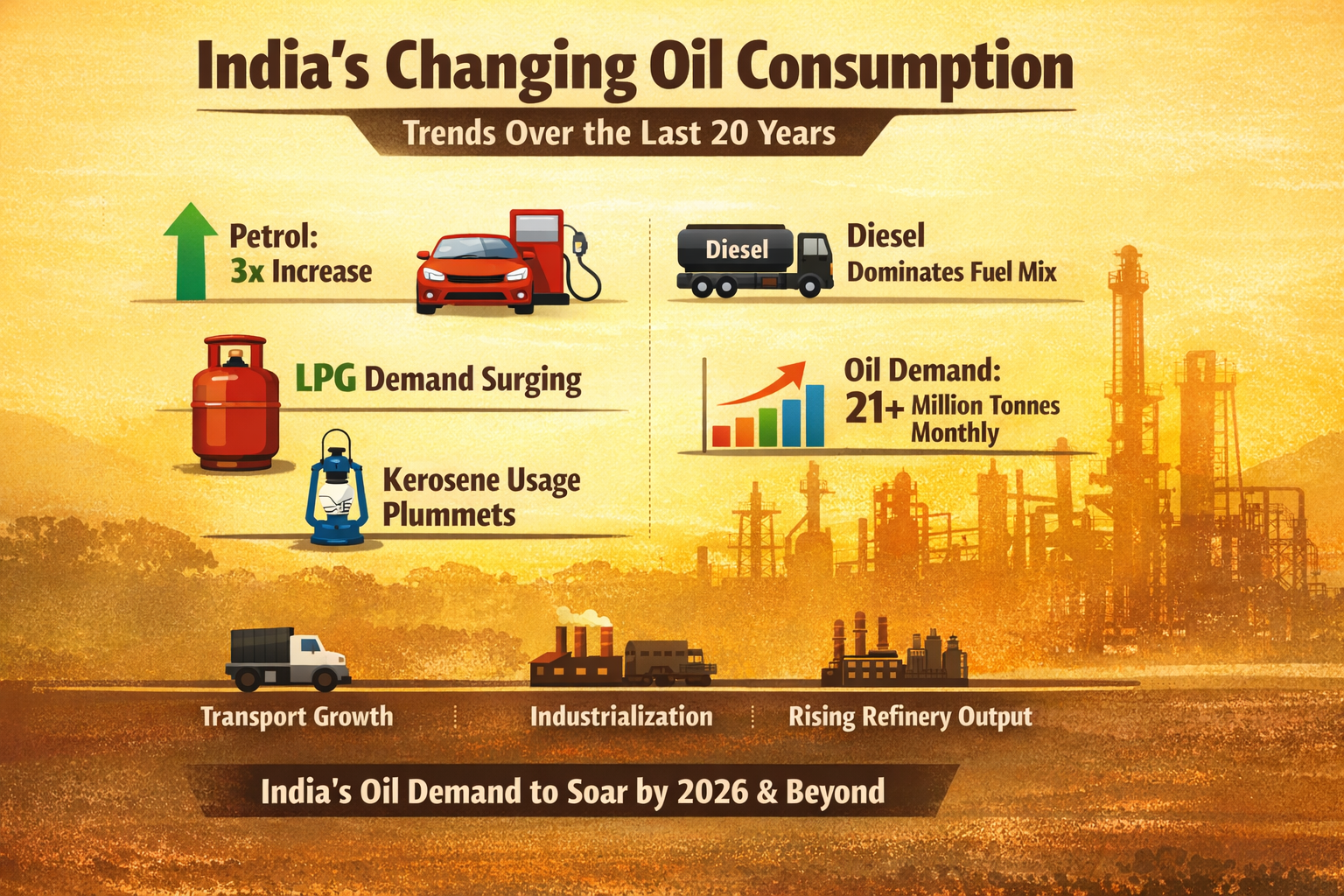
The consumption of petroleum in India has changed dramatically, as per numbers given by the Petroleum Planning and Analysis Cell (PPAC). In the last 20 years, the proportion of petrol in the fuel basket of the country has almost tripled, and today, the country consumes about 18 percent of oil consumption as a result of increased individual mobility and uptake of petrol engine products. Another fuel that has gone on a rampage is Liquefied Petroleum Gas (LPG) as a domestic and industrial fuel, whereas the demand for kerosene has plummeted to insignificant levels due to the transition to cleaner fuels, as well as LPG infiltration. Such changes highlight a greater change in the energy mix in India.
India Oil Demand Growth 2026: Key Highlights from Latest Data
-
The total oil consumption in India is still increasing, which is the manifestation of increasing economic activity and demand for transport fuels. As per the data by PPAC, the fuel consumption has been at an all-time high, with the total consumption of oil and petroleum products in India standing at more than 21 million metric tonnes in the last few months.
-
The demand for petrol has been increasing tremendously due to the growth in passenger vehicle usage and urban mobility, and the consumption is increasing year-by-year.
-
The diesel takes up the majority of the fuel mix in India because it is important in freight, agricultural, and industrial applications, but the percentage is rising in petrol.
-
The consumption of LPG is still on an upward trend, which is sustained by the clean cooking programmes and the transition of household energy to LPG, and the demand for this substance increases year by year.
-
The demand for kerosene has dropped considerably in the last 10 years as its place is taken up by other cleaner fuels, and the study has seen the fuel occupying very low proportions in the total fuel basket.
-
Energy agencies such as OPEC have projected that oil demand in India will keep rising at a faster rate than most of the leading economies, and the demand will reach high levels in 2026 and beyond.
- Increasing demands are being caused by transport, industrialisation, infrastructure development, and increasing refinery throughputs to satisfy domestic and export demand.
Latest PYQs on Petrol, LPG & Kerosene
| Exam | Year | Question (with Options) | Answer |
|---|---|---|---|
| UPSC CSE Prelims | 2012 | Consider the following fuels: 1. LPG 2. Kerosene 3. Hydrogen. Which of the above are used as rocket fuel? (A) 1 only (B) 2 and 3 only (C) 3 only (D) 1, 2, and 3 | (B) |
| SSC CGL | 2018 | LPG mainly consists of: (A) Methane & Ethane (B) Propane & Butane (C) Pentane & Hexane (D) Ethylene & Acetylene | (B) |
| SSC CHSL | 2017 | Kerosene is obtained by: (A) Destructive distillation of coal (B) Fractional distillation of petroleum (C) Cracking (D) Polymerisation | (B) |
| SSC MTS | 2022 | The foul smell in LPG is due to the addition of: (A) Methanol (B) Ethanol (C) Ethyl mercaptan (D) Acetone | (C) |
| RRB NTPC | 2019 | Petrol is mainly a mixture of: (A) Alkanes (B) Alkenes (C) Alkynes (D) Alcohol | (A) |
| RRB Group D | 2020 | LPG is stored in cylinders in: (A) Gaseous form (B) Solid form (C) Liquid form under pressure (D) Plasma state | (C) |
| RRB ALP | 2018 | Octane number is associated with: (A) Diesel (B) Petrol (C) Kerosene (D) LPG | (B) |
| SSC CPO | 2019 | The main constituent of LPG is: (A) Methane (B) Butane (C) Ethane (D) Acetylene | (B) |
| UPSC CDS | 2015 | Kerosene belongs to which fraction of crude oil? (A) Light fraction (B) Middle fraction (C) Heavy fraction (D) Residue | (B) |
| RRB NTPC | 2021 | Petrol has higher volatility because it contains: (A) Long-chain hydrocarbons (B) Short-chain hydrocarbons (C) Aromatics only (D) Alcohols | (B) |
Conclusion
India will have a fuel basket that indicates a shift towards changing patterns of consumption. The growing mobility and uptake of cleaner cooking and the sharp drop in kerosene use point to growing demand for and a trend of petrol and LPG, and the energy transition. The changing blend highlights the importance of economic growth, urbanisation, and a slow transition of India towards more efficient and modern use of fuel.