


The national song of India, Vande Mataram, has a formal protocol issued by the Union Ministry of Home Affairs that establishes that the entire six stanzas of the song are the official stanzas. In the new guidelines, when Vande Mataram and the national anthem, Jana Gana Mana, are sung simultaneously in governmental functions, schools, and other official events, then the national song must be sung first, and thereafter the national anthem follows. The directive specifies the timeline for its performance and demands respect and decency in the performance of the national song, which was the first set of organised rules for how to play or sing it.
Six Stanzas of Vande Mataram for Mass Events, Says MHA
-
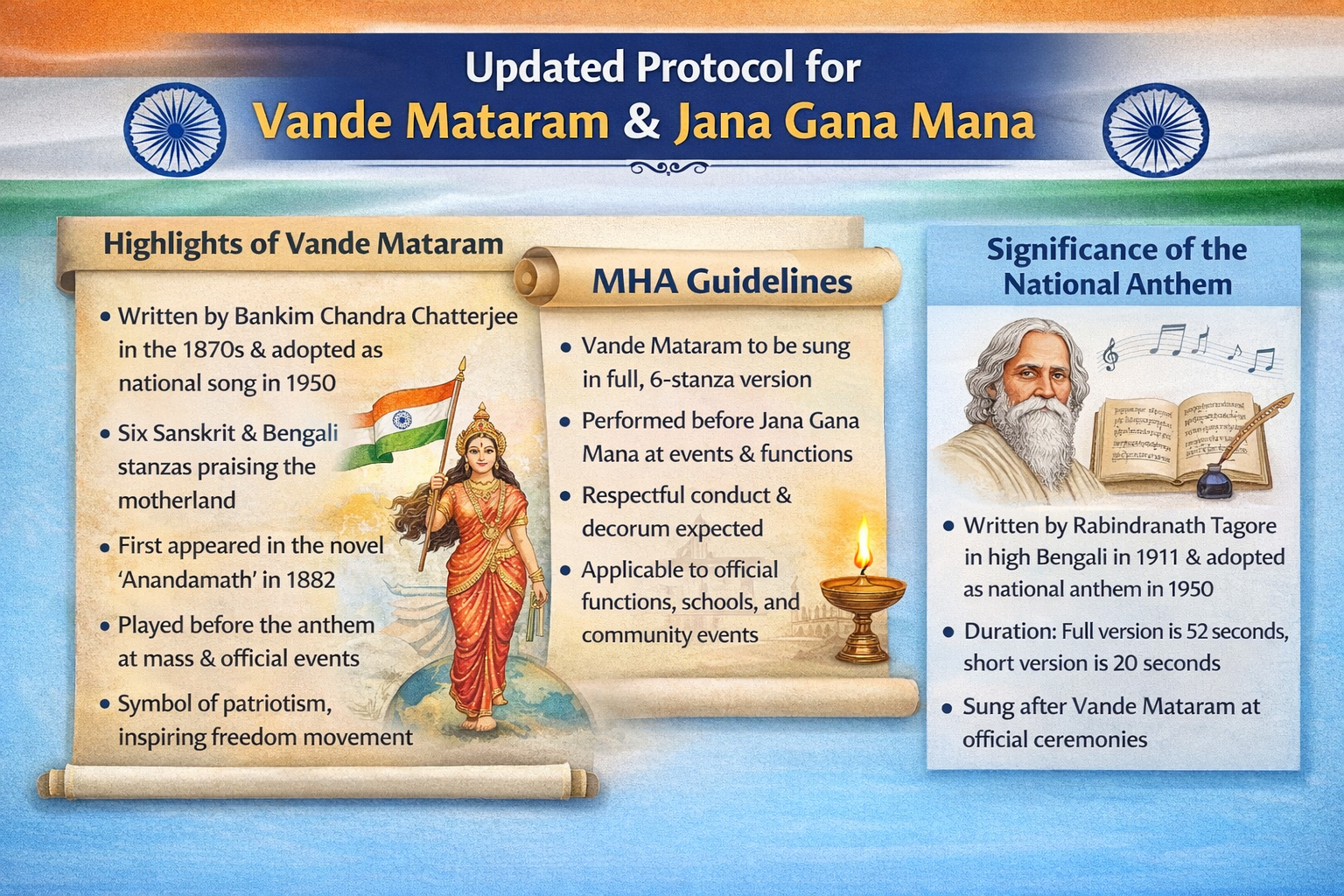
The Union Ministry of Home Affairs has generated official guidelines according to which the national song Vande Mataram is to be sung in its entire 6-stanza form at official and mass meetings.
-
The official approved version that lasts about three minutes has been explained by the government to be the full version that is to be used during ceremonial events.
-
In case of a situation when both Vande Mataram and the national anthem, Jana Gana Mana, are performed at an event, then the national song should be sung first and then the anthem.
-
The rule is applicable to the big popular events, governmental programmes, schools, cultural events, and other official functions in which the national songs are performed.
-
The action is meant to unify the translation of Vande Mataram throughout the nation to have a homogeneous practice in both official and state ceremonies.
-
The rules describe the anticipated behaviour during the performance, such as upholding proper behaviour and respect during the performance.
-
The order is one of the most elaborate clarifications that has been made concerning the observance and ceremonial position of the national song when it comes to mass events.
Highlights of Vande Mataram
The Vande Mataram is the national song in India and the brainchild of a writer, Bankim Chandra Chatterjee, and it hails the nation as a motherland and is an expression of patriotism and unity. The song has been very instrumental in the struggle for freedom in India, and it is still a demonstration of national pride and culture.
-
Year of Composition: It was written in the 1870s and published in the book (novel) Anandamath in 1882.
-
Move to become a National Song: Adopted as the national song by the Constituent Assembly on 24 January 1950.
-
Language: It was first written in Sanskrit and Bengali.
-
Stanzas: The entire song has six stanzas.
-
Theme and Meaning: The song glorifies India as the mother of god and reminds us of the natural beauty of the country, its power and its cultural richness.
-
Role in Freedom Movement: It was used as a slogan of the patriotic motto, but it encouraged the freedom fighters against British rule.
-
Cultural Significance: Vande Mataram is one of the expressions of national cohesiveness, national pride and a sense of respect towards the motherland.
-
Official Recognition: It has the designation of the National Song, Jana Gana Mana, which is the National Anthem
-
Current Usage: The song is sung at government ceremonies, cultural places, and patriotic concerts.
Significance of the National Anthem
Nobel Laureate Rabindranath Tagore wrote the National Anthem of India, Jana Gana Mana, and it was adopted on 24 January 1950. It represents the unity, diversity and sovereignty of India and is sung during such vital national and international events.
-
First Performance: It was first sung on 27 December 1911 in a Calcutta session of the Indian National Congress.
-
The Adoption: It was adopted as the National Anthem of India on 24 January 1950.
-
Language: Highly Sanskritised Bengali.
Duration:
-
The whole version requires 52 seconds to sing.
-
The short version is approximately 20 seconds and includes the opening and closing lines.
Meaning and Theme:
-
The anthem glorifies India and brings into focus togetherness between various regions, cultures and communities.
-
It signifies national wholeness and national pride.
Occasions of Performance:
Such national holidays as Republic Day and Independence Day.
Government official ceremonies.
-
Sporting and diplomatic activities on an international scale.
-
Assemblies and propaganda in school.
Legal Protection:
-
Copyrighted under the Prevention of Insults to National Honour Act, 1971.
-
Being rude or hurling at the anthem is punishable by law.
Protocol During Anthem:
-
During the recitation of the anthem, citizens are required to be in an attention pose.
-
The anthem should be recited with integrity and devoid of modification.
National Significance:
The National Anthem is an identity of India, sovereignty and unity, and this is why it is considered to be one of the most admired symbols of the country of India, nationally.
Conclusion (Full Six Stanzas of Vande Mataram Before Anthem)
The order to sing all six stanzas of Vande Mataram before the national anthem makes it clear that it has become a ritualistic aspect of the events held by the government. The government seeks consistency by establishing a standard order and structure in the mass gatherings to provide dignity and respect, and the significance of the official symbols in the observance of national holidays cannot be overlooked.