


The National Green Tribunal (NGT) has upheld the environmental clearance for the Great Nicobar Island development project, dismissing multiple legal challenges and finding “no good ground to interfere” with prior approvals. The tribunal’s Eastern Zone bench emphasised that the environmental clearance includes safeguards and that strict compliance with all conditions must be ensured as the project moves forward. This decision clears the way for a major infrastructure plan spanning about 166 square kilometres, including an international container terminal, airport, power plant, and township, with authorities instructed to adhere closely to regulatory and environmental requirements.
What is the National Green Tribunal's approval of the Nicobar Project?
-
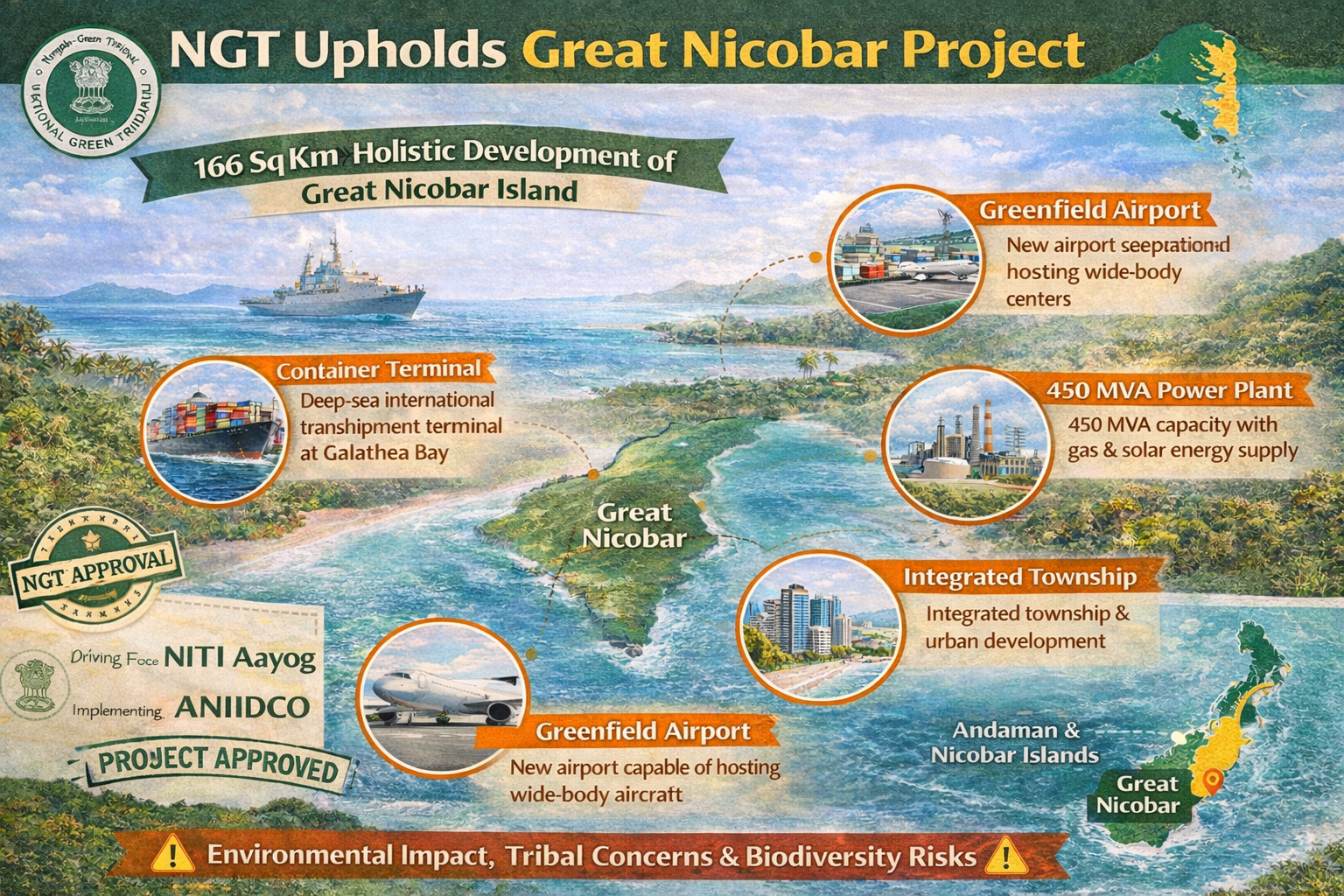
Name and scale: The project is officially referred to as the Holistic Development of Great Nicobar Island, a mass infrastructure project with an area of approximately 166 sq km of the southern end of the Great Nicobar Island in the Indian Union Territory of Andaman and Nicobar Islands.
-
Implementation bodies: It has been the brainchild of NITI Aayog, and it is being put in place by the Andaman and Nicobar Islands Integrated Development Corporation (ANIIDCO).
Primary components:
Galathea Bay: A deep-sea international container transhipment terminal with a capacity to accommodate millions of TEUs of cargo.
-
An international greenfield airport that can accommodate wide-body aircraft.
-
An energy supply power plant of 450 MVA, gas and solar.
Integrated township and associated urban/area development.
-
Strategic objectives: The strategy will enhance maritime commerce in India, reduce dependence on foreign transhipment centres, promote economic growth and increase India's presence in the Indo-Pacific region.
-
Approvals: The Ministry of Environment, Forest and Climate Change granted the project an Environmental and Coastal Regulation Zone clearance, and the NGT affirmed their environmental clearance.
-
Controversies: The project has received some controversial critiques on issues of environmental impact, loss of forest, and biodiversity risk, as well as impacts on tribal communities.
Most Asked PYQs Based on Great Nicobar
| Exam / Exam Type | Question | Answer |
|---|---|---|
| RRB NTPC | The Andaman and Nicobar Island group of India is an emergent part of which of the following submerged mountain ranges? (1) Kunlun Shan (2) Eastern Ghats (3) Arakan Yoma (4) Himalayas | (3) Arakan Yoma |
| SSC | What is the total number of districts in the Andaman and Nicobar Islands? (A) 2 (B) 3 (C) 5 (D) 6 | (B) 3 |
| SSC | Which latitude separates the Andaman and Nicobar Islands? (A) 5°N (B) 10°N (C) 12°N (D) 14°N | (B) 10°N |
| SSC / Railway GK | What is the total number of islands in Andaman & Nicobar? (A) 402 (B) 452 (C) 498 (D) 572 | (D) 572 |
| Railway / SSC GK | Which island has the only active volcano in South Asia? (A) Barren Island (B) Smith Island (C) Neil Island (D) Narcondam | (A) Barren Island |
| State PSC | Saddle Peak, the highest point of the Andaman & Nicobar Islands, is located on which island? (A) Little Andaman (B) North Andaman (C) Great Nicobar (D) Car Nicobar | (B) North Andaman |
| SSC / State PSC | What is the approximate height of Saddle Peak? (A) 732 m (B) 812 m (C) 965 m (D) 1,200 m | (A) 732 m |
| SSC / Railway | Indira Point, the southernmost point of India, is located on which island? (A) Little Andaman (B) Great Nicobar (C) Car Nicobar (D) Neil Island | (B) Great Nicobar |
| UPSC Civil Services | In which one of the following places is the Shompen tribe found? (A) Nilgiri Hills (B) Nicobar Islands (C) Spiti Valley (D) Lakshadweep | (B) Nicobar Islands |
| SSC / Railway | Andaman Islands are separated from the Nicobar Islands by which waterway? (A) Strait of Malacca (B) Ten Degree Channel (C) Palk Strait (D) Bab-el-Mandeb | (B) Ten Degree Channel |
| SSC | In which year were the Andaman & Nicobar Islands declared a Union Territory of India? (A) 1947 (B) 1950 (C) 1953 (D) 1956 | (D) 1956 |
Conclusion (Great Nicobar Project by NGT)
The National Green Tribunal's decision in favour of environmental clearance of the Great Nicobar Project is a crucial move that can lead to the strategic as well as economic interests of India. Although the decision permits infrastructure development, it is also concerned with ensuring that environmental issues are adhered to to strike a balance between growth, protecting the biodiversity and the interests of the indigenous community