

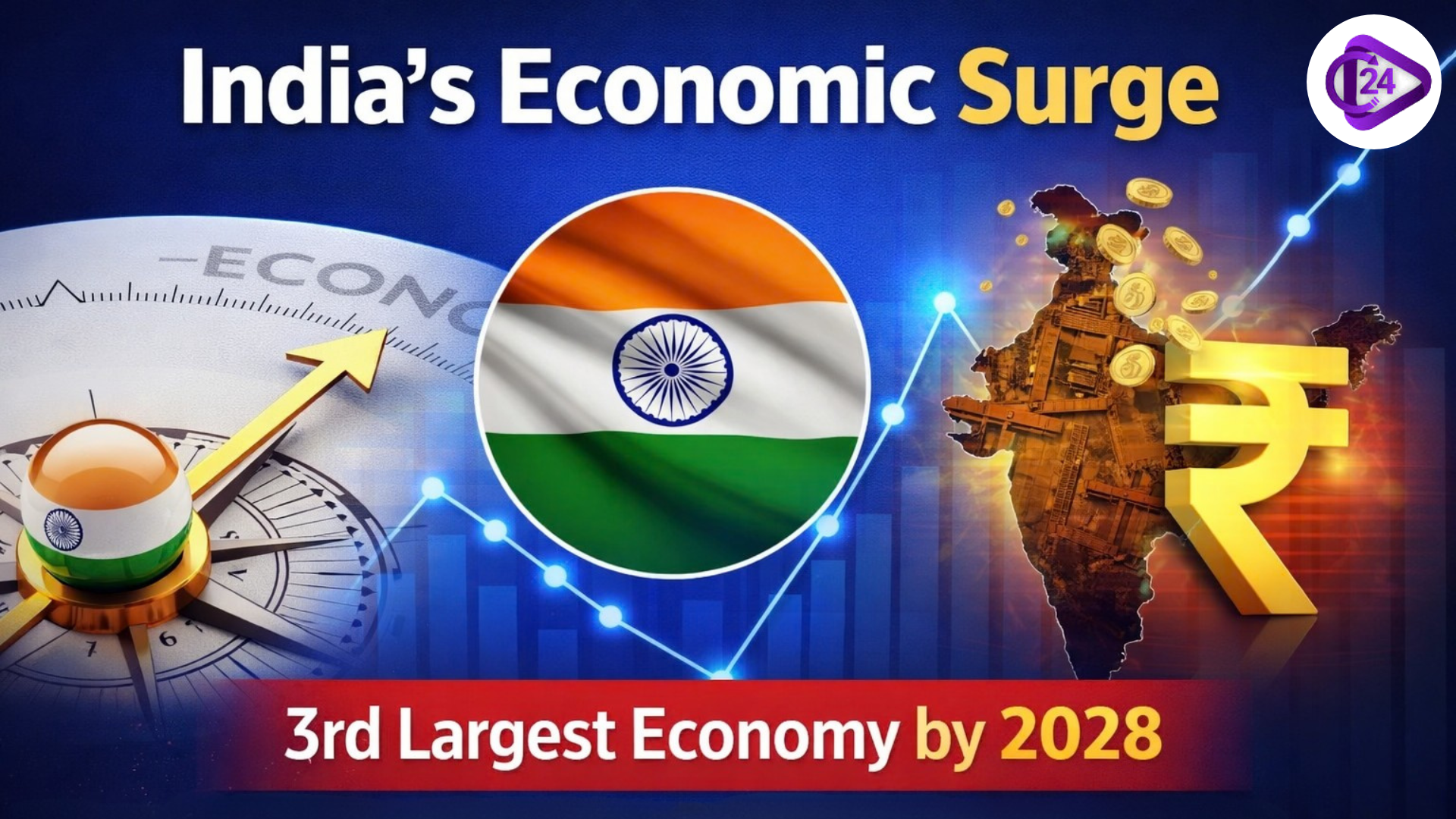
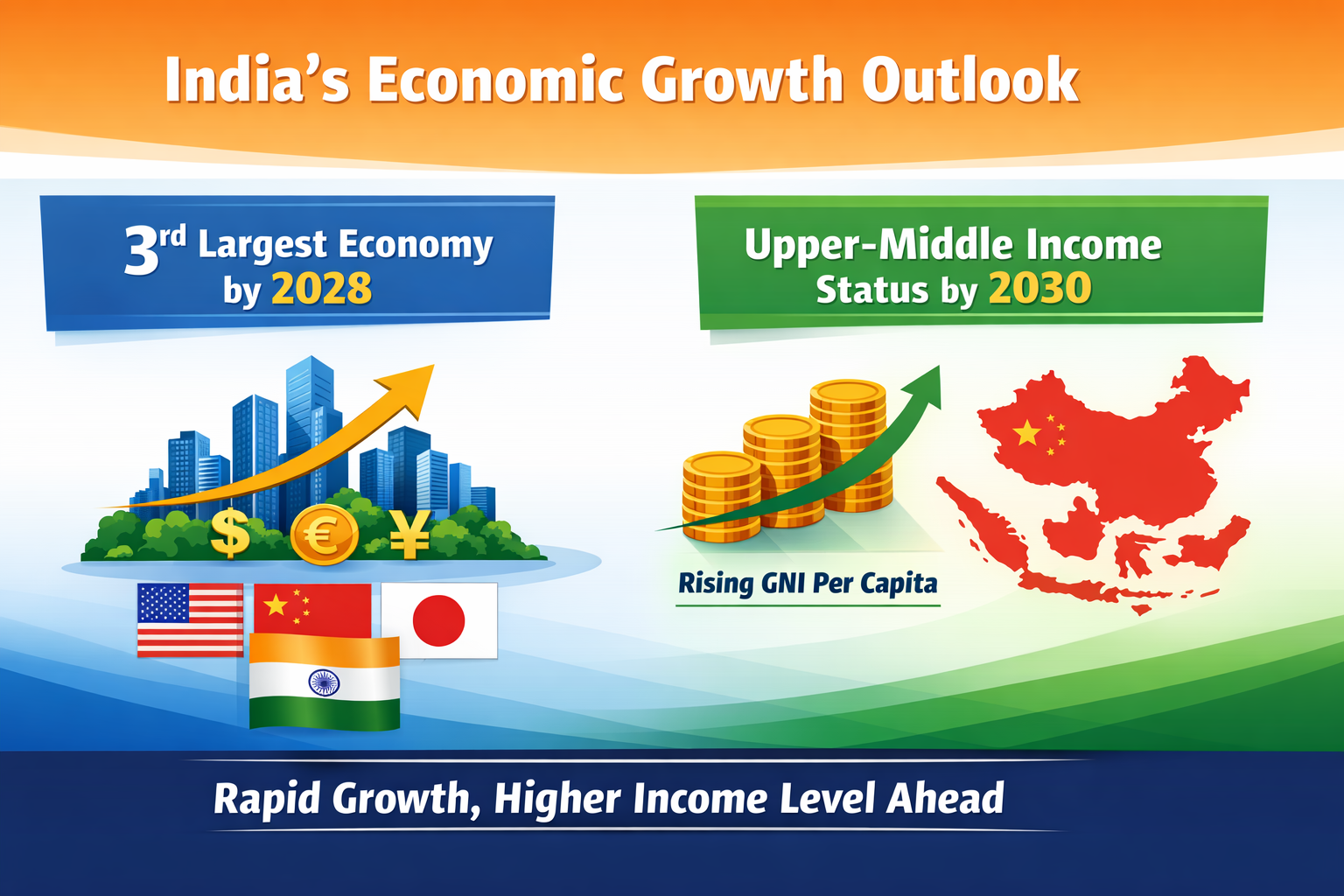
A recent report by SBI Research estimates India to be the third-largest in the world in terms of economy by 2028 and elevated into an upper-middle-income country by 2030. This projection indicates a fast rate of growth in the GDP and per capita income, and the projected growth is expected to continue due to the high domestic demand, structural reforms and rising GNI per capita. When India becomes an upper, not a lower-middle-income country, it will be an important milestone in its economic development, as it will be placed side by side with other Asian economies such as China and Indonesia in the world of income ranking and will promptly begin to take its role in the global economy.
India on Track to Become 3rd Largest Economy by 2028
-
India is set to be the third-largest economy globally by 2028; after a number of major advanced economies, its nominal GDP keeps rising.
-
Gross national income (GNI) per capita in the country is projected to increase gradually, allowing it to gain membership in the upper-middle income group by the year 2030.
-
Robust GDP growth, an increased pace of reforms and increasing domestic demand are the bedrock of this boom, as India has risen in the economic ranking by a notch higher than position 14 in 1990 to position 4 by 2025.
-
In this growth path, India will ensure that its economy reaches 500 billion dollars, or 5 trillion, by 2027-28.
- The growth will also lead to a major impact on world influence, investment chances and living standards of its people.
Recently Asked PYQs on Income and Poverty
| Exam | Year | Question (Poverty / Per Capita Income) | Answer |
|---|---|---|---|
| SSC Selection Post | 2024 | In 1989–90, whose per capita income was higher: Karnataka or Bihar? | Karnataka’s per capita income was higher than Bihar’s. |
| RRB ALP | Various | The total income of the country divided by its total population is termed as? | Per capita income |
| SSC CGL Tier-I | Various | Which state has the lowest per capita income? | Bihar has the lowest per capita income |
| SSC CGL Tier-I | 2021 | If India’s national income is 200 lakh crore and the population is 100 crore, what is the per capita income? | ₹2 lakh per person |
| SSC MTS | 2020 | Which of the following affects per capita income the most? (a) Population growth (b) Inflation (c) Literacy rate (d) Exports | Population growth |
| UPSC Prelims | 2017 | How is per capita income related to economic development? | It measures average income per person, indicating living standards and growth |
| UPSC Prelims | 2019 | Official poverty lines are higher in some States than others because: | Price levels vary |
| UPPCL JE | 2022 | Approximate percentage of people below the poverty line in India in 2011–12 (Tendulkar method)? | 22% |
| State PCS (UP PCS) | 2020 | Which methods are used to estimate poverty in India? | Head Count Ratio, Calorie Intake, Household Consumption Expenditure |
| UPPCS Prelims | 2017 | In which year did UNO adopt a definition of absolute poverty? | 1994 |
| U.P. R.O. / A.R.O. | 2013 | The basis of poverty estimates in India is: | Household Consumption Expenditure |
| UPSC Prelims | 2012 | The Multidimensional Poverty Index (MPI) covers which aspects? | Deprivation in education, health, assets and services |
| SSC CGL Tier-I | 2004–05 | Approximate percentage of the population below the poverty line | 37.2% |
| UP PCS | 2011–12 | Estimated percentage of persons below the poverty line (Tendulkar method) | 21.9% |
| UPPCS Prelims | 2011 | Official estimates of the Indian population below the poverty line | 26% |
Conclusion (India to Become 3rd Largest Economy by 2028)
The growth of India to the third-largest economy in 2028 and the upper-middle-income status in 2030 is an indication of booming GDP growth, structural reforms, and rising domestic demand. This economic boom will boost the world impact, investment attraction, elevated living standards, and entrench Indian identity as a top emerging economy in the world.