



Google DeepMind has presented the AlphaGenome, which elucidates the impact that a DNA mutation has by observation of regulatory factors in long scales of the genome. In contrast to older models in which codons constitute the primary topic of coding studies, AlphaGenome studies up to one million DNA base pairs simultaneously and resolves in great detail, enabling scientists to observe the effect of genetic variations on the regulation and expression of genes. Trained on large-scale genomic data, the AI might hasten the study of complicated pathologies like cancer, cardiovascular illnesses, autoimmune conditions, and neurodegenerative diseases by revealing highly important regulatory changes and promoting precision medicine and genetic discovery.
Key Highlights of Google DeepMind’s AlphaGenome Tool
-
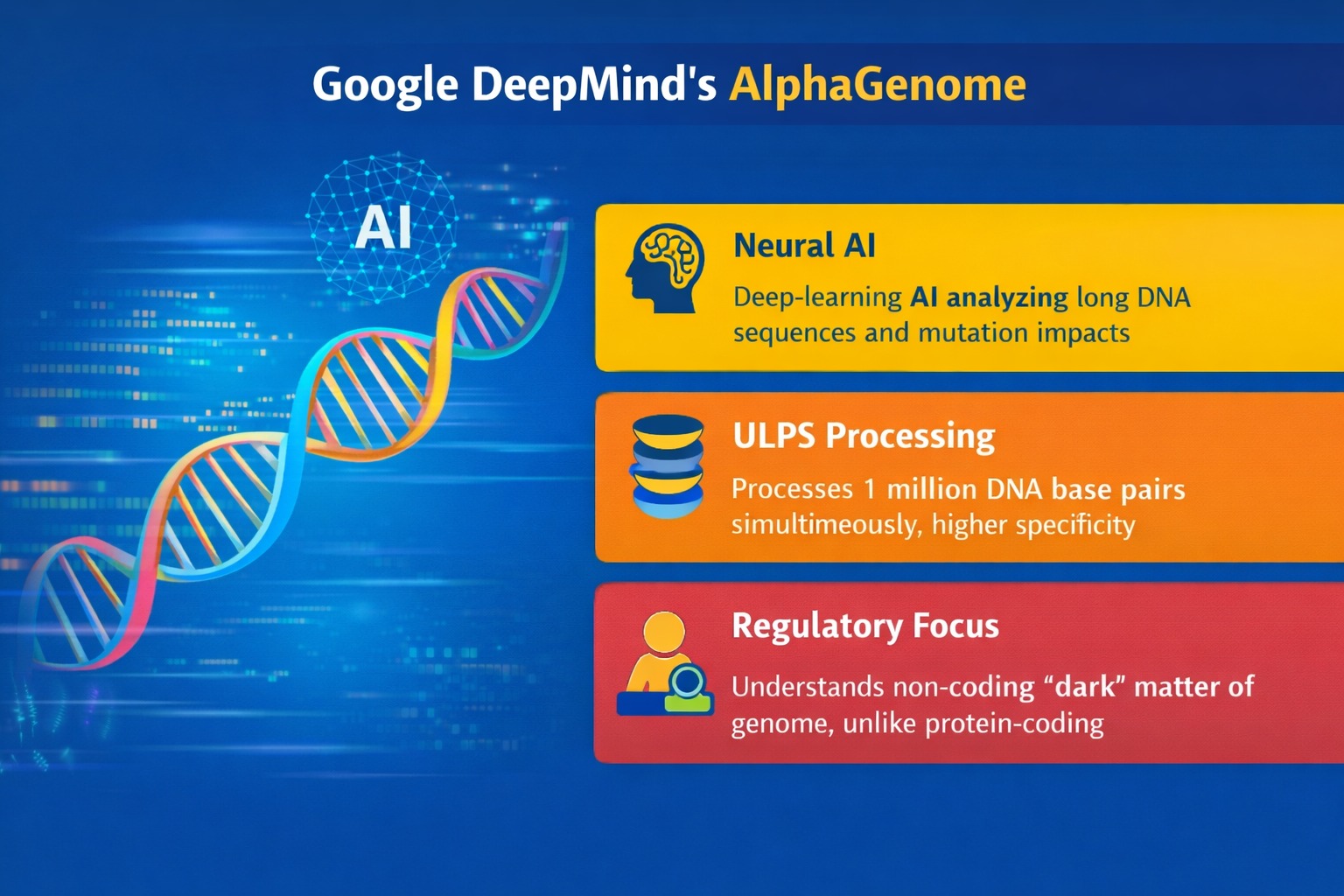
Neural AI: AlphaGenome is a deep-learning engine by Google DeepMind that is trained to analyse long sequences of DNA and predict the influence of genetic mutations on the regulation and expression of genes.
-
ULPS Processing: The model is capable of processing DNA base pairs in large quantities (up to 1 million base pairs) with more detail and base-level specificity, which is enormously more powerful than older genomic models.
-
Regulatory Focus AlphaGenome does not target protein-coding sequences, as many other tools do, and is good at understanding non-coding sequences (also referred to as the dark matter of the genome) that regulate the timing and manner of gene expression.
-
Multimodal Predictions: It is capable of predicting gene expression states, RNA splicing levels, chromatin access states and transcription factor binding and providing a full functional understanding.
-
Excellent performance on Benchmarks: AlphaGenome performs equally or better than the existing state-of-the-art models on genomic prediction and variant effect tasks, indicating its general applicability.
-
Variant Impact Scoring: The model can be used to score the effects of mutations on regulatory activity, allowing researchers to prioritise variants of interest to study.
-
Research and Disease Insight: AlphaGenome allows scientists to study disease-related mutations as well as how diseases are controlled, and boost the development of precision medicine.
-
Broad Academic illustration: The instrument is presented as API to the research community and already serves the worldwide population to enable the genomic examination and discovery.
Most Previous Year Questions on DNA Mutations
| Exam | Year | Question (DNA / Mutation / Genetics) | Options | Answer |
|---|---|---|---|---|
| UPSC CSE Prelims | 2018 | Which of the following causes point mutations in DNA? | A) Radiation B) Chemicals C) Spontaneous errors D) All of the above |
D |
| UPSC CSE Prelims | 2020 | Consider the following statements: 1. Mutations can be somatic or germline. 2. Somatic mutations can be inherited. 3. Mutagens increase the mutation rate. Which are correct? |
A) 1 and 2 only B) 1 and 3 only C) 2 and 3 only D) All |
B |
| NEET UG | 2019 | Frameshift mutation occurs due to? | A) Insertion B) Deletion C) Substitution D) Both A and B |
D |
| NEET UG | 2021 | Which of the following is an example of a silent mutation? | A) Change in DNA but same amino acid B) Nonsense mutation C) Missense mutation D) Insertion mutation |
A |
| SSC CGL Tier-I | 2017 | A DNA mutation that changes a single base pair is called? | A) Point mutation B) Frameshift mutation C) Chromosomal mutation D) Gene duplication |
A |
| SBI PO Prelims | 2018 | Can mutations occur due to? | A) Spontaneous errors in replication B) Radiation C) Chemicals D) All of the above |
D |
| RRB NTPC | 2020 | Which type of mutation does not alter the protein sequence? | A) Missense B) Nonsense C) Silent D) Frameshift |
C |
| NEET UG | 2022 | Mutagens are agents that? | A) Repair DNA B) Cause mutations C) Transcribe RNA D) Translate protein |
B |
| UPSC Prelims | 2016 | Spontaneous mutations occur due to? | A) Chemical mutagens B) UV radiation C) DNA replication errors D) Virus |
C |
Conclusion (Google DeepMind’s AlphaGenome)
An important advance in the study of genomics comes with the creation of Google DeepMind AlphaGenome, which utilises AI to process long sequences of DNA to make predictions on the consequences of mutations. It enables quick disease research, precision medicine, and establishes the future standard of AI-advanced genomic discovery and the advancement of healthcare through the decoding of regulatory regions and the evaluation of the global impact of variations.