

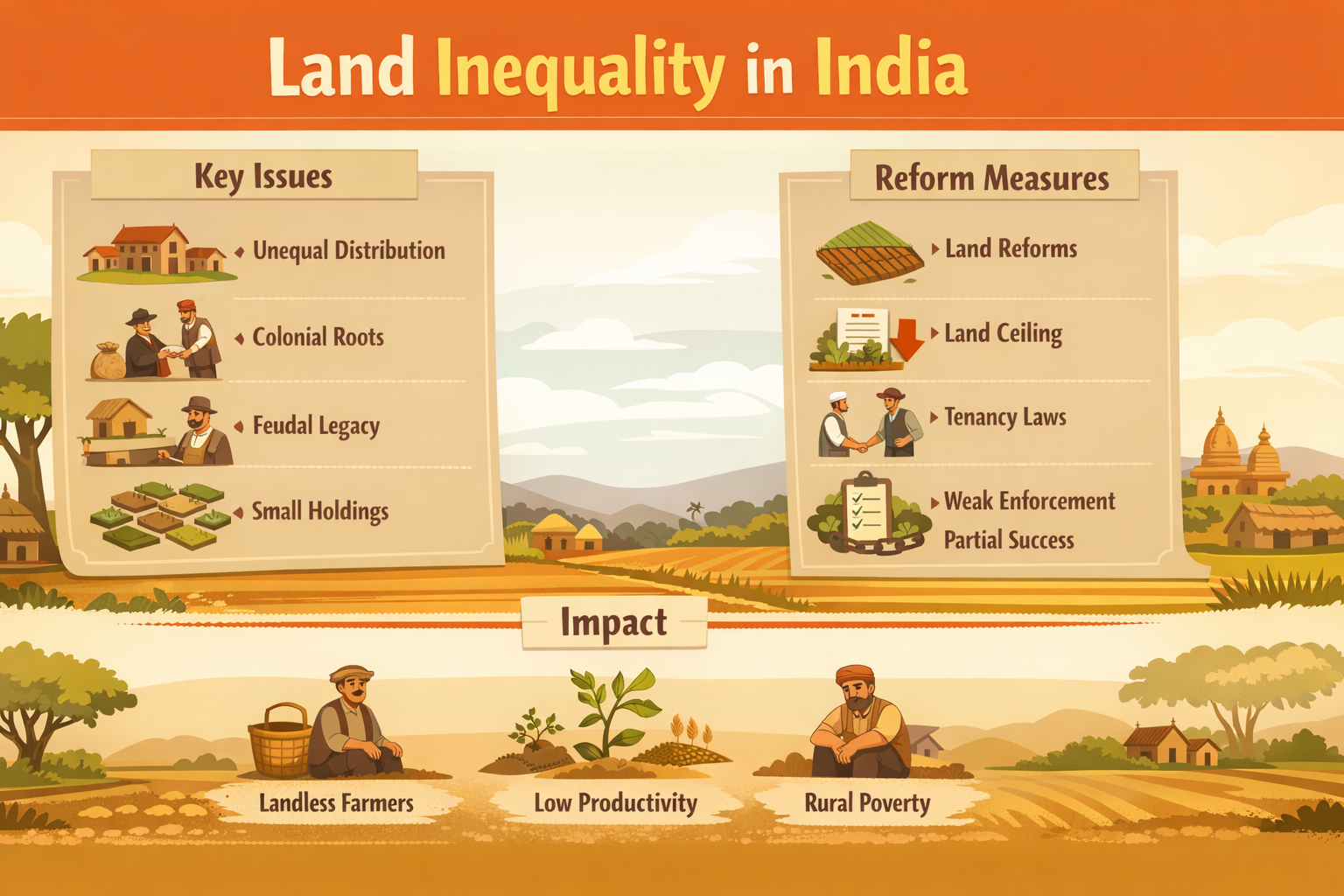
The land inequality in India is a severe socio-economic problem, which is deeply embedded in history and institutional aspects. It has been described as disparate land ownership, whereby a minuscule part of the society owns much of the land, leaving many landless or marginal farmers. This disproportionately impacts agricultural productivity, rural lifestyle, and economic development. The land ownership patterns have been influenced over the years by colonial policies, land reforms and market forces. This knowledge about land inequality is critical to solving poverty, guaranteeing social justice, and encouraging inclusive growth in the fast-changing Indian economy.
Significance of Land Inequality in India
-
Very Unequal Distribution: Land has been among the most unequally distributed resources in India, which presents itself in rural livelihoods.
-
Nature Factor: Variation in the quality of soil, irrigation, and agroclimatic conditions affects the level of land productivity and the pattern of land ownership.
-
Historical Foundations: Colonialism had instituted a category of landlords and landless workers through the Zamindari.
-
Feudal Legacy: At independence, a few elite concentrated land in their hands, and tenants had no rights to own land.
-
Post-Independence Reforms: The reforms aimed to end intermediaries and social injustice by redistributing land.
-
Reform Measures: These included tenancy regulation, land ceilings, and consolidation of holdings, among others.
-
Partial Success: Reforms were only partially successful due to loopholes, weak enforcement, and political opposition.
-
Fracturing of Land: Smaller and less productive land lots were the result of inheritance practices.
-
Market Dynamics: Access to markets, credit, and infrastructure impacts land value and inequality.
-
Caste Influence: The social stratification still affects the access and ownership of land.
-
Economic Impact: Inequality in land is a restriction to productivity as well as rural poverty.
-
Policy Dilemma: Structural inequality and power imbalance still exist in spite of numerous reforms.
-
Reform is Required: There is a need to make reforms to improve land records, fair policies, and inclusive growth policies to minimise inequality.
Legal Framework for Land Reforms in India
-
Intermediaries (Zamindari Abolition Acts) were abolished with the intention of moving the property rights to real cultivators.
-
Tenancy reforms aimed to control rent, ensure security of tenure, and give ownership rights to tenants.
-
Sample: Operation Barga, West Bengal.
-
The Land Ceiling Act gave a maximum limit on the amount of land one person or family should own, with excess land supposed to be distributed to the landless people.
-
Landholdings were to be consolidated to alleviate fragmentation and enhance agricultural productivity, with a specific preference to Punjab and Haryana states.
-
Efforts such as the Digital India Land Records Modernisation Programme (DILRMP) are trying to digitise land records so that they can increase transparency and decrease conflicts.
-
The Forest Rights Act, 2006, acknowledged land rights of the forest-dwelling Scheduled Tribes and other traditional forest dwellers in correlation with historical injustices.
Conclusion – Land Inequality in India
Land inequality in India remains a significant challenge towards inclusive growth and rural development. Uneven distribution remains a reality despite the policy and land reforms because of historical undertakings and market forces. To solve this problem, it is necessary to properly implement reforms, provide better land control, and provide equal resource access. To maximize agricultural production, maximize poverty reduction and to achieve social justice in the changing India economy, it is imperative to reduce land inequality.