

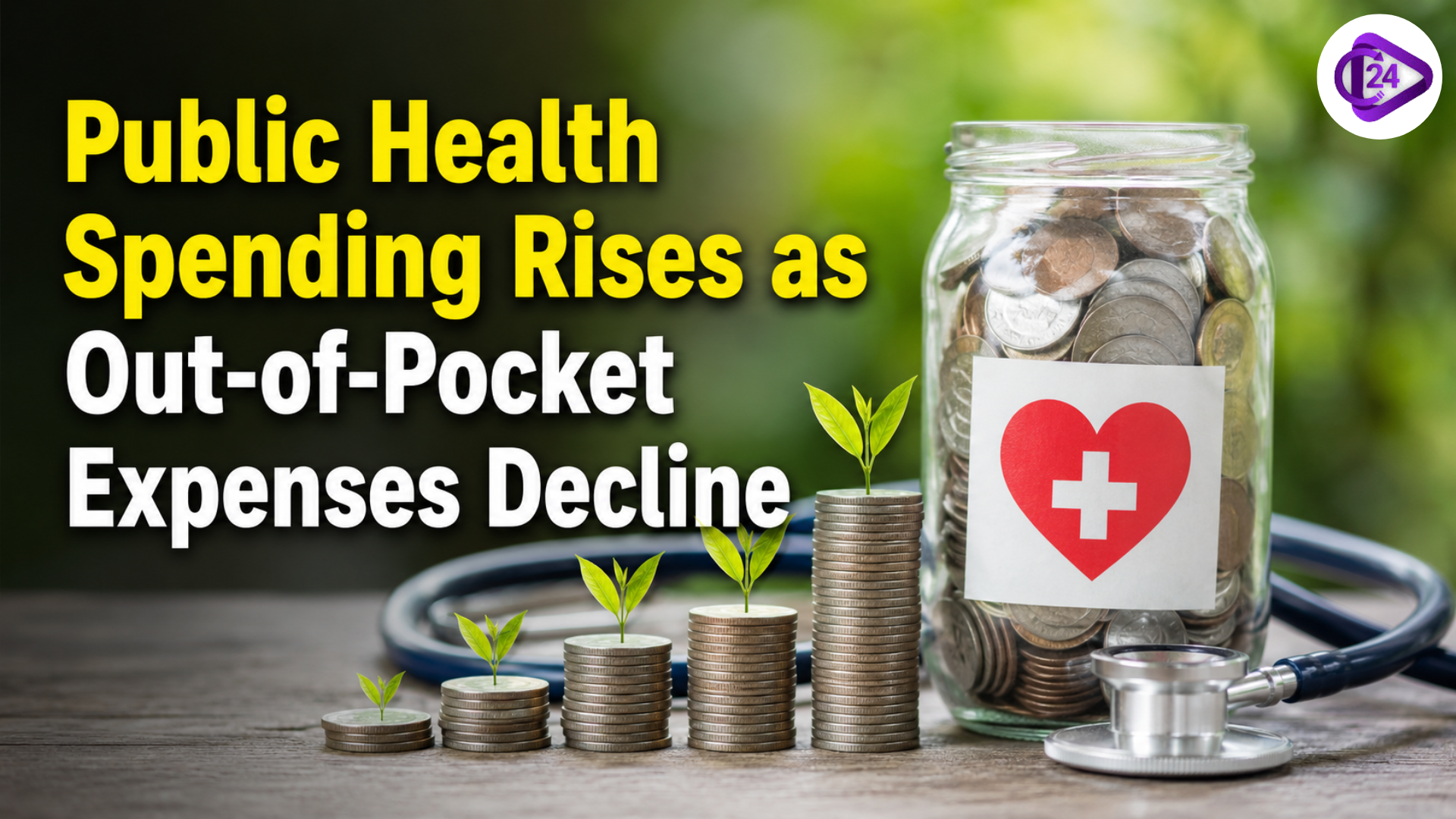
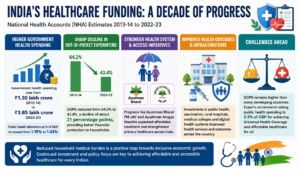
Over the past ten years, India’s healthcare funding system has undergone a significant shift. Government expenditure on healthcare has also seen a substantial rise, which has led to a substantial decrease in the burden on households, according to the latest National Health Accounts (NHA) Estimates, released by the Ministry of Health and Family Welfare. Out-of-pocket expenditure (OOPE), defined as direct payments made by citizens for medical treatment, has reduced from 64.2 per cent in 2013-14 to 43.4 per cent in 2022-23. This improvement is attributable to increased public health expenditure, insurance coverage, Ayushman Bharat schemes, and a robust healthcare system. But experts feel an additional investment is needed to make healthcare affordable and accessible for everyone in India.
Public Health Spending in India: Key Highlights
- Government health spending rose from ₹1.30 lakh crore in 2013-14 to almost ₹3.85 lakh crore in 2022-23.
- During the same period, public health allocation as a percentage of GDP climbed from 1.15% to almost 1.43%.
- The OOPE has decreased steeply by approximately 21 percentage points over 10 years.
- The decrease in OOPE reflects better financial protection for Indian households.
- The Ayushman Bharat and PM-JAY schemes opened new doors to getting treatment for millions of families at affordable prices.
- The government’s promotion of Ayushman Arogya Mandirs enhanced primary health care.
- There was overall enhancement of public health facilities because of vaccination drives and investments in the health sector during the pandemic.
- Per capita public expenditure on health care has risen significantly in the past few years.
- The stagnation of the number of deaths in the Philippines was also attributed to the increasing share of state governments in financing health care, as reflected in the National Health Accounts report.
- Even with the improvement, Indian OOPE is still higher than a number of other developing countries, experts note.
- Enhancing coverage by the family has lowered catastrophic out-of-pocket expenses that poor families face when it comes to health care costs.
- The World Health Organisation (WHO) has been calling for enhanced public funding as a key requirement for achieving Universal Health Coverage (UHC).
- Enhanced investment was observed in the healthcare industry for rural hospitals, medical colleges, digital healthcare systems, etc.
- Improvements in spending have enhanced services for disease control, maternal services, child health services and immunisation.
- But it is also reported that the billings of private hospitals are still high.
- The results of some surveys show that even some patients obtain loans and savings for health and emergencies.
- Benchmarking the spending on healthcare to 2.5% of GDP is suggested to improve the objectives of healthcare in the long run.
- Reducing household medical burden is seen as being a positive development towards inclusive economic growth.
- Improved health-care financing can boost productivity, alleviate poverty and promote general human development.
- Policymakers remain preoccupied with extending insurance coverage and greater access to health care throughout the country, as well as the affordability of these options.
PYQs on Public Health Spending and Healthcare Financing
| Exam Name | Year | Question | Options | Answer |
| UPSC Prelims | 2020 | Ayushman Bharat scheme is related to which sector? | A. Education B. Healthcare C. Agriculture D. Defence | B. Healthcare |
| SSC CGL | 2021 | What does OOPE stand for in healthcare economics? | A. Out of Public Expenditure B. Out-of-Pocket Expenditure C. Official Public Economic Expenditure D. Out of Patient Expense | B. Out-of-Pocket Expenditure |
| RRB NTPC | 2022 | Which ministry releases National Health Accounts Estimates in India? | A. Ministry of Finance B. Ministry of Statistics C. Ministry of Health and Family Welfare D. Ministry of Rural Development | C. Ministry of Health and Family Welfare |
| UPSC Mains | 2018 | Discuss the importance of public healthcare expenditure in achieving inclusive growth. | A. Only economic growth B. Universal healthcare and social welfare C. Defence expansion D. Industrialization only | B. Universal healthcare and social welfare |
| SSC CHSL | 2023 | PM-JAY is a component of which flagship programme? | A. Digital India B. Ayushman Bharat C. Skill India D. Startup India | B. Ayushman Bharat |
India-US, Quad Push Critical Minerals Partnership
Conclusion: Rising Public Health Investment Strengthens India’s Healthcare System
As India invests in public healthcare, it is moving towards a more cost-effective, accessible, and inclusive healthcare system. Reducing the share of OPE helps draw attention to greater healthcare infrastructure, increased insurance coverage, and greater government support. In the Government of India’s schemes, such as Ayushman Bharat, increased public funding has lessened the financial strain on millions of households. Nonetheless, health issues like an increasing health care hospitalization expenses and uneven access to quality health services remain. Leading experts say that India should do more to scale up the allocation of financial resources for health, enhance the capacity of rural health systems and make health insurance more effective to achieve the goal of Universal Health Coverage and build sustainable social and economic growth.