Day: April 11, 2026
Land InEquality

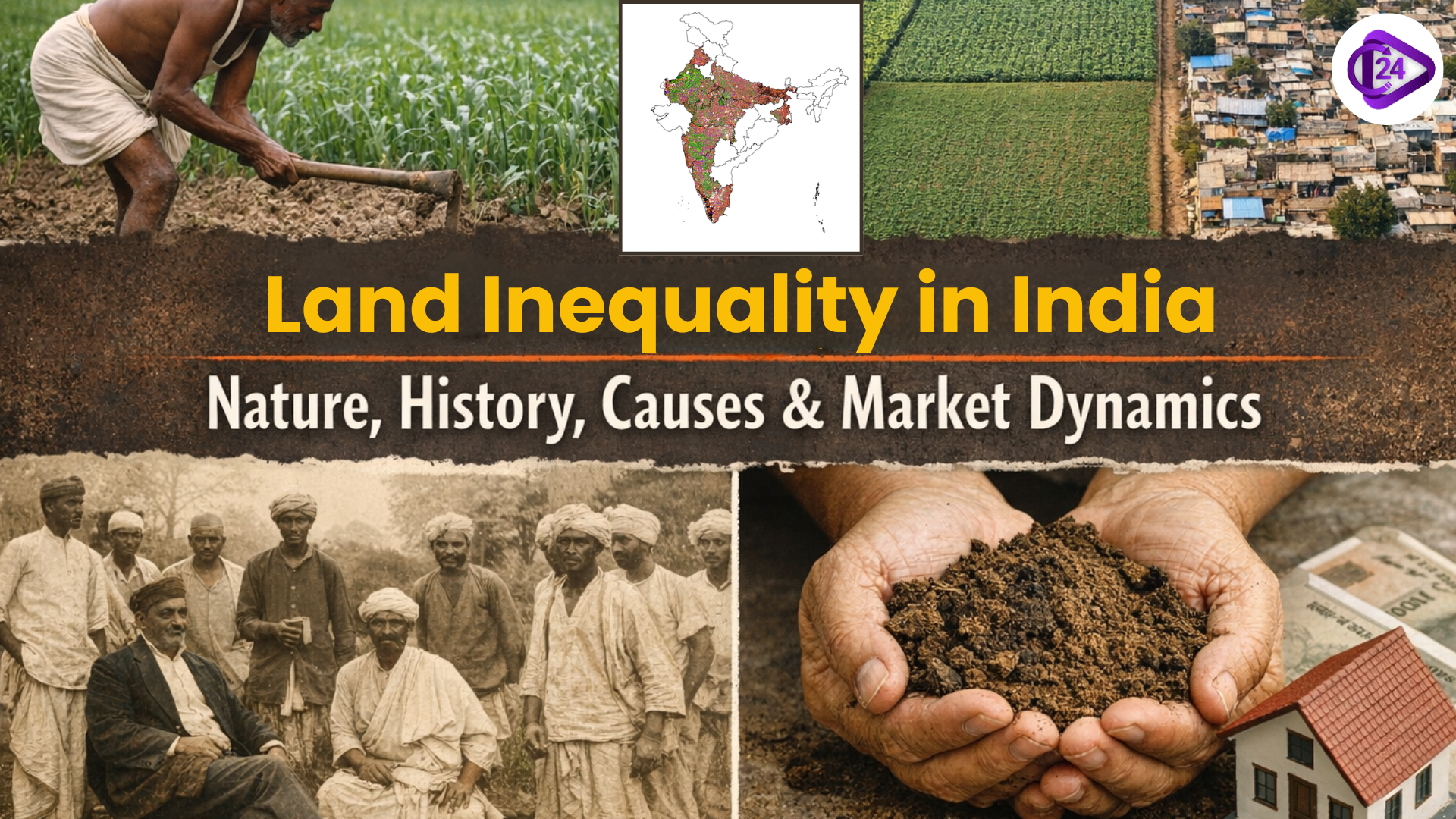
Land Inequality in India: Nature, History, Causes & Market Dynamics

The land inequality in India is a severe socio-economic problem, which is deeply embedded in history and institutional aspects. It has been described as disparate land ownership, whereby a minuscule part of the society owns much of the land, leaving many landless or marginal farmers. This disproportionately impacts agricultural productivity, rural lifestyle, and economic development. The land ownership patterns have been influenced over the years by colonial policies, land reforms and market forces. This knowledge about land inequality is critical to solving poverty, guaranteeing social justice, and encouraging inclusive growth in the fast-changing Indian economy.

Significance of Land Inequality in India

  • Very Unequal Distribution: Land has been among the most unequally distributed resources in India, which presents itself in rural livelihoods.

  • Nature Factor: Variation in the quality of soil, irrigation, and agroclimatic conditions affects the level of land productivity and the pattern of land ownership.

  • Historical Foundations: Colonialism had instituted a category of landlords and landless workers through the Zamindari.

  • Feudal Legacy: At independence, a few elite concentrated land in their hands, and tenants had no rights to own land.

  • Post-Independence Reforms: The reforms aimed to end intermediaries and social injustice by redistributing land.

  • Reform Measures: These included tenancy regulation, land ceilings, and consolidation of holdings, among others.

  • Partial Success: Reforms were only partially successful due to loopholes, weak enforcement, and political opposition.

  • Fracturing of Land: Smaller and less productive land lots were the result of inheritance practices.

  • Market Dynamics: Access to markets, credit, and infrastructure impacts land value and inequality.

  • Caste Influence: The social stratification still affects the access and ownership of land.

  • Economic Impact: Inequality in land is a restriction to productivity as well as rural poverty.

  • Policy Dilemma: Structural inequality and power imbalance still exist in spite of numerous reforms.

  • Reform is Required: There is a need to make reforms to improve land records, fair policies, and inclusive growth policies to minimise inequality.

Legal Framework for Land Reforms in India

  • Intermediaries (Zamindari Abolition Acts) were abolished with the intention of moving the property rights to real cultivators.

  • Tenancy reforms aimed to control rent, ensure security of tenure, and give ownership rights to tenants.

  • Sample: Operation Barga, West Bengal.

  • The Land Ceiling Act gave a maximum limit on the amount of land one person or family should own, with excess land supposed to be distributed to the landless people.

  • Landholdings were to be consolidated to alleviate fragmentation and enhance agricultural productivity, with a specific preference to Punjab and Haryana states.

  • Efforts such as the Digital India Land Records Modernisation Programme (DILRMP) are trying to digitise land records so that they can increase transparency and decrease conflicts.

  • The Forest Rights Act, 2006, acknowledged land rights of the forest-dwelling Scheduled Tribes and other traditional forest dwellers in correlation with historical injustices.

World Health Day 2026

Conclusion – Land Inequality in India

Land inequality in India remains a significant challenge towards inclusive growth and rural development. Uneven distribution remains a reality despite the policy and land reforms because of historical undertakings and market forces. To solve this problem, it is necessary to properly implement reforms, provide better land control, and provide equal resource access. To maximize agricultural production, maximize poverty reduction and to achieve social justice in the changing India economy, it is imperative to reduce land inequality.

World Homoeopathy Day

World Homoeopathy Day 2026: Date, Theme, History & Significance

It is celebrated on the 10th of April each year to recognise the birth date of the father of homoeopathy, Samuel Hahnemann; it is World Homoeopathy Day 2026. This day shows consideration of alternative medicine and creates awareness about holistic healing practices. Homoeopathic medicine is founded on the rule of like cures like and emphasises natural remedies that contain few side effects. The day is celebrated throughout the world, notably in India by the Ministry of AYUSH, as it acknowledges the emergence of homoeopathy in health care provision and promotes research, learning, and interacting with mainstream medicine.

Key Points on World Homoeopathy Day

  • Date: March 10, April, the anniversary of the birth of Samuel Hahnemann, which is celebrated annually.

  • Founder: Hahnemann (1755) can be called the father of homoeopathy, and he proposed this system in the 18th century.

  • Theme 2026: “Homoeopathy for Sustainable Health”

  • History: The practice was initiated in India, and subsequently, it drew attention worldwide as a significant health awareness campaign.

  • Main Thesis: The law of like cures like suggests that similar maladies can be cured by similar substances in limited amounts.

  • International Significance: Observed all over the globe to encourage alternative and complementary systems of medicine.

  • Significance in India: Widely practised, with millions relying on homoeopathic treatment for healthcare.

  • AYUSH Role: The Government of India encourages homoeopathy by creating awareness and carrying out research.

  • Awareness Programmes: Seminars, workshops, and conventions are arranged to make people aware of their advantages.

  • Training concentration: Training is an incentive that highlights scientific validation and the incorporation of scientific research into a mainstream healthcare framework.

  • Holistic Healing: Focuses on natural medicine, has few side effects, and takes a patient-centred approach.

  • Contemporary Applicability: Is relevant in the prevention of healthcare and sustainable medical practices around the world.

Stagflation Explained 2026

Conclusion – World Homoeopathy Day 2026

World Homoeopathy Day is a special day to remember the role of Samuel Hahnemann and the increasing importance of homoeopathy in healthcare today. It underlines the importance of natural, safe and holistic ways of treating people. The day evokes more consciousness, investigation, and acknowledgement of alternative medicine systems, inviting an equilibrium in terms of health and well-being in the modern, rapidly changing society.

Jyotiba Phule Jayanti

Jyotiba Phule Jayanti 2026: Significance, Biography & Social Reforms

Jyotirao Phule Jayanti 2026 is celebrated on 11th April to celebrate the birth anniversary of one of the most outstanding social reformers in India. He was Mahatma Phule, and he devoted his life to struggling against social injustice, caste discrimination, and inequality. His view on education was that the process is the key to social change, and he was energetic in his efforts to improve the lives of women and the disadvantaged communities. His work formed the basis of new social justice movements in India. The day has been observed throughout the country as a commemoration of his works and a call to action by people for equality, justice, and inclusive development.

Key Points on Jyotiba Phule Jayanti

  • Observed on the 11th of April every year in honour of the birthday of Jyotirao Phule, who was born in 1827 in Maharashtra.

  • He was a social reformer, the man of equality and human rights in 19th-century India.

  • Vitriolically opposed the caste system and led to the upliftment of Shudras and Dalits.

  • In 1848, the first girls’ school in India was opened, along with Savitribai Phule.

  • Advancing the schooling of women when education was denied to women.

  • Established the Satyashodhak Samaj (1873), intending to promote equality and social justice.

  • Promoted remarriage among widows and was against child marriage.

  • Found homes to aid orphaned children and widows.

  • Opened his water well to every caste that encouraged social equality.

  • Left remarkable works such as Gulamgiri, where he wrote on caste oppression.

  • His thoughts inspired the leaders, such as B. R. Ambedkar, and current social justice movements.

  • Jyotiba Phule Jayanti highlights the roles of education, equality, and social reform in society today.

Jyotiba Phule’s Contribution to Social Reformation

Jyotirao Phule made a bold stance against the caste system, patriarchy, and religious orthodoxy. Phule never gave up on challenging societal principles that perpetuated inequality through his writings, activism, and institutions. His contributions have included:

Satyashodhak Samaj (1873): Satyashodhak Samaj, which was also known as a Society of Truth Seekers, was founded to eliminate caste discrimination, train people to think logically, and provide social awareness to the underprivileged groups. It strived to create a society that was founded on equality and justice.

Women’s Education Promotion: He opened the first girls’ school in India in 1848, together with Savitribai Phule. He thought that women had to be educated to transform society.

Widow Rights and Social Reform: Phule was a proponent of widow remarriage and child marriage and was keen on enhancing the status of widows by setting up care centres to address their concerns.

The Stand against Caste Inequality: He actively opposed the dominance of the Brahmans by writing on equality and human dignity, highlighting caste-based exploitation, such as in Gulamgiri.

Education as a Process of Change: Jyotiba was a great believer that learning was the greatest weapon to empower the downtrodden communities and equip them to build an inclusive society.

CAG Report: 518 Out of 697 Lakes

Conclusion – Jyotiba Phule Jayanti

Jyotiba Phule Jayanti is a great rejuvenation of the vision of an equal and just society that Jyotirao Phule had. His works in the field of education, social reform and upliftment of the marginalised societies remain an inspiration to several generations. The day is a reminder to respect equality, combat discrimination and appreciate education as the change tool. Recalling the legacy of Phule will assist in creating a more progressive and inclusive India based on justice and humanity.

Frequently Asked Questions (FAQs)

The current affairs cover recent national and international events related to UPSC, SSC, Banking, Railways, and State PCS.

You need to read about the current affairs daily, and revise them every week and every month to keep them longer in your memory.

Yes, Class24 provides free downloadable Daily Current Affairs PDFs for easy revision.

Yes, you can practice MCQs and quizzes to boost your exam preparation.

Absolutely. The content is written in simple, easy-to-understand bilingual language suitable for beginners.

Go to class24.com and click on the current affairs section directly, where you find everything that you need.

ssc-toppers

Start Learning Today with Class24

Related current affairs

Class24 offers free video lectures for smart preparation, covering CGL, CPO, CHSL, MTS, and GD exams. Learn from expert faculty, revise concepts easily, practice with PYQs, and improve speed and accuracy through high-quality, exam-focused video lessons anytime, anywhere.

Get success in your hand. Start study anytime anywhere.

The journey becomes simple and enjoyable when you start taking interest in it. And through our app “Class24”, we will be your trusted partners in developing that interest.

Daily Quizzes
Mock Tests
Ongoing

No ongoing tests right now.