

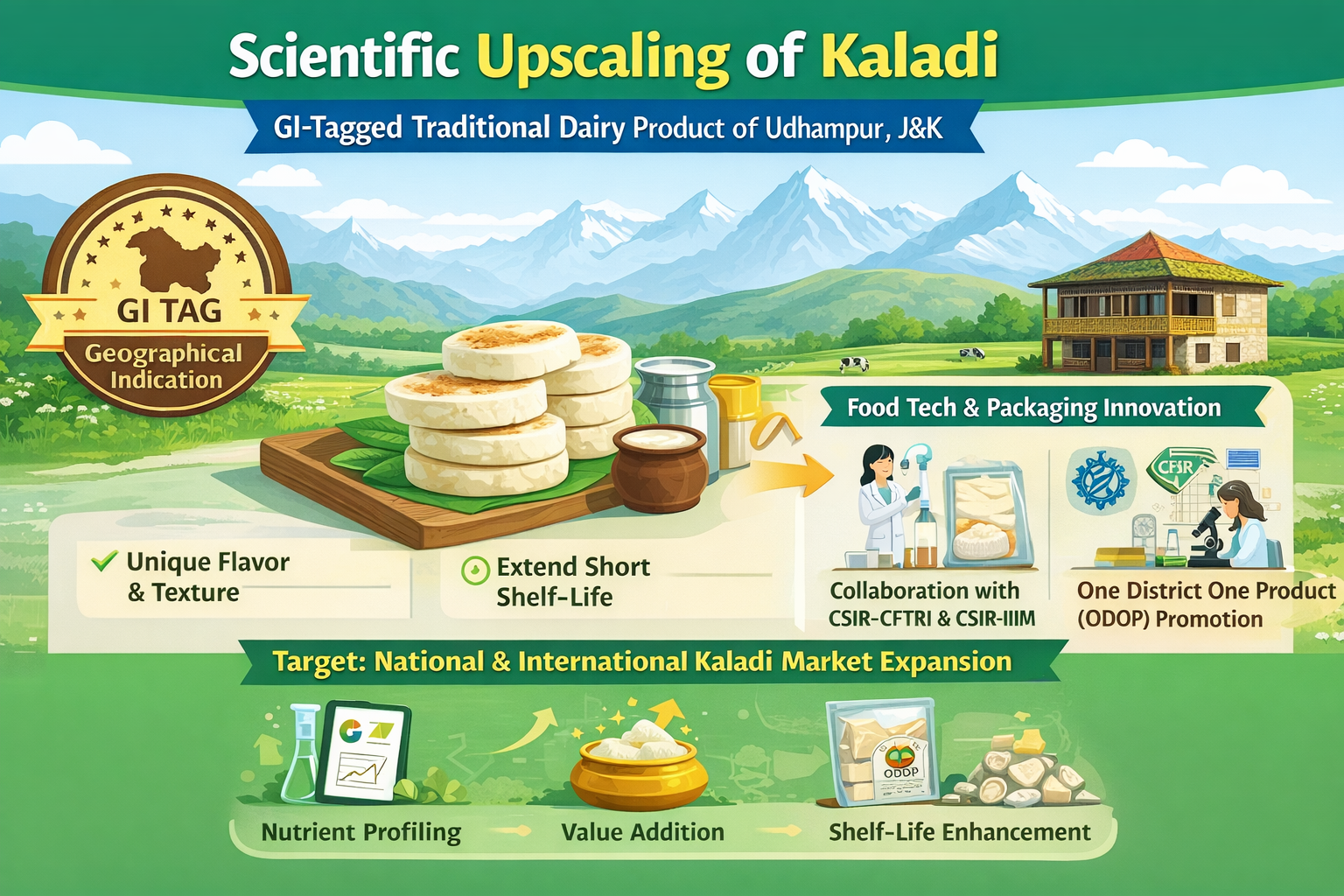
The scientific upscaling of Kaladi, a GI-tagged traditional dairy product of Udhampur district, Jammu and Kashmir, has been directed by the Government of India to be in a position to be used in wider culinary applications and in broader markets, without compromising on its unique flavour, texture, and nutritional value. The project, spearheaded by the Union Minister of State in Science and Technology as well as Earth sciences, seeks to deal with the low shelf life of Kaladi using cutting-edge food technologies and packaging in the One District One Product (ODOP) model. Nutrient profiling, value addition, and shelf-life enhancement will be done in collaboration with premier research institutes such as CSIR-CFTRI and CSIR-IIIM to increase the national and international market potential.
Importance of GI Tag for Kaladi Cheese
-
Definition of Geographical Indication (GI) Tag: A GI tag is a sign attached to a product that claims that it was produced at a particular geographic place with certain unique qualities, fame, or attributes by the location. The GI name has restrictions on who can use it, but only the authorised producers in that region.
-
Defends Authenticity: GI tagging assures the Kaladi cheese of Udhampur, Jammu and Kashmir, that it is the real thing and that the manufacturers in other regions cannot replicate it. It preserves the old production techniques and does not allow the market to become diluted.
-
Economic Benefits: The GI tag will increase the marketability and value of Kaladi so that producers can charge high premium prices and compete favourably in both the domestic and global markets.
-
Empowers Local Economies: GI recognition helps to create rural jobs and income among local artisans and dairy farmers through boosting the demand for authentic Kaladi.
-
Cultural Preservation: It assists in the conservation of special culinary heritage and traditional knowledge that is attributed to Kaladi, which is identified with the regional character of Jammu and Kashmir.
-
Markets, Tourism, and Export: GI-tagged products tend to be touristic, and they are more likely to be exported to raise awareness about the cuisine of the area.
GI‑Tagged Products of Jammu and Kashmir
| GI-Tagged Product | Category | District / Region |
|---|---|---|
| Kashmir Saffron | Food | Kashmir Valley |
| Kashmir Pashmina | Handicraft | Kashmir |
| Kashmiri Hand-Knotted Carpet | Handicraft | Kashmir Valley |
| Kashmir Paper Mache | Industrial / Handicraft | Kashmir |
| Kashmir Walnut Wood Carving | Handicraft | Kashmir |
| Kani Shawl | Handicraft | Kanihama, Budgam |
| Basmati Rice | Agricultural | Jammu & Kashmir |
| Kashmir Sozani Craft | Handicraft | Kashmir |
| Khatamband | Handicraft | Kashmir |
| Basohli Painting | Handicraft | Basohli, Kathua |
| Mushqbudji Rice | Agricultural | Anantnag |
| Bhaderwah Rajmash | Agricultural | Doda (Bhaderwah) |
| Ramban Sulai Honey | Natural / Agricultural | Ramban |
| Basohli Pashmina Woollen Products | Textiles / Handicraft | Kathua |
| Udhampur Kaladi | Foodstuffs | Udhampur |
| Rajouri Chikri Wood Craft | Handicraft | Rajouri |
| Ramban Anardana | Agricultural | Ramban |
Conclusion (Jammu and Kashmir GI-Tagged Kaladi)
The GI-tagged Kaladi of Jammu and Kashmir is the symbol of the rich culinary and traditional craftsmanship of the region. Through scientific upscaling, it can make it authentic, increase shelf life and increase the market potential. The project helps in livelihood sustainability and culture, and encourages sustainable economic development and links the uniqueness of the product in J&K with the domestic and international markets.