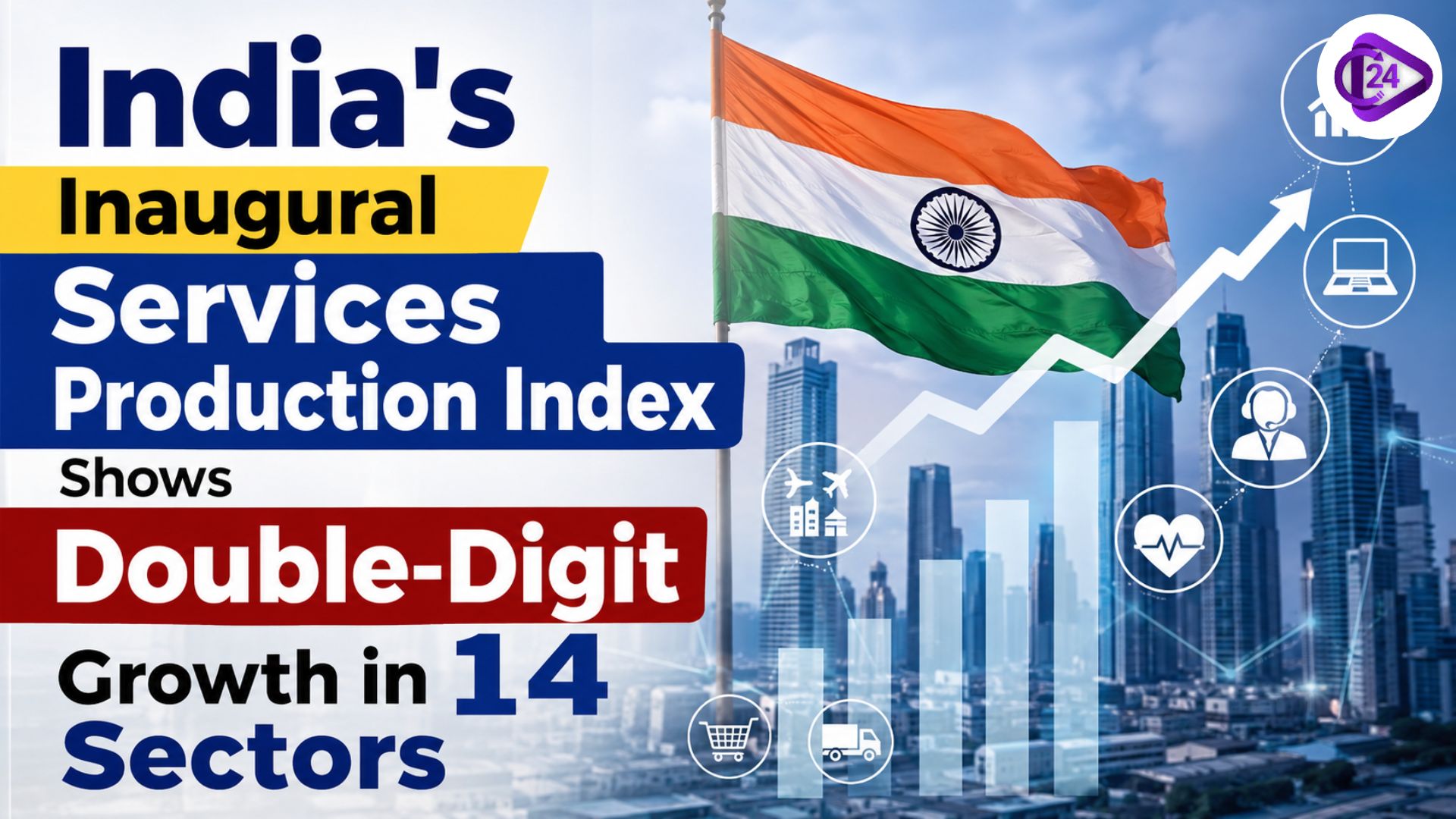


The recently implemented high-frequency economic indicator, which has been created to track India’s Services Production Index (SPI), provides the look and feel of services performance in India. The first SPI was released on December 20 by the Ministry of Statistics and Programme Implementation (MoSPI), which recorded double-digit growth in 14 top service sectors, confirming a resilient and quickly-growing service-driven economy for India.
The index is a timely measure of sectors like information technology, finance, transport, healthcare, hospitality, and education. The SPI is anticipated to enhance economic monitoring and policymaking, contribute towards improving GDP estimation and investment planning, etc., while also bolstering India’s statistical framework; the services sector accounts for more than 50% of India’s Gross Value Added (GVA).
Why in News?
Services Production Index (SPI), India has a new high-frequency economic indicator against which to gauge the performance of its services sector: SPI. The MoSPI combines hundreds of thousands of statistics in one detail, and reports monthly as part of its overall estimate system alongside GDP estimates with proper reporting on quarterly outputs too. Data released in early October exhibited strong growth in 14 of the nation’s largest service sectors, including information technology, financial services, transportation, hospitality, healthcare, education and professional services.
The SPI is expected to enhance the measurement of India’s services economy, enable evidence-driven policy response and provide timely information on one of the largest sectors contributing to India’s GSDP from output (contribution to GDP) and employment points of view.
India’s Inaugural Services Production Index (SPI)
India has launched the Services Production Index (SPI) to ensure more comprehensive and timely data of the services sector in India. Like that of manufacturing for the Index of Industrial Production (IIP), the SPI is designed to provide a clearer picture of changes in service-sector output over short periods, thereby assisting policymakers, businesses and investors in better grasping economic activity. Given that the services sector provides more than 50% of the country’s Gross Value Added (GVA), and continues to be a major employment generator, the introduction of the SPI is an important step towards improving India’s economic statistics.
Key Highlights of the Services Production Index (SPI)
- Source: Ministry of Statistics and Programme Implementation (MoSPI)
- Objective: To estimate the performance and output growth of India’s tertiary sector.
- First high-frequency Services Production Index in India.
- In the first release, a total of 14 service sectors had double-digit growth.
- It supplements other available economic indicators like IIP(Index of Industrial Production).
- This indicator offers timely information on the condition of the services economy.
- Assists in better GDP estimation and economic forecasting.
- Facilitates evidence-based policy formulation and business decision-making
What is the Services Production Index?
Services Production Index (SPI)The Services sectored SPI: the services production index, is a statistical indicator that measures how much the output and production of some service industry has changed over time. It works on the same lines as the Index of Industrial Production (IIP) but only for services.
The index aims to
- Measure short-term growth in services.
- Track sector-wise economic performance.
- Improve monitoring of business cycles.
- Strengthen national income estimation.
- Support investment and policy decisions.
Major Sectors Covered Under SPI
- Financial and Banking Services
- Insurance
- Transport and Logistics
- Warehousing
- Hotels and Restaurants
- Tourism
- Healthcare Services
- Education Services
- Professional and Technical Services
- Real Estate Services
- Communication Services
- Administrative and Business Support Services
- Entertainment and Recreation Services
Significance of the Services Sector in India
- The services sector is one of the biggest contributors to the Indian economy, and that is why:
- Accounts for over 50 % of India’s Gross Value Added (GVA).
- Contributes to a large percentage of GDP growth.
- Jobs across urban and rural areas
- Creates large national and foreign investments
- Brings exports due to IT and practically everything else in business.
- That becomes the force for innovation, digital transformation and entrepreneurship.
- Advantages of the Services Production Index
SPI approach has multiple benefits
- Assigns a reliability or timeliness score for economic data.
- Allows for more accurate tracking of growth by sector.
- Improves macroeconomic planning.
- Enables the Reserve Bank of India (RBI) and policymakers to monitor economic trends.
- Assists businesses in investment planning.
- Enhances transparency in economic statistics.
- Bringing India statistical regime in line with international best practices
R. Vairamuthu Receives 60th Jnanpith Award 2025
Conclusion on First Index of Services Production
The introduction of the Services Production Index (SPI) is a big step forward to assess the rapidly expanding services economy in India. SPI will enhance economic analysis, strengthen policymaking and sustain growth by delivering reliable data from across service sectors on a timely basis. A more service-driven Indian economy makes it all the more crucial for the index to monitor economic performance and guide future strategies over time.