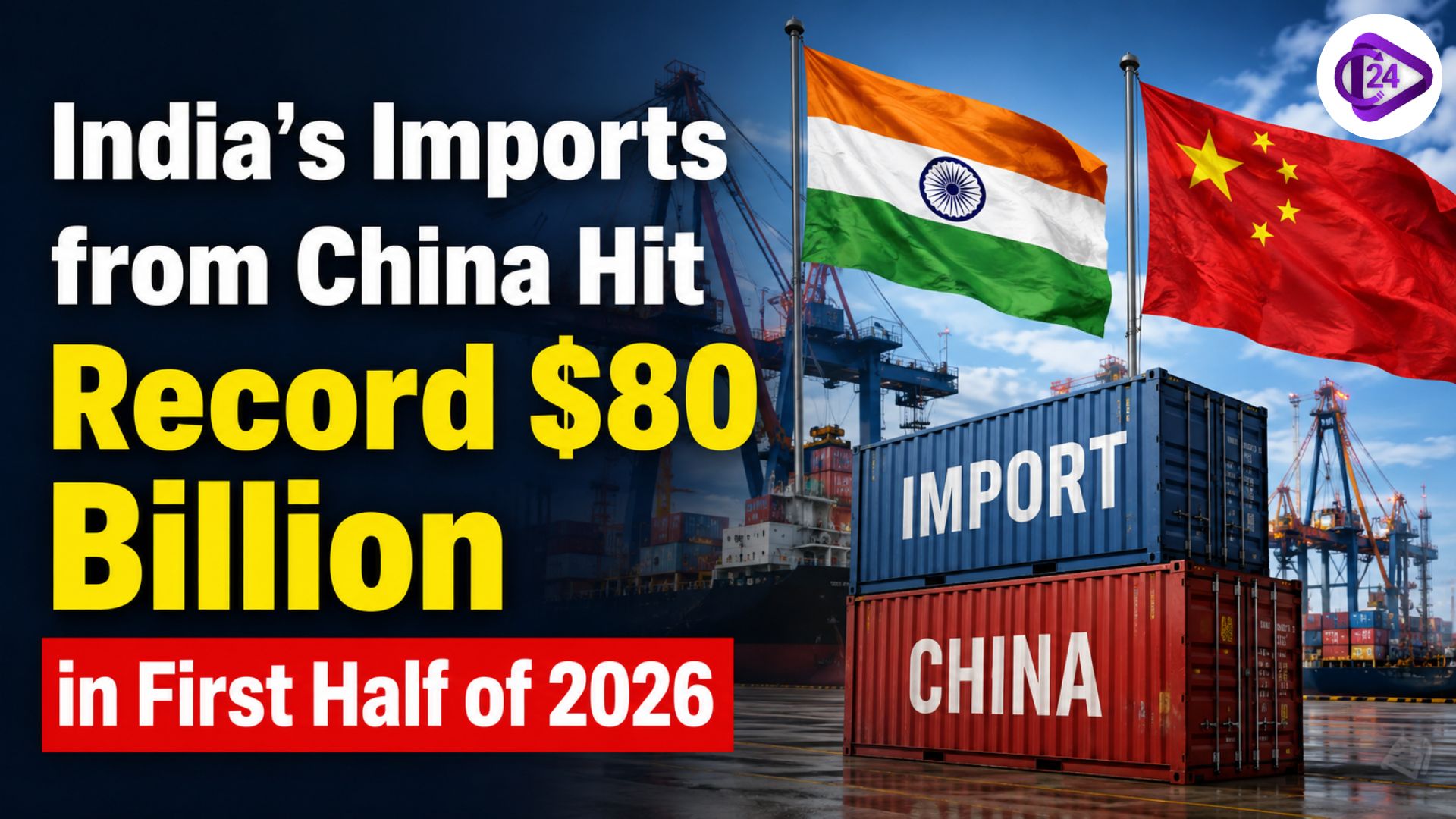


India-China Trade: Despite current geopolitical tensions, trade with China continues to be a promising avenue for India, with the value of its imports reaching a record US$80 billion in the first half (January-June) of 2026. It was only fueled by the increasing demand for electronics, machines, industrial equipment, chemicals, pharmaceutical ingredients (APIs), solar modules and parts for manufacturing. The trade deficit with China also expanded at a time when imports were on an incredible uptrend, raising concerns about India’s import dependence and focus on strengthening domestic manufacturing under Make in India and the Production Linked Incentive (PLI) Scheme.
Why in News?
In the first half of 2026 (January-June), India imported an all-time high amount of USD 80 billion from China. The growth was boosted by the rising demand for electronic equipment, machinery, industrial equipment, active pharmaceutical ingredients and intermediates (APIs), chemicals and solar products. It is this sudden increase that has increased India’s trade deficit with China and brought the topic of India’s dependence on China back to the forefront, especially regarding the slogans ‘Make in India’, ‘Atmanirbhar Bharat’ and ‘Production Linked Incentive (PLI) Scheme’. Despite some suspicions and worries to the contrary, the development shows how increasingly interdependent the two nations have become economically, despite the current tension.
Why Have India’s Imports from China Increased? – India-China Trade
However, there are several reasons for this steep increase in imports:
- Favourable outlook for leading electronics component applications such as smartphones and consumer electronics.
- Expanding imports of equipment and construction.
- Growing reliance on APIs from China for the manufacturing of medicines.
- Expanding PV market with imported modules from abroad.
- An increase in auto and electric vehicle production.
- Chinese manufacturers’ competitive pricing principles and large-scale production capability.
Key Highlights of India-China Trade in 2026
- The total imports from China in January-June 2026 were recorded at the highest level of US$80 billion.
- China continued as India’s top source for imports.
- Consumer electronics and electrical equipment. Carry electrical and electronic items.
- Grasping aspects of machinery and industrial equipment.
- Active Pharmaceutical Ingredients (APIs)
- Chemicals and fertilisers
- Also known as photovoltaic cells and modules.
- Automobile components
- The country still exports less to China than it imports.
- The population of 10.0 billion euros in bilateral trade was further restricted by an increase in the trade gap with China.
- The rise in imports has been due to rising demand in the manufacturing and infrastructure sectors from India.
- The government is still striving to make India self-reliant through schemes like Make in India, Atmanirbhar Bharat, and PLI schemes.
Major Items Imported from China – India-China Trade
India imports a wide range of products from China, including:
- Electrical machinery/electronic components
- Telecom equipment
- Industrial machinery
- Active ingredients, pesticides, and other chemicals or speciality chemicals.
- All medicines used in the production of drugs are referred to as pharmaceutical raw materials (APIs).
- Solar photovoltaic modules
- Consumer goods
- Automobile parts
- Engineering goods
- Plastic products
Conclusion on India-China Trade 2026
India-China Trade: During the first half of 2026, India recorded US$80 billion in imports from China, highlighting the deep economic interdependence between the two countries. These imports continue to support India’s manufacturing, infrastructure, pharmaceutical, electronics, and renewable energy sectors. However, they have also widened the trade deficit and raised concerns over import dependence. Going forward, initiatives such as Make in India, Atmanirbhar Bharat, and the Production Linked Incentive (PLI) Scheme will play a crucial role in strengthening domestic manufacturing, diversifying supply chains, reducing dependence on imports, boosting exports, encouraging innovation, attracting investments, and enhancing India’s long-term economic resilience and global competitiveness.
Supreme Court Puts Madras HC’s Cow Slaughter Ban Order on Hold