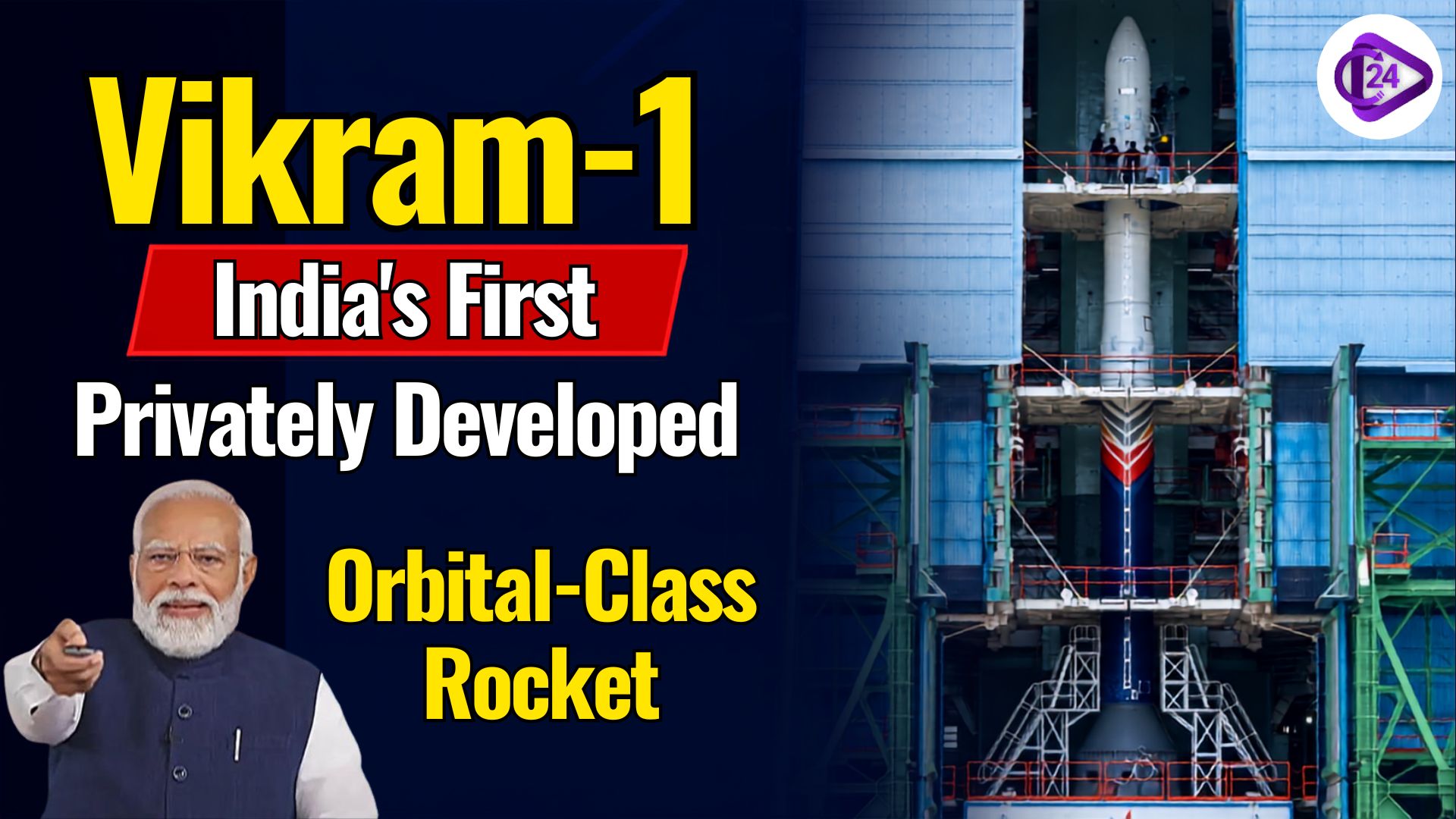


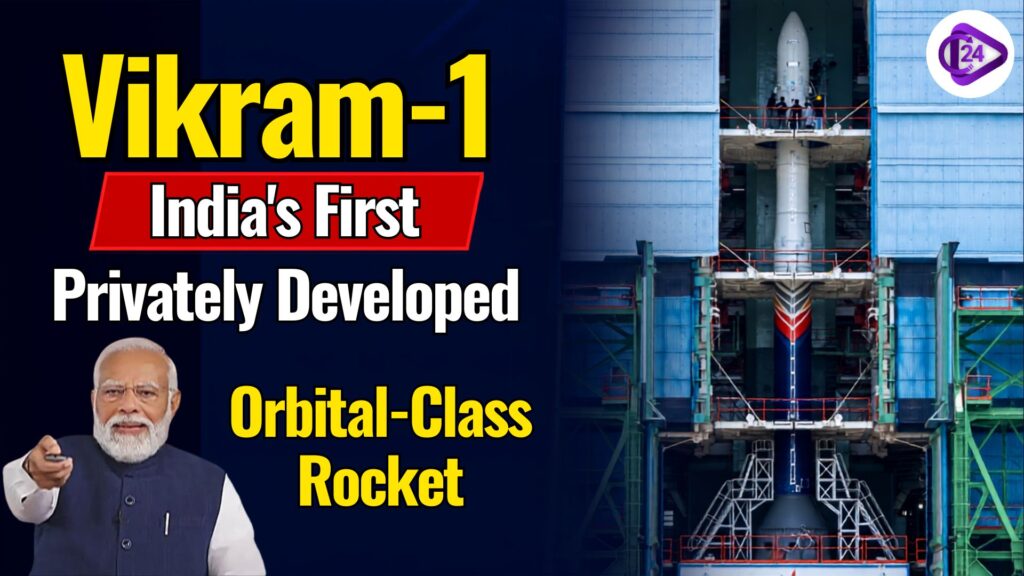
Vikram-1: India’s First Privately Developed Orbital-Class Rocket” marks India’s new era in the space sector. The Vikram-1 is developed by Hyderabad-based firm Skyroot Aerospace and is the first privately built rocket developed by the aerospace start-up to put satellites in orbit. India’s private contribution to space technology has started since its space sector reforms, as is reflected by the mission. Furthermore, Vikram-1 showcases India’s indigenous innovation and capabilities in advanced engineering and cost-efficient space launches, which can enhance its market capabilities in the commercial space launch industry.
Vikram-1 Key Highlights
- First private fully developed orbital launch vehicle from India.
- It was developed by Hyderabad-based start-up Skyroot Aerospace.
- It is named in honour of Dr Vikram Sarabhai, the father of the space program in India.
- To be used to launch small satellites into Low Earth Orbit (LEO).
- Built entirely using carbon composite material.
- Applies sophisticated 3D-printed rocket engines.
- Favours business launches placed by satellites.
- Significant step towards the private space industry in India.
- Like India’s space sector reforms, the incentive was developed.
- Aided by expected growth in crewed work for others, India is expected to gain in the global launch services market.
What is Vikram-1?
Vikram-1 is a small satellite launch vehicle to be developed by a private venture called Skyroot Aerospace, which will launch satellites into orbit on a three-stage rocket system developed partly or completely by the company. Unlike sounding rockets, Vikram-1 can reach orbital velocity, so satellites can be placed in orbit after they are launched.
In addition, the rocket uses low-cost carbon-composite materials and sophisticated propulsion systems that are both easy to launch and efficient. As a result, Vikram-1 is likely to cater to the booming market of small sky-sat launches around the world.
Technical Features of Vikram-1
- A Lightweight Carbon Composite Structure by construction with carbon fibre composite, the rocket is lighter, more efficient, stronger and has a bigger payload.
- Advanced 3D-Printed Engines: 3D-printed rocket engines made in the country, which bring down manufacturing time, cost and fire-proofness.
- 3-stage Configuration: three-stage launch system that efficiently delivers into orbit for the deployment of a satellite.
- Utilises a modular design, permits additional changes in mission profile, and accommodates various customer payload requirements.
- Small Satellite Launch Capability: Designed to launch nano, micro and small satellites (4 to 600 kilograms) in Low Earth Orbit (LEO) and Sun-Synchronous Orbit (SSO).
- Cost-Effective Launch Vehicle: Designed to offer the world increasing small satellite commercial-and-dedicated launching at an affordable cost.
- Lightweight design and optimised propulsion provide high payload efficiency, which not only maximises payload performance, but also cuts launch costs.
- Indigenous Technology: Advanced Indian technology and innovative aerospace technology have been designed and manufactured.
Important PYQs on Indian Space Technology
| Year | Exam | Question | Options | Answer |
| 2024 | UPSC Prelims | Aditya-L1 Mission is placed at which location? | (a) Geostationary Orbit (b) L2 Point (c) L1 Lagrange Point (d) Polar Orbit | (c) L1 Lagrange Point |
| 2023 | SSC CGL | Which Indian organisation developed the NavIC navigation system? | (a) DRDO (b) ISRO (c) HAL (d) BEL | (b) ISRO |
| 2022 | CDS | PSLV is mainly used for launching satellites into which orbit? | (a) Geostationary Orbit (b) Sun-Synchronous Polar Orbit (c) Lunar Orbit (d) Medium Earth Orbit | (b) Sun-Synchronous Polar Orbit |
| 2022 | AFCAT | Which launch vehicle is popularly known as ISRO’s ‘Workhorse’? | (a) GSLV (b) SSLV (c) PSLV (d) LVM3 | (c) PSLV |
| 2021 | SSC CGL | NavIC provides navigation services mainly for: | (a) Entire World (b) India and about 1,500 km beyond its borders (c) Europe (d) South-East Asia only | (b) India and about 1,500 km beyond its borders |
| 2021 | NDA | Chandrayaan-2 consisted of which three components? | (a) Orbiter, Lander & Rover (b) Rocket, Capsule & Satellite (c) Orbiter, Space Station & Rover (d) Lander, Probe & Shuttle | (a) Orbiter, Lander & Rover |
| 2020 | UPSC Prelims | With reference to NavIC, consider the following statements… | (a) 1 only (b) 2 only (c) Both 1 and 2 (d) Neither 1 nor 2 | (c) Both 1 and 2 |
| 2019 | UPSC Prelims | EMISAT is primarily associated with: | (a) Weather Forecasting (b) Electronic Intelligence (c) Navigation (d) Communication | (b) Electronic Intelligence |
| 2018 | SSC CHSL | GSAT satellites are mainly used for: | (a) Communication (b) Agriculture (c) Navigation (d) Weather Forecasting | (a) Communication |
| 2017 | UPSC Prelims | South Asia Satellite (GSAT-9) was launched mainly to: | (a) Military Surveillance (b) Regional Communication (c) Weather Monitoring (d) Lunar Exploration | (b) Regional Communication |
| 2016 | UPSC Prelims | IRNSS (NavIC) is developed to provide: | (a) Global Navigation (b) Regional Navigation (c) Military Radar (d) Weather Services | (b) Regional Navigation |
| 2015 | SSC CGL | India’s Mars Orbiter Mission is also known as: | (a) Chandrayaan (b) Mangalyaan (c) Aditya (d) Astrosat | (b) Mangalyaan |
Govt Sends Notice to WhatsApp Over Username Feature
Vikram-1 to Become India’s First Private Orbital-Class Rocket: Conclusion
For India, Vikram-1 is their first privately developed rocket for their journey into orbit. It reflects how the country has moved from a government-takeover space programme to a co-entrepreneurial and co-operative setup with a significant role for private players. Furthermore, it offers low-weight design, the use of advanced technologies, and a commercial bias that leaves India on gun-point for competing in the global market of small satellite launch service providers. With private sector involvement on the rise, Vikram-1 is poised to be a key player in the future of Indian space innovation and commercialisation.