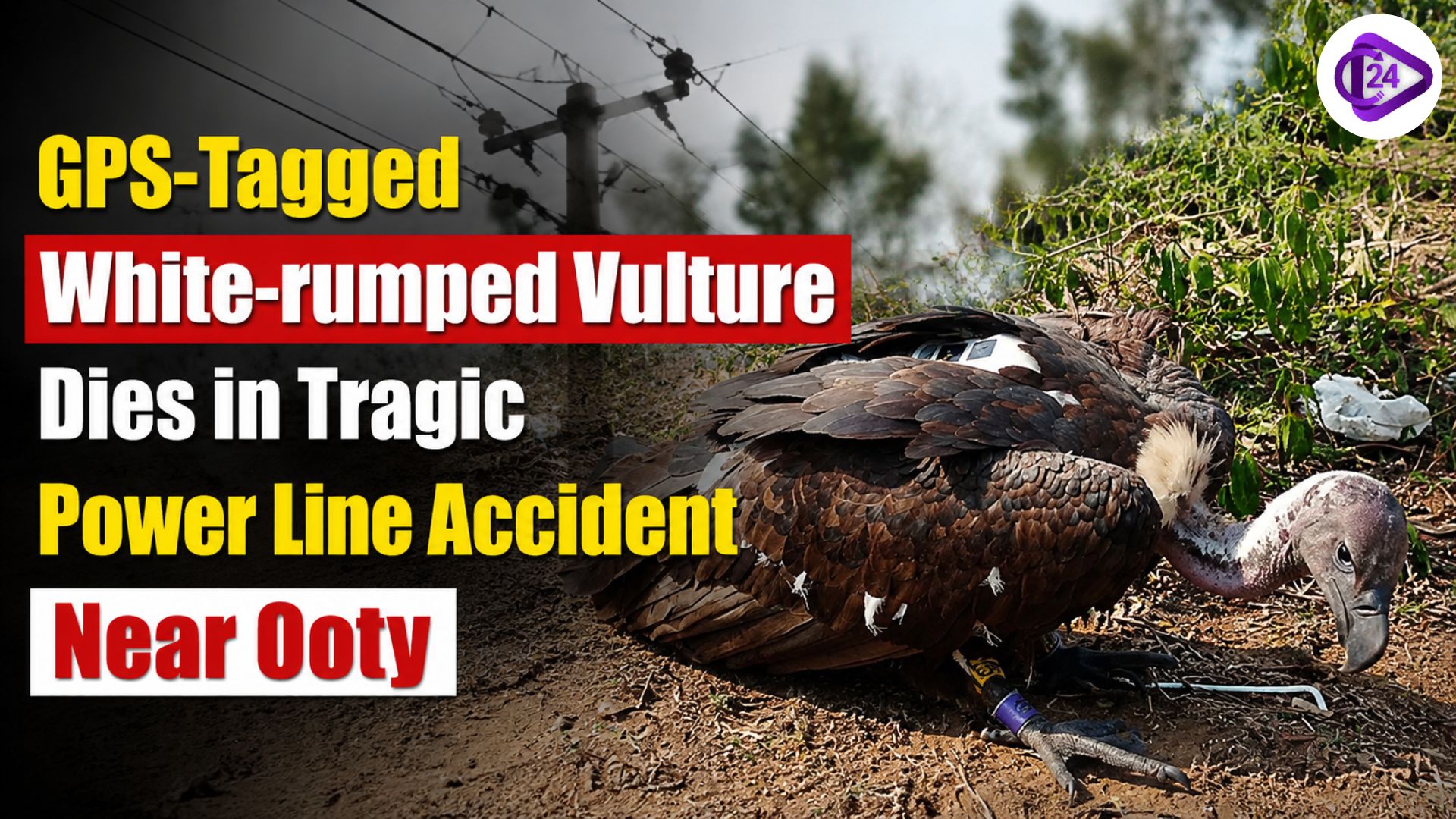


GPS-Tagged: The death of a White-rumped Vulture is raised to the next level after Prince George Petty hits the overhead power line and the bird attaches its GPS on, raising fresh concern for the safety of endangered birds in India’s landscapes. The accident happened in the Nilgiri area of Tamil Nadu, where conservationists had been keeping a close follow-up of the bird using a satellite tracking system. The sad death underscores one of the single largest dangers that then hang on vultures even after numerous conservation efforts.
Wildlife authorities are convinced that these incidents have a serious biopharming impact on the conservation efforts, particularly with regard to endangered species. Furthermore, the incident has highlighted the critical need to reduce hazards for large soaring birds in power installations.
About the White-rumped Vulture
| Feature | Details |
| Common Name | White-rumped Vulture |
| Scientific Name | Gyps bengalensis |
| Family | Accipitridae |
| Habitat | Open forests, grasslands, villages |
| Diet | Carrion (dead animals) |
| Distribution | Indian Subcontinent |
| IUCN Status | Critically Endangered |
Why Was the Bird GPS-Tagged?
- Tangled at an overhead power line caused the death of a crashed GPS-tagged White-rumped Vulture in the Nilgiris around Ooty. A White-rumped Vulture tagged with GPS died after making contact with an overhead power line in the Nilgiris near Ooty.
- This was a long-term vulture conservation and monitoring programme.
- It was first released in Tadoba-Andhari Tiger Reserve, Maharashtra, in December 2025, fitted with a tracking device.
- It was taken for rescue and treatment in Karnataka and later moved to Mudumalai Tiger Reserve in April 2026.
- The Forest staff retrieved the carcass using the GPS and post-mortemed it.
- The Forest Department, Maharashtra, have been apprised and conservationists have reiterated the demand for bird-friendly power infrastructure in vulture habitats.
Mobilisation on what happened near Ooty?
The White-rumped Vulture tagged with the GPS was killed while traversing the Nilgiri landscape and flying into an overhead electricity line near Ooty. The bird was electrocuted when it crashed and died on the spot.
The location of the carcass was sent via tracking device and retrieved by forest officials and researchers. As the bird was continuously monitored, conservationists were able to pick up and quickly locate their final destination. Moreover, the incident just again exemplifies how human-induced risks to wildlife are not completely abated with cutting-edge tracking technology.
Importance of GPS Tracking in Wildlife Conservation
- GPS tracking can help researchers keep tracking wildlife in real-time.
- It identifies migration paths, animals’ home ranges, and critical habitats for their use.
- Using data from GPS, conservationists are able to catch breaches like habitat, poaching and human-wildlife conflict.
- Tracking devices offer helpful details on feeding, breeding areas, and seasonal movement.
- The use of GPS can aid in evidence-based conservation planning and protected area management.
- Assists forest officials in promptly identifying injured or dead animals to act promptly.
- Long-term monitoring is useful to support species recovery and long-term tracking.
- Research using GPS supports wildlife conservation policies and helps to guide policy towards protecting threatened species.
Wildlife Conservation PYQs
| Exam & Year | Question | Options | Correct Answer |
|---|---|---|---|
| UPSC CSE Prelims 2020 | In India, the M-STrIPES system is primarily used for: | A. Monitoring tiger population and patrolling B. Tracking migratory birds C. Monitoring elephants D. Managing wetlands |
A. Monitoring tiger population and patrolling |
| UPSC CSE Prelims 2020 | With reference to the Indian Elephant, which of the following statements is/are correct? 1. It is listed in Schedule I of the Wildlife (Protection) Act. 2. It is listed in Appendix I of CITES. |
A. 1 only B. 2 only C. Both 1 and 2 D. Neither 1 nor 2 |
C. Both 1 and 2 |
| UPSC CSE Prelims 2017 | The term M-STrIPES is sometimes seen in the news in the context of: | A. Captive breeding of tigers B. Monitoring tiger reserves C. Elephant census D. Rhino conservation |
B. Monitoring tiger reserves |
| UPSC CSE Prelims 2015 | Which one of the following National Parks is famous for the conservation of the one-horned rhinoceros? | A. Gir National Park B. Kaziranga National Park C. Bandipur National Park D. Kanha National Park |
B. Kaziranga National Park |
| UPSC CSE Prelims 2014 | Which of the following species is classified as the National Aquatic Animal of India? | A. Ganges River Dolphin B. Olive Ridley Turtle C. Dugong D. Saltwater Crocodile |
A. Ganges River Dolphin |
| SSC CGL 2023 | Which of the following is the largest tiger reserve in India? | A. Corbett B. Nagarjunsagar-Srisailam C. Ranthambore D. Kanha |
B. Nagarjunsagar-Srisailam |
| SSC CGL 2022 | The Project Tiger was launched in which year? | A. 1969 B. 1973 C. 1976 D. 1980 |
B. 1973 |
| RRB NTPC 2021 | Which organisation maintains the Red List of Threatened Species? | A. UNEP B. WWF C. IUCN D. UNESCO |
C. IUCN |
| CDS 2022 | Which Indian state has the largest forest cover according to the India State of Forest Report? | A. Madhya Pradesh B. Arunachal Pradesh C. Chhattisgarh D. Odisha |
A. Madhya Pradesh |
| CAPF (AC) 2021 | Which Schedule of the Wildlife (Protection) Act, 1972, provides the highest level of legal protection to animals? | A. Schedule I B. Schedule II C. Schedule IV D. Schedule VI |
A. Schedule I |
Gujarati Movie Laalo’s Word-of-Mouth Journey to Blockbuster Success
Conclusion on GPS-Tagged White-rumped Vulture in Ooty
The GPS-Tagged white-rumped vulture, which dies near Ooty, is a potent reminder of the serious human cause towards endangered wildlife. While GPS technology has aided tremendously in wildlife monitoring, impacted infrastructure, better conservation planning, and collaboration between government, scientific, and utility parties are required to ensure safety and reduce the number of fatalities accidentally occurring. India can increase its efforts to conserve the remaining White-rumped Vulture population and help sustain its survival by adopting bird-friendly power systems and increasing conservation efforts.