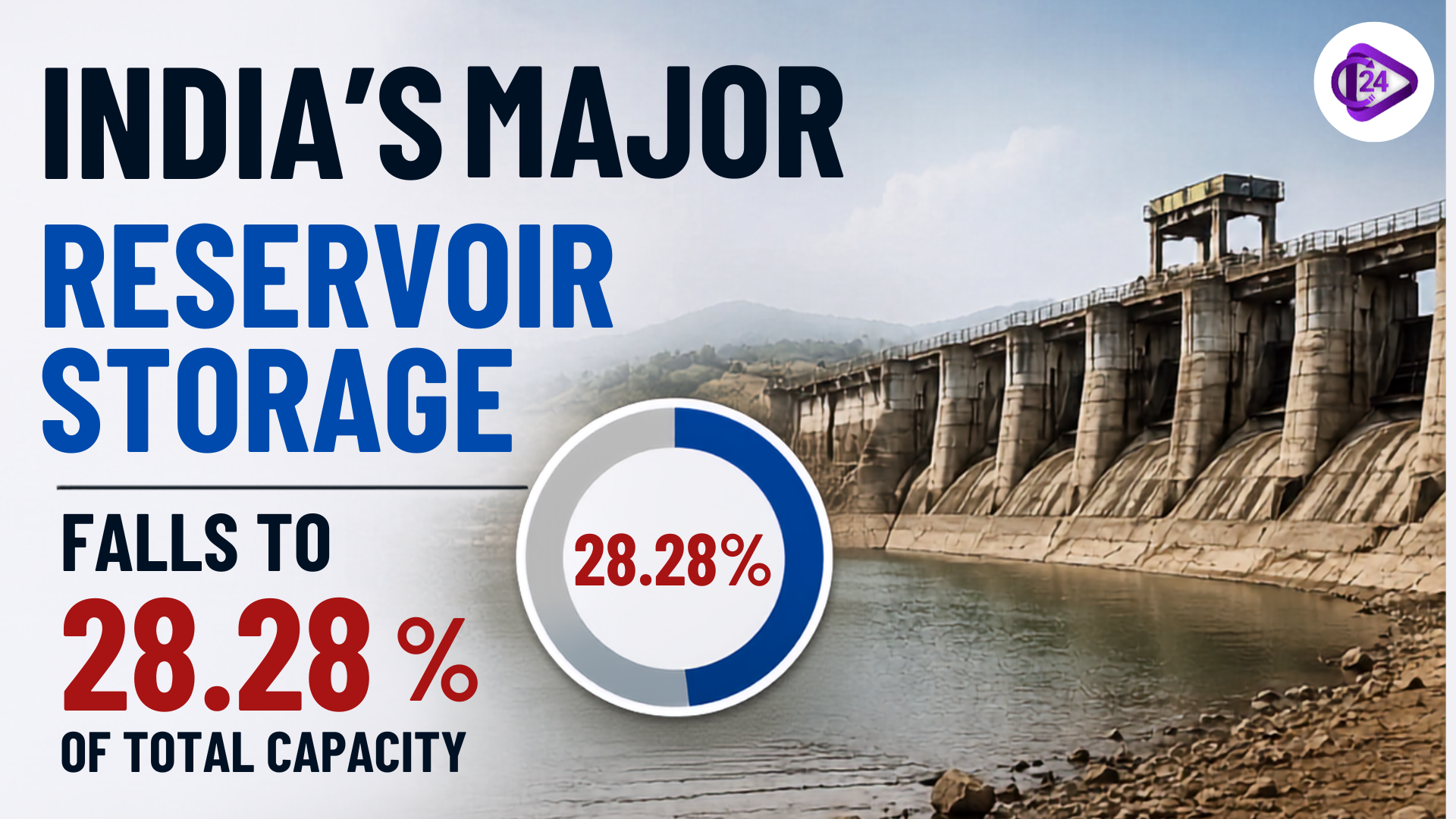


Reservoir Storage: The total storage in the major reservoirs of India has decreased to 28.28% while the water supply has taken a turn for the worse.It revealed that India has experienced a decrease in the total storage of its major reservoirs to 28.28% of their total capacity, emphasizing the growing concern regarding water availability in the country. Reservoirs are considered to be an important resource for irrigation, potable water supply, generation of hydropower, and flood control. Hence, when the major reservoir storage of India is reduced to 28.28% of the total storage, the government, farmers, and water resource managers keep a watch on it.
The current water storage shows considerable water stress levels already, prior to the monsoon rain filling water pools. This means that a number of states will have to implement alternatives of water conservation and efficient water resource management.
Key Highlights: India’s Major Reservoir Storage Falls
- The current reservoir storage is 28.28% of the total storage.
- If storage levels are reduced it can impact irrigation operations.
- In some areas, water supply might be challenged due to insufficient supplies.
- The amount of hydropower produced may be hampered if water is not high enough.
- Reservoir recharges will be very important with monsoon rains.
- Water conservation measures are all the more relevant.
- Reservoirs are used for potable water, industries, and agriculture.
- Storage continues to be monitored in each of the major river basins.
What Are Major Reservoirs?
Major reservoirs are big water storage systems with dams and other water management facilities. These are reservoirs containing and holding the water flowing in rivers, rain and catchment.
They have some essential roles:
- Irrigation for agriculture
- Drinking water supply
- Hydropower generation
- Flood control
- Industrial water usage
- Environmental flow maintenance
Reservoirs, Dams & Water Resources, PYQs
| Year | Exam | Question | Options | Answer |
| 2024 | SSC CGL | Which organization publishes the live storage status of major reservoirs in India? | (A) IMD (B) Central Water Commission (C) NITI Aayog (D) FCI | (B) Central Water Commission (CWC) |
| 2023 | UPSC Prelims | The Tehri Dam Project is located on which river? | (A) Alaknanda (B) Bhagirathi (C) Mandakini (D) Yamuna | (B) Bhagirathi |
| 2023 | SSC CHSL | Hirakud Dam is built across which river? | (A) Godavari (B) Krishna (C) Mahanadi (D) Tapi | (C) Mahanadi |
| 2022 | RRB NTPC | Bhakra Nangal Dam is constructed on which river? | (A) Ravi (B) Beas (C) Sutlej (D) Chenab | (C) Sutlej |
| 2022 | UPSC Prelims | Sardar Sarovar Project is associated with which river? | (A) Godavari (B) Narmada (C) Krishna (D) Mahi | (B) Narmada |
| 2021 | SSC CGL | Which is the longest dam in India? | (A) Tehri Dam (B) Hirakud Dam (C) Bhakra Dam (D) Idukki Dam | (B) Hirakud Dam |
| 2021 | State PCS | Nagarjuna Sagar Dam is built on which river? | (A) Cauvery (B) Krishna (C) Godavari (D) Mahanadi | (B) Krishna |
| 2020 | SSC GD | Which dam is known as the highest dam in India? | (A) Bhakra Dam (B) Tehri Dam (C) Hirakud Dam (D) Koyna Dam | (B) Tehri Dam |
| 2019 | UPSC Prelims | Reservoirs are primarily important for which of the following? | (A) Irrigation (B) Hydropower (C) Drinking Water Supply (D) All of the Above | (D) All of the Above |
| 2018 | SSC CPO | The Central Water Commission functions under which ministry? | (A) Ministry of Agriculture (B) Ministry of Jal Shakti (C) Ministry of Environment (D) Ministry of Rural Development | (B) Ministry of Jal Shakti |
Also Read
| Yamuna River System | Son River |
| Ganga River System | Jhelum River System |
| Indus River System | Godavari River System |
| Brahmaputra River System | Indian River Systems |
Conclusion on Water Levels in India’s Key Reservoirs Fall to 28.28%
The decrease of India’s Major Reservoir Storage to 28,28% of the total storage volume highlights the need for water management and timely monsoon rains. Reservoirs will continue to play a crucial role in all the main components of agriculture, drinking water, hydropower, and economic viability. This indicates that India’s Major Reservoir Storage is depleted at 28.28% of its Total Storage capacity, and therefore, water conservation, water efficient utilization and long-term security measures must be put into place in a timely fashion by the governments, communities and water users. Reservoir levels can be improved with good practices and sufficient rainfall to continue meeting the country’s increasing water demand.