

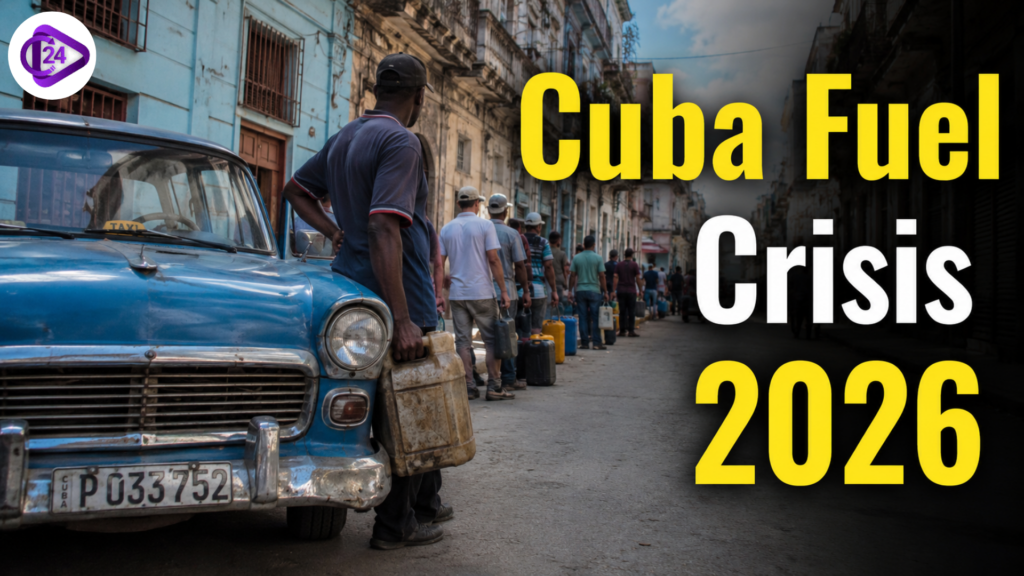
Cuba is in one of its biggest energy crises in decades as supplies of diesel and fuel oil have virtually run out, causing large-scale blackouts in Havana and a number of provinces in 2026. Cuba’s energy and mines ministry says all fuel reserves are now exhausted and as a result some areas are experiencing electricity blackouts of up to 20 to 22 hours per day. a. The crisis has completely disrupted and affected transportation, hospitals, water, industries, and public services. The situation has been exacerbated by the squeeze on fuel imports, domestic measures by the U.S. authorities and the rise in world oil prices. Unrest has additionally gripped Havana after building cooperations that battle for prolonged electric power disruptions and economic issues.
Cuba Fuel Crisis 2026: Key Highlights and Impact
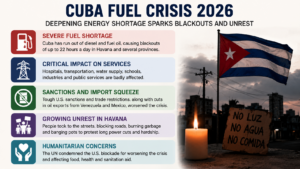
- In May 2026, Cuba severely exacerbated its fuel scarcity problem when the regime announced it was short of diesel and fuel oil supplies.
- Blackouts in Havana and a number of Cuban provinces lasted up to 22 hours a day.
- “The country has “absolutely no fuel” to spare, said Cuba’s Energy Minister Vicente de la O Levy.
- The country’s power grid was put under a “critical situation” because of coal shortages.
- Hospitals, transportation, water supply, schools and businesses have suffered, as have seen disruptions by fuel shortages.
- The Cuban government pointed to tougher U.S. fuel sanctions and trade restrictions as culprits for the growing crisis.
- Two countries, Venezuela and Mexico, allegedly cut oil exports to Cuba in response to new sanctions pressure.
- Russia did provide some crude oil shipments, though, it wasn’t enough to keep the energy picture from getting dicey.
- The people of Havana had staged protests demanding the restoring of electric services.
- Protestors reportedly blocked roads and burned garbage and pots were banged.
- The failure of Cuba’s electricity infrastructure and power grid, due to aging systems, continued to exacerbate power cuts.
- The United Nations condemned the blockade’s negative effects on humanitarian aid with regard to food, health and sanitation.
- Anchoring was also unable due to fuel shortages, garbage was left in the streets of Havana.
- Limited service on public transport and tourism has resulted from fuel shortages.
- Cuba URGES to increase the speed of solar energy projects in order to break off the reliance on imported fuel.
PYQs on Cuba Fuel Crisis and Energy Security
| Exam Name & Year | Question | Options | Correct Answer |
| UPSC Prelims 2022 | Which country has been under a long-standing U.S. economic embargo? | A) Brazil B) Cuba C) Chile D) Peru | B) Cuba |
| SSC CGL 2021 | Havana is the capital city of which country? | A) Mexico B) Cuba C) Venezuela D) Colombia | B) Cuba |
| UPSC Prelims 2020 | Which organization globally monitors humanitarian and human rights issues? | A) IMF B) WTO C) United Nations D) OPEC | C) United Nations |
| Banking Awareness 2023 | Rising fuel prices generally lead to which type of inflation? | A) Demand-pull inflation B) Cost-push inflation C) Hyperinflation D) Core inflation | B) Cost-push inflation |
| CDS Exam 2021 | Cuba is located in which region? | A) South Asia B) Middle East C) Caribbean D) Eastern Europe | C) Caribbean |
Maize Emerges as India’s Top Ethanol Feedstock
Conclusion
The island nation of Cuba is increasingly under the threat of a fuel shortage in its future, which underscores the dangers of dependence on fossil fuels, economic sanctions, and the aging of its infrastructure. In Havana and other parts of the country, power has been completely cut off, causing a wave of economic and social difficulties and provoking unrest. The crisis has also captured global attention to the humanitarian issues and geopolitical tensions in the Caribbean region. Cuba is seeking ways to increase the amount of renewable energy being utilized, and to obtain foreign supplies of fuel for which it lacks the necessary funds and which in any case remains under a strict embargo. This current crisis shows how a lack of fuel (a local issue) can quickly reach national proportions leading to public services interruptions, destabilisation of countries and a global economic impact in developing countries.