

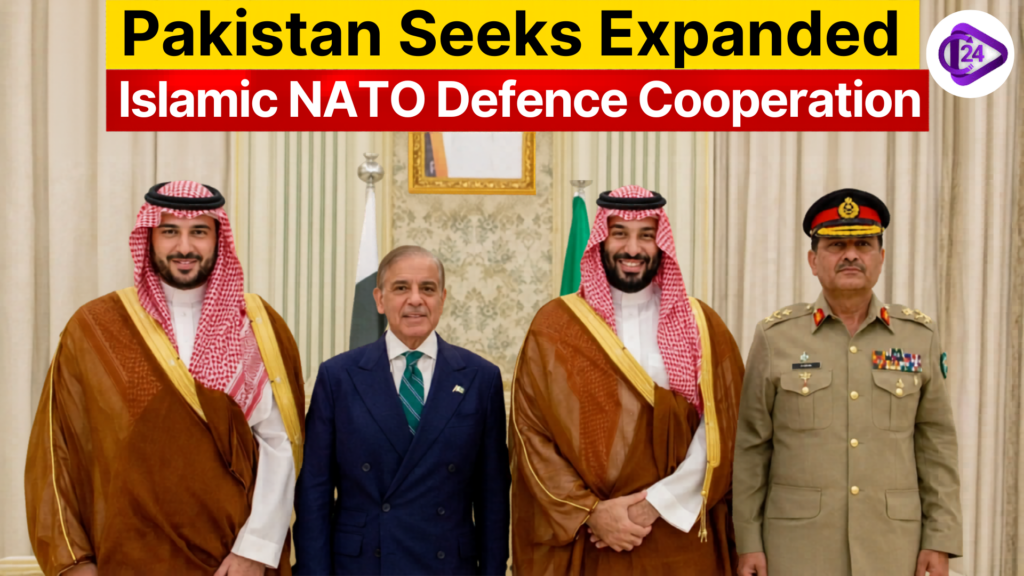
The Islamic Military Counter Terrorism Coalition (IMCTC), which is also known as “Islamic NATO”, the country has been making efforts for intensifying cooperation in defence and counter terrorism with other participating countries.Pakistan has been making efforts for strengthening Defence and Counter-Terrorism cooperation with other participating countries under the Islamic Military Counter Terrorism Coalition (IMCTC) or “Islamic NATO.” Saudi Arabia, led this coalition, was established in 2015 to share ideas, priorities and strategies for combating terrorism and extremism. During the last couple meetings between the military leadership and IMCTC officials, intelligence sharing, regional security, military training, and institution cooperation were discussed. Pakistan sees deeper coalition engagement in line with its overall regional security and defence posture. The move has garnered global interest because of its potential implications for geopolitical dynamics in South Asia and the Middle East.
Islamic NATO Defence Cooperation and Pakistan’s Strategic Role
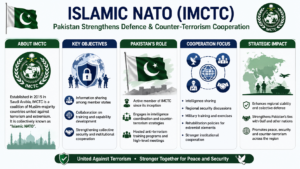
- The Islamic Military Counter Terrorism Coalition (IMCTC) was formed in Saudi Arabia in 2015 at the head of the Islamic nation.
- IMCTC is an anti-terrorism cooperation group of the countries with Muslim major citizens.
- One of the current members of the alliance is Pakistan.
- Collective security is the basis that made the alliance collectively known as “Islamic NATO.”
- IMCTC encourages the sharing of information among the member countries.
- One of the coalition’s primary goals is collaboration on trainings and capability development.
- Recently the Secretary General of IMCTC, Major General Mohammed Bin Saeed Al-Moghedi, paid a visit to Pakistan during the reign of the Defence Minister, perched in a citadel overlooking the sea, for Defence affairs.
- Security and counter-terrorism cooperation was discussed during the meetings.
- Raheel Sharif was once the Commander of IMTC of Pakistan Army.
- Countries from Asia, Africa and the Middle East are part of the coalition.
- Pakistan and IMCTC agreed to further strengthen cooperation among institutions to combat terrorism and extremism.
- Issues discussed were intelligence coordination and rehabilitation policies for elements of extremists.
- IMCTC held a week-long anti-terrorism training programme in Pakistan.
- Military diplomacy is an integral part of Pakistan’s foreign policy.
- It’s not against a particular country or religion, the coalition says.
- Regional defence alignments can be expected to be affected by the alliance, according to security experts.
- Stronger cooperation likely to boost Pakistan’s strategic relations with Gulf countries.
- The issue of counter-terrorism continues to be a significant security issue for member countries.
- The coalition also focuses on combating terror financing and extremist ideology.
- The rising significance of IMCTC also highlights the importance of multilateral partnerships in raising security in international politics.
Defence Alliances & International Relations PYQs
| Exam Name | Year | Question | Options | Answer |
| UPSC Prelims | 2021 | NATO stands for: | (A) National Treaty Alliance Organization (B) North Atlantic Treaty Organization (C) Northern Allied Treaty Organization (D) National Atlantic Trade Organization | (B) North Atlantic Treaty Organization |
| SSC CGL | 2022 | Which country leads the Islamic Military Counter Terrorism Coalition (IMCTC)? | (A) Pakistan (B) Iran (C) Saudi Arabia (D) Turkey | (C) Saudi Arabia |
| CDS Exam | 2020 | The primary objective of IMCTC is: | (A) Space Research (B) Counter Terrorism Cooperation (C) Trade Promotion (D) Climate Change | (B) Counter Terrorism Cooperation |
| RRB NTPC | 2021 | Which former Pakistan Army Chief served as commander of IMCTC? | (A) Pervez Musharraf (B) Raheel Sharif (C) Ashfaq Kayani (D) Asim Munir | (B) Raheel Sharif |
| State PCS | 2023 | NATO was established in which year? | (A) 1945 (B) 1947 (C) 1949 (D) 1955 | (C) 1949 |
| SSC CHSL | 2022 | IMCTC mainly focuses on combating: | (A) Climate Change (B) Terrorism and Extremism (C) Trade Deficit (D) Food Crisis | (B) Terrorism and Extremism |
Conclusion: IMCTC Cooperation
Pakistan is increasingly focussing on collective security and regional defence cooperation with the Islamic Military Counter Terrorism Coalition (IMC) through expanding their cooperation. The alliance aims to counter new security threats in the Islamic world by means of intelligence sharing, military training and counter-terrorism co-ordination. Pakistan’s greater engagement can build its strong relationship with the countries in the Gulf and help raise its profile in regional security issues. But there is a possibility of longer-term issues with the effectiveness of the alliance regarding geopolitical rivalry and national interests amongst the members. In an ongoing era of continued challenges from terrorism and regional instability, multilateral security partnerships, such as IMCTC, are likely to stay a key facet of global security cooperation.