
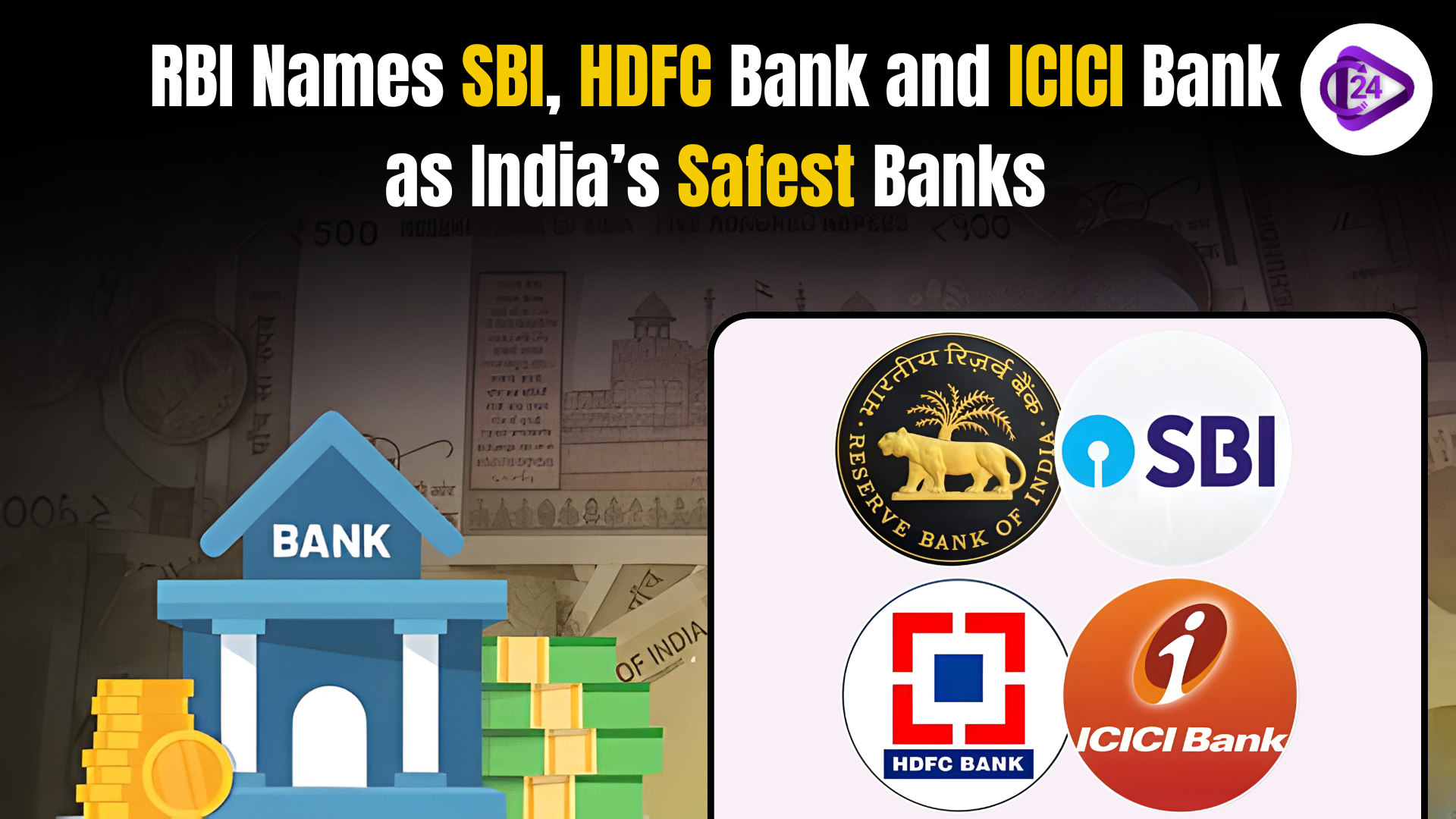
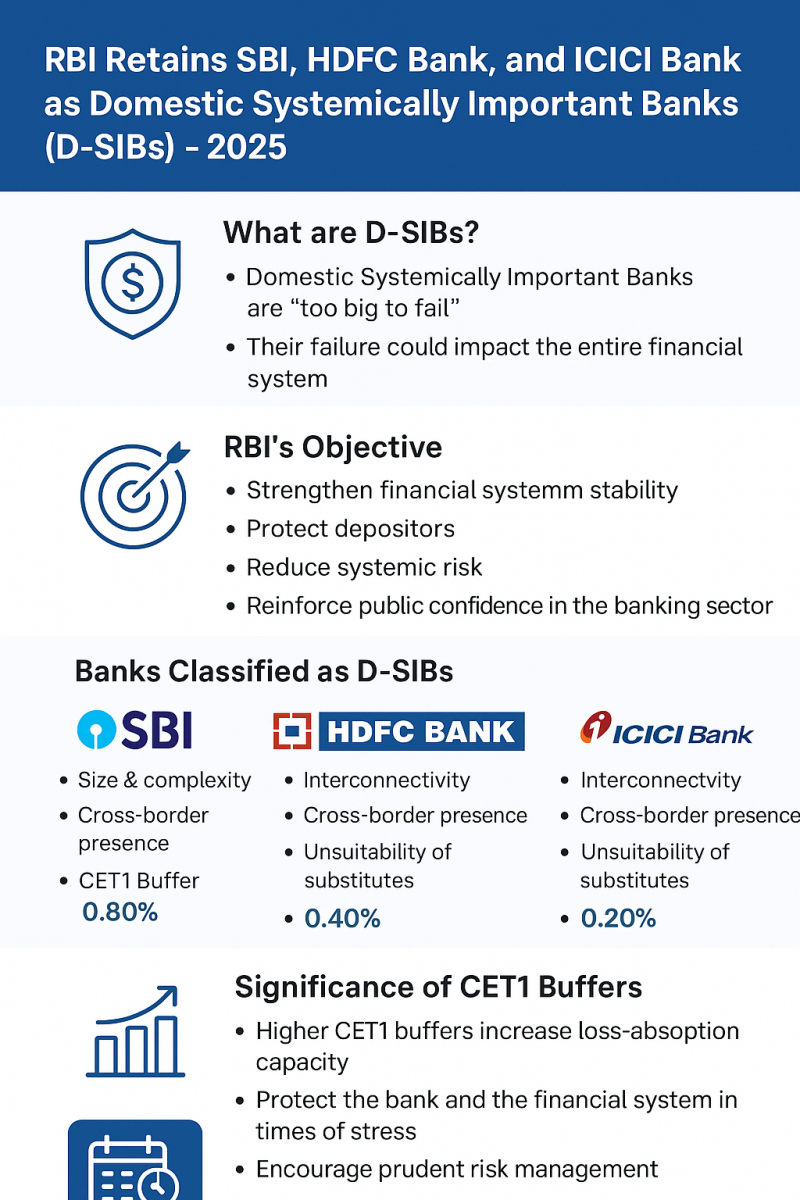
The Reserve Bank of India has now officially reaffirmed State Bank of India, HDFC Bank and ICICI Bank as the country's safest banks by keeping them as Domestic Systemically Important Banks (D-SIBs). These institutions are deemed "too big to fail" because of their size, complexity and important role in the financial system. As part of the designation, they have to maintain enhanced Common Equity Tier-1 capital buffers to increase resilience in situations of financial stress. By identifying these banks as systemically important, RBI strengthens public confidence and assures greater stability in the banking sector of India.
SBI, HDFC Bank, ICICI Bank Continue as India’s Systemically Important Banks
-
RBI has reclassified SBI, HDFC Bank and ICICI Bank as Domestic Systemically Important Banks (D-SIBs) of India for the year 2025, implying that they are "too big to fail."
-
These banks are of major importance because of their size, complexity, interconnectivity, cross-border presence & unsuitability of substitutes.
-
Ratios required to be maintained by Banks under the Basel Committee of Supervisors by banks will maintain higher CET1 capital buffers: SBI – 0.80%, HDFC Bank – 0.40%, ICICI Bank – 0.20%
-
The idea is that "these additional capital charges increase the resilience, essentially to protect depositors and also to decrease systemic risk."
-
The revised classification is based on the D-SIB framework, which was introduced in 2014 and revised in 2023.
PYQs-Based Questions Related to the Banking Sector
| Exam (Name, Year) | Question | Answer |
|---|---|---|
| RRB NTPC, 2016 | Which was the first bank in India? | Bank of Hindustan |
| RRB NTPC, 2021 | Which bank was established in India at Calcutta under European management in 1770? | Bank of Hindustan |
| SSC CPO, 25 Nov 2020 (Shift-1) | "The Name You Can Bank Upon" is the slogan of which bank? | P unjab National Bank (PNB) |
| SSC MTS, 2019 | What is the slogan of Punjab National Bank (PNB)? | "The Name You Can Bank Upon" |
Expected Question About SBI, HDFC Bank, and ICICI Bank
Which of the following banks was first declared a D‑SIB by the RBI among SBI, HDFC Bank, and ICICI Bank?
A. SBI
B. HDFC Bank
C. ICICI Bank
D. All declared together
Answer: A. SBI
Explanation: SBI was among the first banks designated as D‑SIB (in 2015), followed by ICICI Bank (2016) and HDFC Bank (2017).
Which private sector bank among the following is not on the current RBI D‑SIB list?
A. ICICI Bank
B. HDFC Bank
C. Axis Bank
D. None of the above
Answer: C. Axis Bank
Explanation: The current D‑SIB list includes SBI, HDFC Bank and ICICI Bank. Axis Bank is not listed.
When did HDFC Bank get classified as a D‑SIB by RBI?
A) 2015
B) 2016
C) 2017
D) 2018
Answer: C) 2017
Explanation: RBI added HDFC Bank to the list of D‑SIBs based on data as of March 31, 2017.
Why does RBI impose an extra CET1 buffer on banks designated as D‑SIBs?
A) To reduce their net interest margin
B) To ensure they can absorb losses and protect the financial system in case of distress
C) To force them to lend less
D) To limit their growth
Answer: B) To ensure they can absorb losses and protect the financial system in case of distress
Explanation: The extra buffer is meant to strengthen their loss‑absorption capacity to prevent systemic risk.
Conclusion
The Reserve Bank of India (RBI) has kept State Bank of India (SBI), HDFC Bank and ICICI Bank as Domestic Systemically Important Banks (D-SIBs). This classification underscores the fact that they are important to ensuring financial stability. These banks are required to have higher capital buffers to absorb possible losses that will ensure the resilience of the overall banking system in India.