

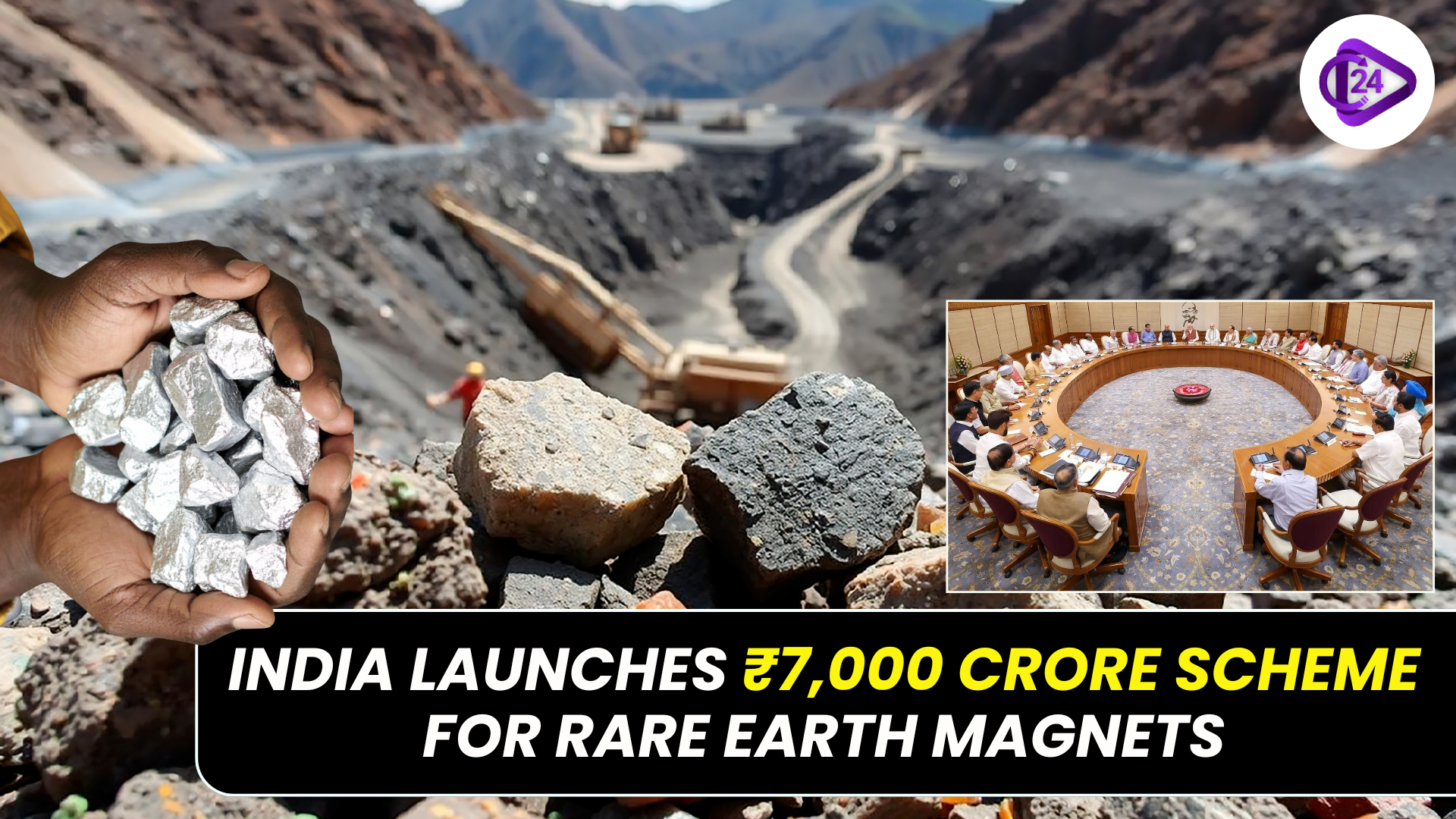
The Union Cabinet of India has approved a scheme with a wholesale value of Rs 7,280 crore to promote the manufacture of rare earth permanent magnets in India, which are a key component of electric vehicles and a vital part of renewable energy, electronics production, aerospace, and defence. The goal of the Scheme to Promote Manufacturing of Sintered Rare Earth Permanent Magnets is to build a well-integrated manufacturing capacity of 6,000 metric tonnes per annum and reduce reliance on imports, especially from China. This programme will run for 7 years, with 2 years to set up and five years of incentives and capital aid on sales in India to boost the supply chain and raise strategic self-sufficiency in the high-tech sectors.
Rare Earth Elements and Their Locations in India
-
Rare Earth Elements (REEs) are 17 chemical elements, such as lanthanides, yttrium, and scandium, that find high-tech applications such as electric vehicles, renewable energy, electronics and defense.
-
The country has approximately 7.23-8.52 million tonnes of the oxide of rare earth elements (REO), which are found as monazite minerals.
-
Andhra Pradesh, Odisha, Tamil Nadu, Kerala, West Bengal, Jharkhand, Gujarat, and Maharashtra contain coastal and beach sands that are rich in monazites.
-
REEs are found in some areas of Gujarat and Rajasthan as hard rock deposits.
-
These regions have been explored, and they are augmenting REE resources by the Atomic Minerals Directorate for Exploration and Research (AMD) and the Geological Survey of India (GSI).
-
The Purulia district of West Bengal has, as of late, been found to be an important rare earth exploration project.
Expected Questions on Rare Earth Elements (REEs)
1. Question: How many rare earth elements are there in the periodic table?
Options:
A) 15
B) 16
C) 17
D) 18
Answer: C) 17
Explanation: There are 15 lanthanides plus scandium and yttrium, totalling 17 rare earth elements.
2. Question: Which of the following elements is NOT a rare earth element?
Options:
A) Lutetium
B) Scandium
C) Yttrium
D) Helium
Answer: D) Helium
Explanation: Helium is a noble gas; REEs include lanthanides, scandium, and yttrium.
3. Question: In which block of the periodic table are most rare earth elements located?
Options:
A) s-block
B) p-block
C) d-block
D) f-block
Answer: D) f-block
Explanation: Lanthanides are f-block elements; scandium and yttrium are in the d-block.
4. Question: Where are rare earth minerals mainly found in India?
Options:
A) Gujarat & Rajasthan
B) Coastal sands of Tamil Nadu, Kerala, Odisha, and Andhra Pradesh
C) Both A & B
D) None of the above
Answer: C) Both A & B
Explanation: REEs occur in coastal monazite sands and hard rock deposits in Gujarat and Rajasthan.
5. Question: What is the primary industrial use of rare earth elements?
Options:
A) Food additives
B) Permanent magnets, EVs, electronics
C) Fertilisers
D) Textile dyes
Answer: B) Permanent magnets, EVs, electronics
Explanation: REEs are critical for high-tech applications, renewable energy, and defence.
Conclusion (Rare Earth Permanent Magnets)
Rare Earth Permanent magnets are essential to modern technology, being used in electric vehicles, renewable energy systems, electronics, and defence. The orientation of India towards domestic production under strategic initiatives enhances self-sufficiency, minimises dependency on importation, and industrial development as India can respond to the increasing demand for a variety of high-performance magnets all over the globe as well as in the nation.