

The Reserve Bank of India (RBI) has launched Mission SAKSHAM – a national capacity development initiative for Urban Cooperative Banks (UCBs). This mission seeks to improve governance, efficiency, and compliance among UCBs. It is a mission-mode project that prioritises capacity-building for all levels of bank employees, including the board and senior management. The mission, with its online and offline learning modules, will help RBI to develop a robust and professionally-driven cooperative banking sector. This programme underscores RBI’s commitment to achieving financial stability, improved risk management, and growth in the UCB sector.
RBI Mission SAKSHAM for UCBs: Objectives, Features & Benefits
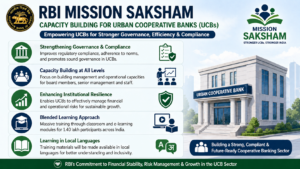
- RBI has launched a pan-India mission-mode capacity-building (MMCB) programme for urban cooperative banks (UCBs) – Mission SAKSHAM.
- A key focus is to build management and operational capacities in the cooperative banking space.
- It seeks to strengthen regulatory compliance and adherence to norms, resulting in sound governance.
- The programme is directed towards enhancing institutional resilience, enabling UCBs to effectively manage financial and operational risks.
- As part of the mission, the RBI will organise massive training courses to train 1.40 lakh participants in India.
- This will include the board of directors, top management, risk managers, audit chiefs, IT professionals and others.
- Training will be based on a blended model, with classroom and e-learning methods.
- RBI will make the training material available to training participants in local languages for improved comprehension.
- Mission SAKSHAM will be implemented in partnership with the Umbrella Organisation of UCBs and cooperative federations.
- The development of a learning and development culture in banking is envisaged.
- It will help UCBs embrace best practices, risk mitigation and internal control processes.
- In short, Mission SAKSHAM is in line with the RBI’s commitment to creating a resilient, transparent and future-proof cooperative banking sector in India.
RBI Previous Year Questions (PYQs) for SSC, Banking & UPSC Exams
| Exam Name | Year | Question | Options | Answer |
| UPSC Prelims | 2020 | With reference to the Indian economy, consider the following statements regarding UPI: UPI is developed by which organization? | A) RBI B) NPCI C) SEBI D) SBI | B) NPCI |
| SSC CGL | 2022 | Which institution issues currency notes in India? | A) SBI B) RBI C) SEBI D) NABARD | B) RBI |
| IBPS PO | 2021 | What does CRR stand for in banking? | A) Cash Reserve Ratio B) Credit Reserve Ratio C) Capital Reserve Ratio D) Current Reserve Ratio | A) Cash Reserve Ratio |
| SSC CHSL | 2020 | Who is known as the banker to the government in India? | A) SBI B) RBI C) NABARD D) SEBI | B) RBI |
| RBI Grade B | 2021 | Repo rate is the rate at which RBI lends money to: | A) Public B) Banks C) NBFCs D) Government | B) Banks |
| IBPS Clerk | 2022 | Which organization manages UPI in India? | A) RBI B) NPCI C) SEBI D) SIDBI | B) NPCI |
| UPSC Prelims | 2019 | Which of the following best describes ‘Repo Rate’? | A) Rate of borrowing by RBI B) Rate at which RBI lends to banks C) Rate of tax D) Rate of inflation | B) Rate at which RBI lends to banks |
| SSC MTS | 2021 | Which bank is called the central bank of India? | A) SBI B) RBI C) PNB D) ICICI | B) RBI |
| SBI PO | 2020 | Reverse Repo Rate is the rate at which RBI: | A) Borrows from banks B) Lends to banks C) Gives loan to public D) None | A) Borrows from banks |
| NABARD Grade A | 2021 | Which institution regulates NBFCs in India? | A) SEBI B) RBI C) NABARD D) SIDBI | B) RBI |
Conclusion – RBI Launches Mission SAKSHAM
The Reserve Bank of India’s mission SAKSHAM is an important move to enhance the capacity and governance of Urban Cooperative Banks (UCBs) in India. The mission will improve the capabilities, compliance and risk management processes of UCBs to build a stronger and more efficient banking system. It will also better prepare UCBs to face future financial risks and regulatory changes. In short, Mission SAKSHAM is a testament to RBI’s focus on stability, security and sustainable growth in the cooperative banking system, which benefits both banks and their customers in India.