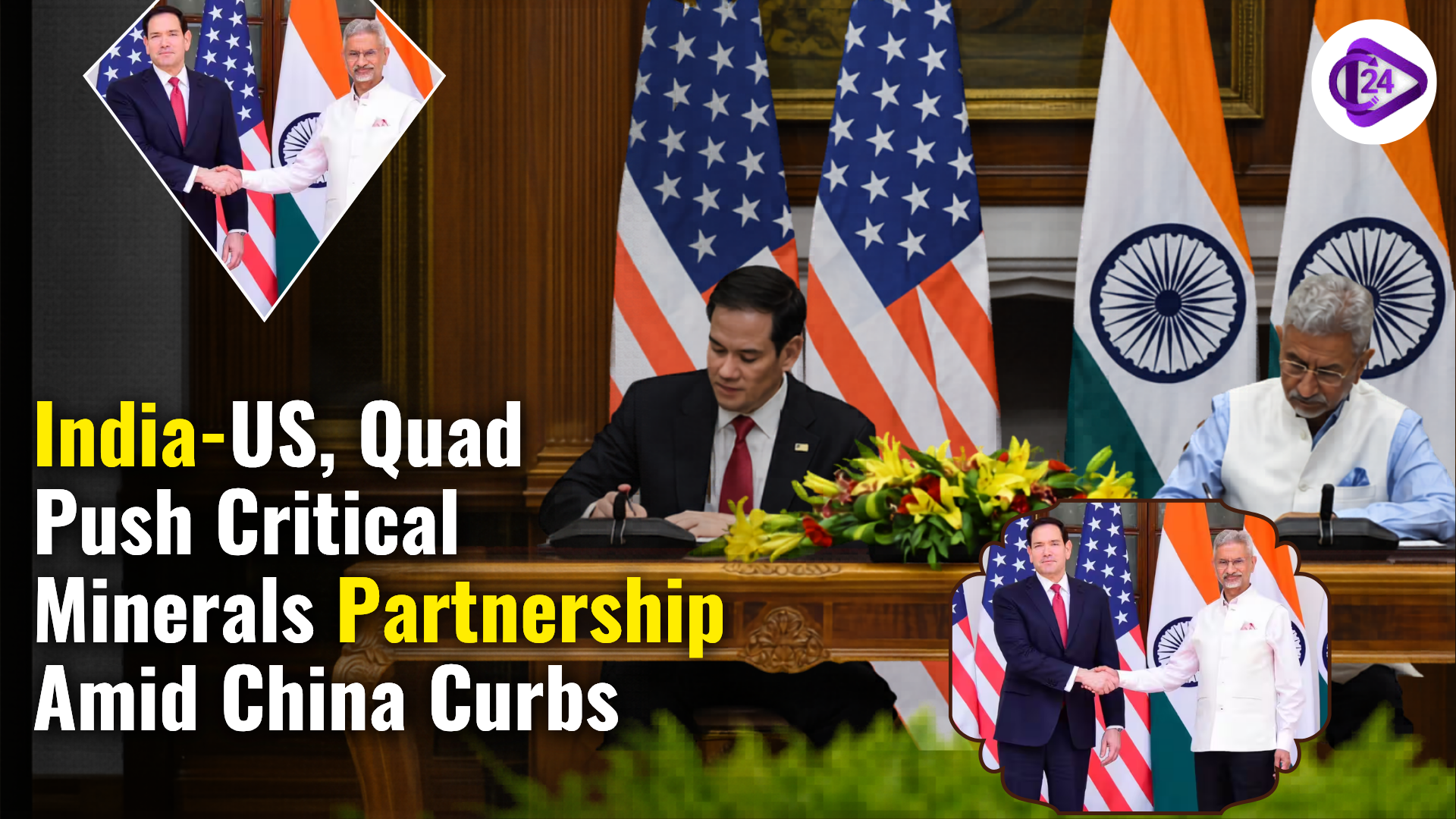
As the demand for EV batteries, semiconductors and renewable energy technologies expands worldwide, so do the critical minerals needed for these applications, such as lithium, cobalt, nickel and rare earth elements. In recent months, India, the United States and Quad countries have stepped up their cooperation on critical mineral supply chains given China’s cut in exports and grounding in the mineral processing industry. The cooperation seeks to mitigate the supply chain risk, enhance economic security and facilitate clean energy transition. The project is of immense strategic significance for the country in the sectors of manufacturing, fuel security and technological development in India.
Importance of India-US and Quad Critical Minerals Partnership
- The critical minerals impact the production of batteries, semiconductors, defense equipment, solar panels, and EVs.
- This Quad grouping consists of the four countries namely, United States, Australia, India and Japan.
- China is the leading supplier of the world for rare earth minerals, controlling the world supply chain for these minerals in the processing market.
- The partnership seeks to curtail over-dependence on China for strategic minerals.
- India and the US push for greater co-operation in the field of minerals, mineral technology, mining, and recycling.
- Australia is a significant producer of lithium and Japan has ahead of the pack mineral processing technologies.
- Critical minerals are important for India’s clean energy and electric mobility targets.
- The National Critical Mineral Mission has been initiated in India to ensure strategic mineral resources.
- The Geological Survey of India (GSI) is investigating reserves of lithium and rare earth elements in the country.
- Lithium reserves have been discovered in the state of Jammu & Kashmir recently.
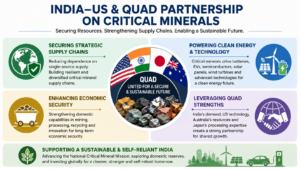
- Quad partnership also enhances robust and resilient global supply chains.
- Rare earth minerals play indispensable roles in defense system, electronics, wind turbines and communication technology.
- Bonuses were issued via China’s export controls, sparking global fears of a shortage.
- India is looking to invest in a foreign country to explore minerals and produce batteries.
- Success in the area of cooperation on critical minerals contributes to economic security and strategic autonomy.
- It is congruent with international climate objectives and the planning of investments in renewables.
- The global situation of critical minerals becomes a new part of geopolitics and international trade relations.The world situation on critical minerals turns into another scope for geopolitics and international trade relations.
PYQs on Critical Minerals and Quad
| Exam Name | Year | Question | Options | Answer |
| UPSC Prelims | 2024 | Which of the following countries are members of the Quad grouping? | A. India, China, Japan, Australia B. India, USA, Japan, Australia C. USA, UK, India, France D. India, Russia, Japan, Australia | B. India, USA, Japan, Australia |
| SSC CGL | 2025 | Lithium is mainly used in the manufacturing of: | A. Cement B. Batteries C. Fertilizers D. Textiles | B. Batteries |
| Railway NTPC | 2024 | Rare earth minerals are important for which sector? | A. Agriculture B. Electronics and Defense C. Fisheries D. Tourism | B. Electronics and Defense |
| UPSC CDS | 2023 | Which country dominates global rare earth processing? | A. Australia B. Russia C. China D. Canada | C. China |
| SSC CHSL | 2025 | Recently discovered lithium reserves in India are located in: | A. Rajasthan B. Gujarat C. Jammu and Kashmir D. Odisha | C. Jammu and Kashmir |
| State PCS | 2021 | Which Quad member country is one of the largest lithium producers in the world? | A. India B. Japan C. Australia D. USA | C. Australia |
Conclusion on India-US and Quad Move Faster on Critical Minerals Strategy
Critical minerals partnership between India-USA and Quad underscores strategic significance of mineral security in the modern global economic system. The ability to ensure just and secure access to mineral supply chains is now central to transition and the rollout of advanced technologies. The partnership between the Quad countries will contribute to mineral diversification and less reliance on China, and enhance the economic resilience. This will help India in ensuring its energy security, promoting industrial development, accelerating technological progress and also improve its strategic role in the international arena in India.