
Government Proposes Approval for E100 Fuel in India to Promote Clean Energy
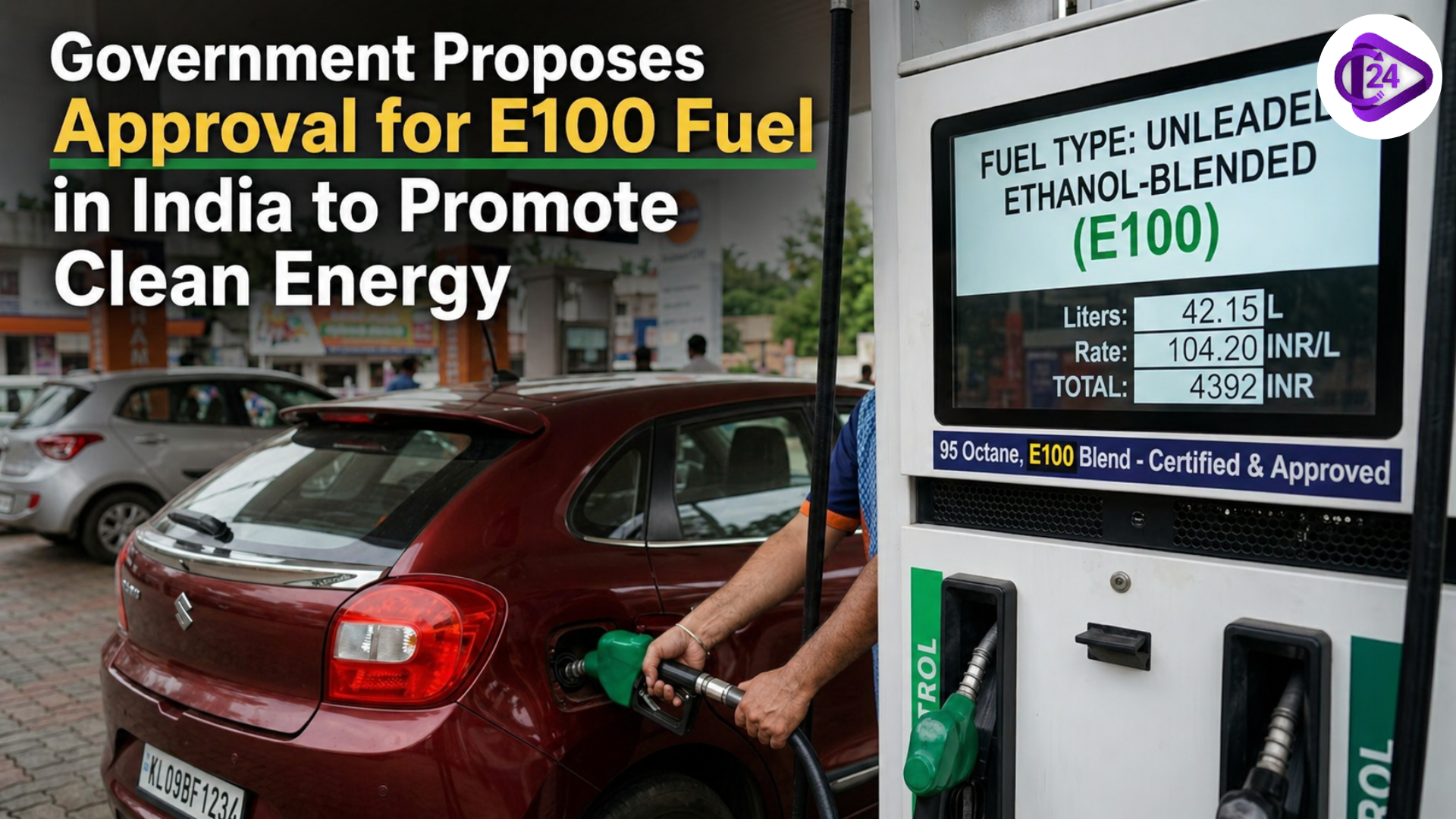
The Indian government has recommended the approval of E100 fuel, a 100% ethanol-blended fuel for petrol, to promote clean energy and fuel diversity. As per the draft notifications released by the Ministry of Road Transport and Highways, the decision will help curb the country’s reliance on imported oil and encourage clean transport. The move is in line with India’s Ethanol Blending Programme, which is already making headway with E20 fuel. The introduction of E100 fuel is anticipated to reduce greenhouse gas emissions, boost the agricultural sector by generating demand for biofuel, and enhance India’s energy security by promoting the use of renewable fuels in the transportation sector.
Government Proposal for E100 Fuel in India: Key Points & Objectives
- E100 fuel (100% ethanol fuel) has been proposed by the Government of India as part of its move to promote green mobility and energy security.
- It is under the Ethanol Blending Programme (EBP) that seeks to lower fossil fuel imports.
- The government’s draft rules for ethanol also cover higher blends such as E85 and E100 fuels.
- E100 fuel will reduce crude oil imports and enhance energy security.
- The move helps India achieve carbon emission reduction and green transportation.
- The move comes after India’s successful implementation of E20 fuel.
- Sugarcane, maize and crop residues can be used to create E100 fuel.
- It will raise rural incomes and provide opportunities for farmers through the ethanol supply.
- The policy promotes the development of flex-fuel vehicles to use high ethanol blends.
- Car manufacturers may require engine modifications to operate E100 fuel.
- India is highly dependent on oil imports, and E100 seeks to minimise imports.
- This move is in line with India’s energy self-sufficiency and net-zero emission targets by 2070.
- According to experts, compatibility with vehicles and infrastructure is the critical factor for E100.
- The government is also encouraging biofuel manufacturing and the ethanol supply chain.
- E100 fuel is thus a significant step towards sustainable and clean transportation in India.
Impact of E100 Fuel on India’s Economy, Environment and Transport Sector
The E100 fuel (100% ethanol) proposal is likely to have a dramatic impact on India’s energy sector by minimising crude oil imports and boosting security. Official documents for government policy discussion on the Ethanol Blending Programme highlight that it can promote local biofuel production and reduce fossil fuel imports. Financially, it can reduce import costs and boost farmer income with increased sugarcane demand and feedstock. In terms of the environment, ethanol fuel contributes to lower greenhouse gas emissions than petrol. There are also implications for the transport sector in terms of promoting flex-fuel vehicles and alternative transport for sustainable development.
Asha Bhosle: The sound of Bollywood Dies Aged 92

Conclusion – E100 Fuel in India to Promote Clean Energy
India’s proposed E100 fuel is a significant step towards green and sustainable energy. The move towards 100% ethanol fuel will help India move away from its reliance on imported oil and lower greenhouse emissions. It will also boost farmers with the growing demand for biofuel crops and help rural livelihoods. While there are issues with vehicle compatibility and infrastructure build-up, E100 fuel can revolutionise the transport sector and bring India closer towards its renewable energy and net-zero targets.