

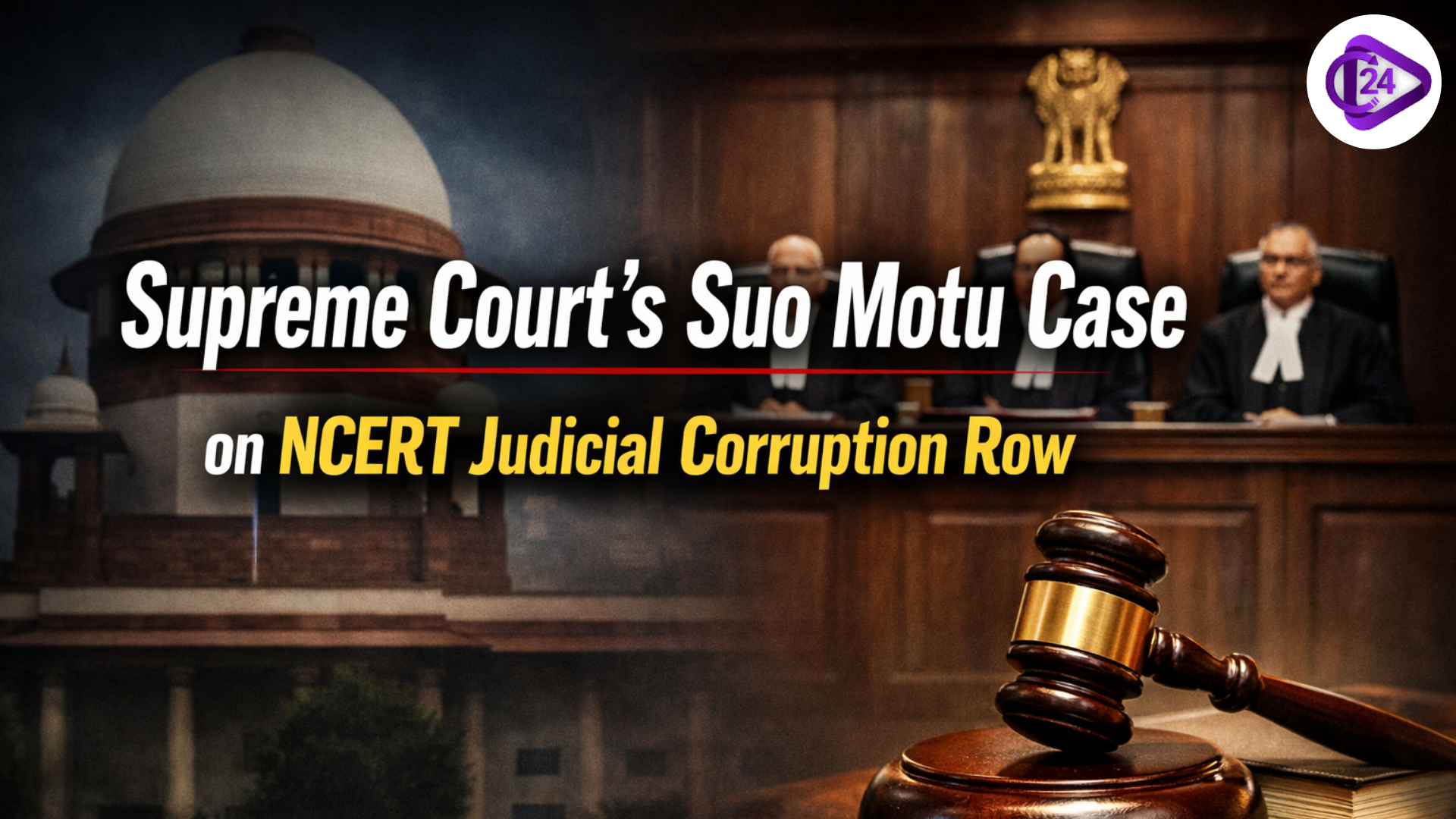
The Supreme Court of India has initiated a suo motu proceeding concerning references to judicial corruption in a Class 8 social science textbook published by the National Council of Educational Research and Training (NCERT). The matter drew attention after concerns were raised that certain portions of the chapter could affect public confidence in the judiciary. Taking cognizance on its own, the apex court decided to examine the issue. In response to the development, NCERT has paused the distribution of the textbook and indicated that the relevant content will be reviewed in light of the court’s observations.
What Does the NCERT Textbook Say About Judicial Corruption?
- The Class 8 Civics chapter titled “The Role of the Judiciary” discussed both the importance and challenges of India’s judicial system.
- It explained that while the judiciary safeguards fundamental rights and interprets the Constitution, it also faces structural pressures.
- The textbook referred to corruption as one of the issues that has been debated in public discourse regarding the justice system.
- It noted concerns about judicial delays and the heavy backlog of pending cases at various court levels.
- Shortage of judges and rising litigation were cited as key reasons for case pendency.
- The chapter aimed to show that no public institution is free from challenges.
- It mentioned that mechanisms exist to ensure judicial accountability and ethical standards.
- The discussion was framed within the broader theme of strengthening transparency and reform.
- The content is intended to encourage critical understanding among students about democratic institutions.
- Following objections, the material came under judicial review and was reconsidered by the authorities.
Previous Year Questions on Suo Motu
| Exam | Year | Question (with Options) | Correct Answer |
| UPSC Prelims | 2019 | Which of the following come under the jurisdiction of the Supreme Court of India? 1. Disputes between Government of India and one or more States. 2. Disputes between two or more States. (A) 1 only (B) 2 only (C) Both 1 and 2 (D) Neither 1 nor 2 | (C) Both 1 and 2 |
| UPSC Prelims | 2012 | The power of the Supreme Court of India to decide disputes between the Centre and States falls under its: (A) Advisory jurisdiction (B) Appellate jurisdiction (C) Original jurisdiction (D) Writ jurisdiction | (C) Original jurisdiction |
| UPSC Prelims | 2013 | Under which Article of the Constitution can the Supreme Court issue writs for enforcement of Fundamental Rights? (A) Article 32 (B) Article 136 (C) Article 226 (D) Article 368 | (A) Article 32 |
| UPSC Prelims | 2015 | Judicial review in India is based on which of the following? (A) Rule of Law (B) Separation of Powers (C) Supremacy of Constitution (D) All of the above | (D) All of the above |
| UPPSC | 2020 | Suo Motu action by the Supreme Court means: (A) Action on appeal (B) Action taken on its own motion (C) Action on request of Parliament (D) Action after presidential reference | (B) Action taken on its own motion |
| BPSC | 2019 | Public Interest Litigation (PIL) can be filed in the Supreme Court under: (A) Article 32 (B) Article 226 (C) Article 136 (D) Article 143 | (A) Article 32 |
Punjab Launches ‘Meri Rasoi’ Scheme
Conclusion – SC Suo Motu Case on NCERT Judicial Corruption Row
The suo motu action by the Supreme Court highlights the sensitivity surrounding how judicial institutions are portrayed in educational content. By stepping in, the Court signalled the importance of maintaining public confidence in the judiciary while allowing space for academic discussion. The outcome of this case may shape how constitutional institutions are addressed in school textbooks in the future.