

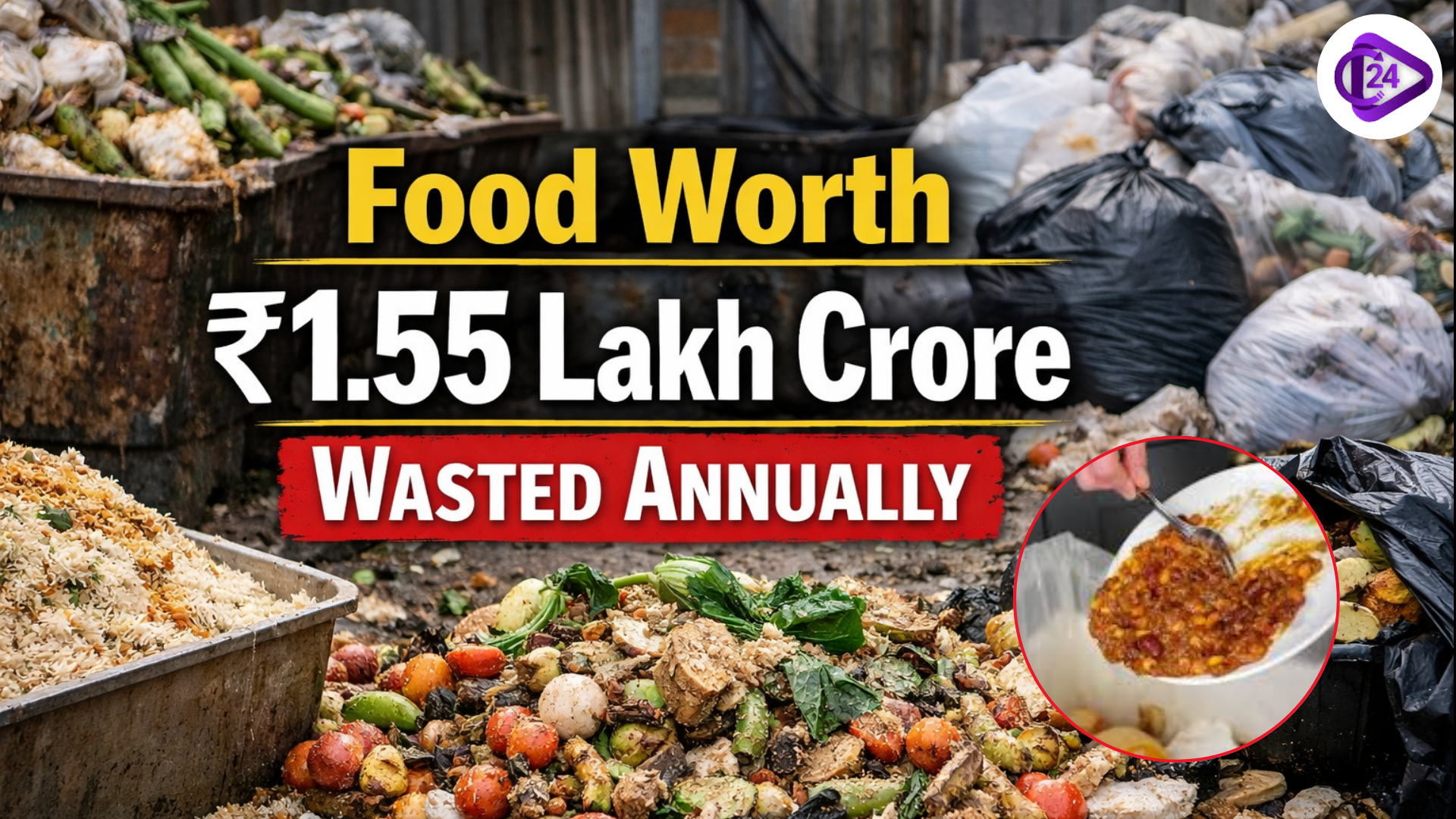
The United Nations Environment Programme, India, has a grave situation of food wastage, with an approximate of 1.55 lakh crore food going to waste each year. The report reveals that India loses about 78-80 million tonnes of food annually and that it ranks among the highest food wastages in the world. Such a great loss comes in the face of extensive food insecurity and hunger. Food waste not only causes economic losses, but it also goes ahead and causes environmental damage in the form of greenhouse gases. This is one of the problematic areas that need to be addressed in order to increase food security, sustainability, and effective use of resources in India.
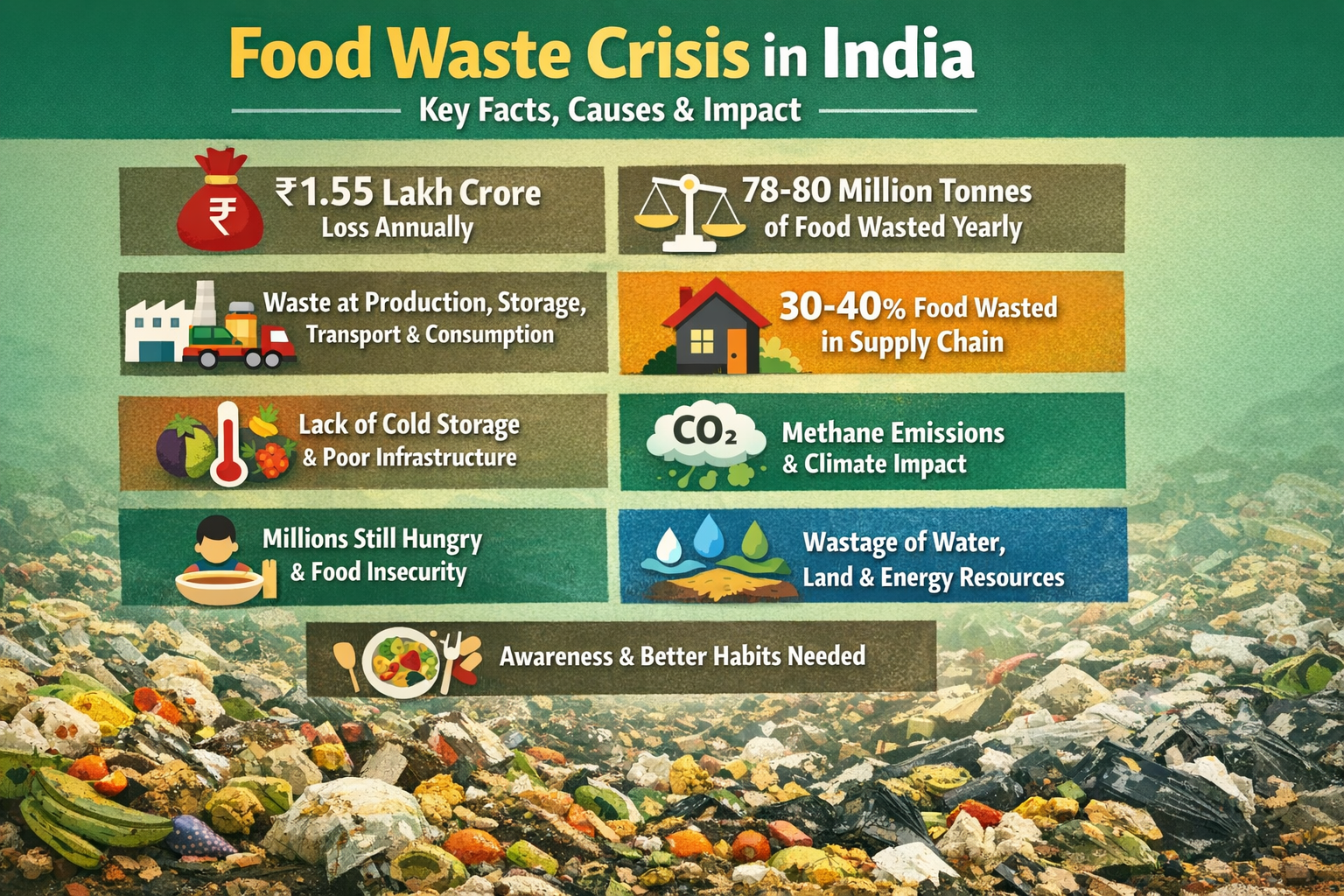
Food Waste Crisis in India: Key Facts, Causes & Impact
-
An annual waste of ₹1.55 lakh crore of food in India is an enormous waste of money and inefficiency of the food system.
-
Each year, food waste amounts to approximately 78-80 million tonnes, which puts India at the top of food-wasting countries of the world.
-
The United Nations Environment Programme points out that people experience food waste at various stages, such as production, storage, transportation, preparation, and consumption.
-
Quite a sizeable amount of waste is at the household level; people are discarding food that is edible regularly.
-
Lack of proper infrastructure in the form of cold storage and transport causes spoilage of fruits, vegetables and perishables.
-
India experiences a loss or wastage of 30 to 40 per cent in its food supply chain.
-
Landfill-related greenhouse gases, particularly methane, exacerbate climate change because food products are a source of such gases.
-
Millions of people are still hungry, and the difference exists between production and distribution, even though there is surplus production.
-
Wastage of food also results in wastage of water, land and energy resources that are utilised in production.
-
Insufficient knowledge and population habits, especially in cities and social gatherings, aggravate food waste.
-
India does not have an overarching national policy that aims at minimising food waste.
-
Less food waste helps to enhance food security, alleviate hunger, and succeed in sustainable development goals (SDGs).
Important PYQs on Food
| Exam & Year | Question | Options | Correct Answer |
|---|---|---|---|
| UPSC Prelims 2016 | Which of the following are indicators used to compute the Global Hunger Index? 1. Undernourishment 2. Child stunting 3. Child mortality | (A) 1 only (B) 2 and 3 only (C) 1, 2 and 3 (D) 1 and 3 only |
(C) 1, 2 and 3 |
| UPSC (PYQ-based) | Global Hunger Index is released by which organizations? | (A) FAO (B) World Bank (C) Concern Worldwide & Welthungerhilfe (D) UNDP |
(C) Concern Worldwide & Welthungerhilfe |
| SSC CGL 2021 | Headquarters of FAO (Food and Agriculture Organization) is located in: | (A) Geneva (B) Rome (C) Paris (D) New York |
(B) Rome |
| UPSC (PYQ-based) | Which SDG aims to achieve “Zero Hunger”? | (A) SDG 1 (B) SDG 2 (C) SDG 3 (D) SDG 4 |
(B) SDG 2 |
| RRB NTPC 2020 | Which report measures global hunger levels? | (A) Human Development Report (B) Global Hunger Index (C) Ease of Doing Business (D) SDG Report |
(B) Global Hunger Index |
| SSC CHSL 2022 | Which organization publishes the State of Food Security and Nutrition in the World (SOFI) report? | (A) FAO (B) IMF (C) WTO (D) ILO |
(A) FAO |
| UPSC (PYQ-based) | Food security means: | (A) Availability of food only (B) Access to sufficient, safe and nutritious food (C) Only production of food (D) Only distribution |
(B) Access to sufficient, safe and nutritious food |
| SSC MTS 2023 | Which index ranks countries based on hunger and malnutrition? | (A) HDI (B) GHI (C) MPI (D) CPI |
(B) GHI |
Conclusion – Food Worth ₹1.55 Lakh Crore Wastage per Year
The food wastage costs 1.55 lakh crore per year, shining a bright light on the major challenge of the Indian economy, environment, and food security. Although there has been enough food production, there is a huge loss due to inefficient storage systems, distribution, and consumption. This not only results in wastage of resources such as water and energy but also aggravates hunger and inequality. Food waste has to be tackled at all levels with improved infrastructure, values and policies so that all can enjoy sustainable growth and development, minimising environmental effects and attaining food security.