
The National Medical Commission (NMC) has already given a vital statement that the provision of stem cell therapy to treat autism spectrum disorder is unlawful in India. This move is made at a time when there is an increasing fallout on the sale of unproven treatments to gullible families. NMC has reiterated that stem cell therapy against autism has not been well researched and approved. The relocation is meant to safeguard patients against false advertising, unethical medical care, and evidence-based treatments in the healthcare system.
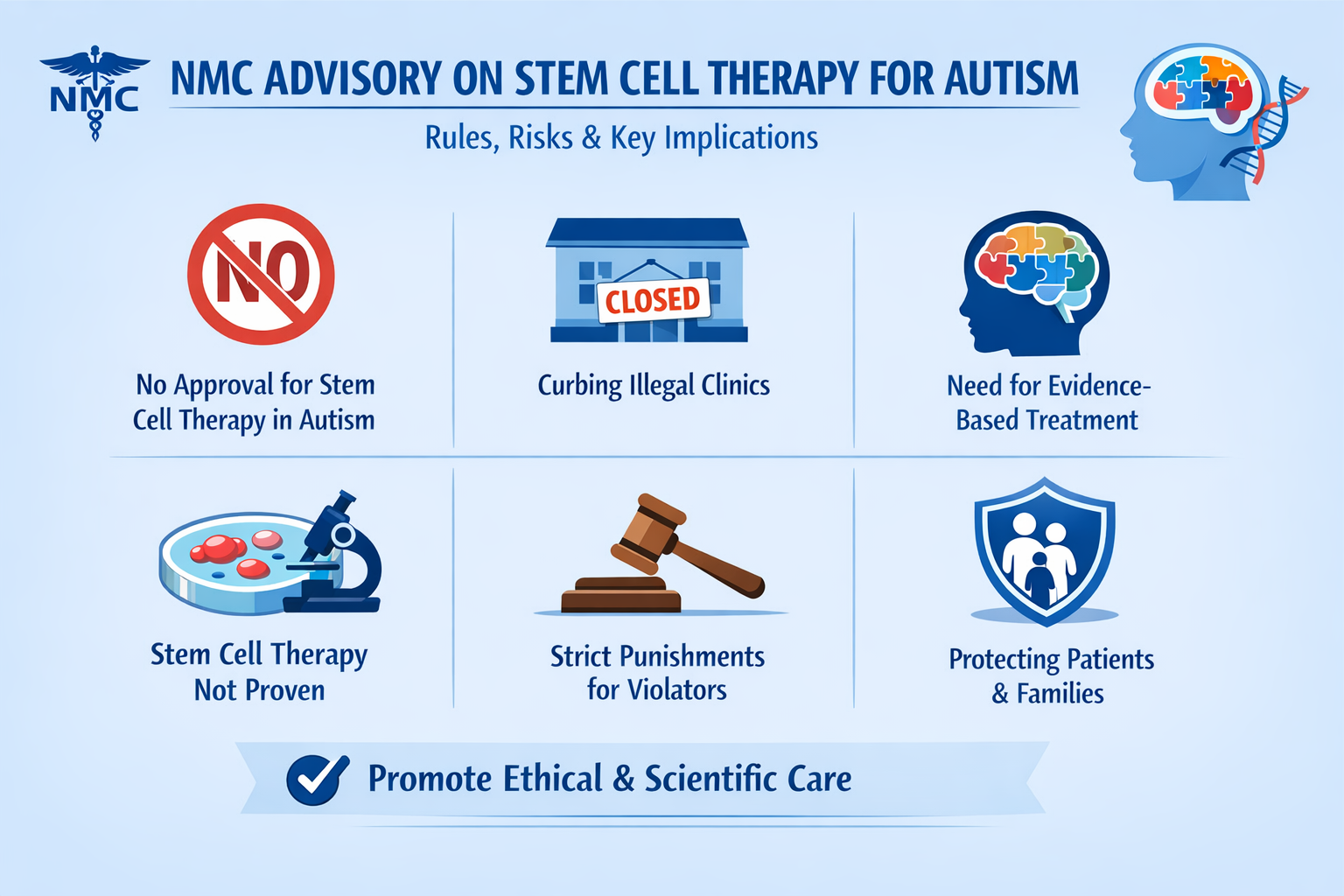
NMC Advisory on Stem Cell Therapy for Autism: Rules, Risks & Key Implications
- The NMC has made it clear that, according to the current medical guidelines, there is no approval of stem cell therapy for autism.
- The recommendation is supposed to help in reducing the emergence of illegal clinics that provide untested therapies.
- Autism Spectrum Disorder is a neurodevelopmental disorder that needs evidence-based interventions.
- Stem cell therapy is still at a research level and has not been proven to treat autism.
- Those clinics that advertise such treatment can have an alternative punishment, which is severe.
- The ruling gives protection to the patients in terms of being exploited and deceived.
- The families are encouraged to use scientifically proven treatment and medicine.
- The ethical standards are reinforced by the advisory in the healthcare sector.
- It discourages dishonest advertisements concerning experimental treatment.
- The NMC is focused on compliance with accepted medical guidelines and procedures.
- The level of awareness concerning accepted autism treatment will go up.
- The medical professionals should be able to maintain openness in the administration of treatments.
- The relocation is in line with the medical practices in the world.
- Stem cell therapy research is still on, but only under limited clinical trials.
- A patient is expected to seek the services of qualified medical practitioners before deciding to undergo treatments.
- The advisory emphasises patient safety and informed consent.
- It also preaches tighter control of health institutions owned by individuals.
- The ruling is a boost to faith in the healthcare regulatory system in India.
- When medical laws are contravened, authorities can act.
- Comprehensively, the advisory makes the care provided to patients safe, ethical, and evidence-based.
What is Autism Spectrum Disorder (ASD)?
Autism Spectrum Disorder (ASD) is a developmental disorder that influences the way an individual communicates and socialises, as well as the manner in which he/she behaves. It is referred to as a spectrum due to the fact that individual patients could experience the symptoms and severity in a wide range. Autism normally presents itself at an early age and extends throughout life.
Individuals with autism can lack social cues, eye engagement, and emotional expression, among others, and develop repetitive behaviours or fascination towards certain subjects. Nevertheless, a lot of people with autism have some similarities, including attention to detail, memory ability, or creativity. Quality of life can be greatly enhanced with predetermined and proper support.
Previous Year Questions on Autism
| Exam | Year | Question | Options | Answer |
|---|---|---|---|---|
| UPSC Prelims | 2020 | Autism Spectrum Disorder primarily affects which of the following? | (A) Digestive system (B) Nervous system (C) Respiratory system (D) Circulatory system |
B) Nervous system |
| 2021 | Autism is best described as which type of disorder? | (A) Infectious disease (B) Genetic disorder (C) Neurodevelopmental disorder (D) Nutritional deficiency |
C) Neurodevelopmental disorder | |
| SSC CGL | 2019 | Autism mainly affects which ability? | (A) Digestion (B) Communication and social interaction (C) Blood circulation (D) Vision |
B) Communication and social interaction |
| 2021 | Which of the following is a common symptom of autism? | (A) Fever (B) Repetitive behavior (C) Hair loss (D) High blood pressure |
B) Repetitive behavior | |
| SSC CHSL | 2020 | At what stage does autism usually appear? | (A) Old age (B) Adolescence (C) Early childhood (D) Adulthood |
C) Early childhood |
| 2022 | Autism Spectrum Disorder is commonly diagnosed in which age group? | (A) Infants and young children (B) Elderly (C) Adults only (D) Teenagers only |
A) Infants and young children | |
| RPSC RAS Prelims | 2018 | Autism is related to which system of the body? | (A) Digestive system (B) Nervous system (C) Muscular system (D) Skeletal system |
B) Nervous system |
| 2020 | Which of the following is NOT a feature of autism? | (A) Social communication difficulty (B) Repetitive behavior (C) Strong memory (D) High fever |
D) High fever | |
| UPSC Prelims | 2022 | Which of the following statements about autism is correct? | (A) It is contagious (B) It affects brain development (C) It is caused by bacteria (D) It affects only adults |
B) It affects brain development |
| SSC CGL | 2023 | Which of the following therapies is commonly used for autism management? | (A) Antibiotics (B) Behavioral therapy (C) Surgery (D) Radiation |
B) Behavioral therapy |
Conclusion – Stem Cell Therapy for Autism Illegal
The aspect of evidence-based medical practice is boosted by the NMC advancement that criminalises stem cell therapy for autism. Unverified prescriptions lead to health hazards and economic abuse for families who are desperate to be healed. Prohibition of these therapies by the advisory will secure the patients, uphold ethical medical practices, and offer effective and scientifically acceptable treatments. The awareness, enforcement, and dependability on approved therapies should continue to protect those with autism in the country and ensure that there is trust in the healthcare system in India.